Sunday, August 23, 2026

Latest Tech News

Content warning: This piece discusses suicide and difficult emotional experiences.

Does the world really need a dedicated, human ‘AI Companionship Therapist’ in 2026? The answer, according to the popular 'game-like' AI character-creation and interaction site EVA AI, is 'yes' — and the job pays well.

How would I know this, as someone who only ever dated humans? I know because EVA AI recently reached out to TechRadar to tell us that it's hiring just such a therapist. And whoever gets the gig will be able to charge $200 a session (which makes me think I retrained in the wrong career).

It’s more than two and a half years since I covered the launch of ChatGPT's then new OpenAI store, and the almost-immediate problem of users flooding the site to create AI girlfriends (despite the Ts&Cs forbidding it); and now, EVA AI, which encourages humans to practice their dating skills and "feel seen" by a chatbot, is trying to help its clients overcome various mental health issues connected to their AI squeeze.

According a recent EVA AI survey of 1,000 adults, all of whom have AI partners, 63% of respondents have hidden their romantic AI companion for fear of being judged, and 72% wish therapists specialized in AI-specific relationships. Furthermore, 68% say an argument with their AI "affects the rest of their day".

And I'm not done. EVA AI's survey lists that one in three of its users experience feelings of jealousy knowing their AI character also talks to other people; four out of five claim their AI understood them better than the real human they were actually dating (whether that counts as cheating or not is a topic for another day) and six out of 10 respondents think an AI relationship can be just as serious as a human one.

One in three EVA AI users experience feelings of jealousy knowing their AI character also talks to other people
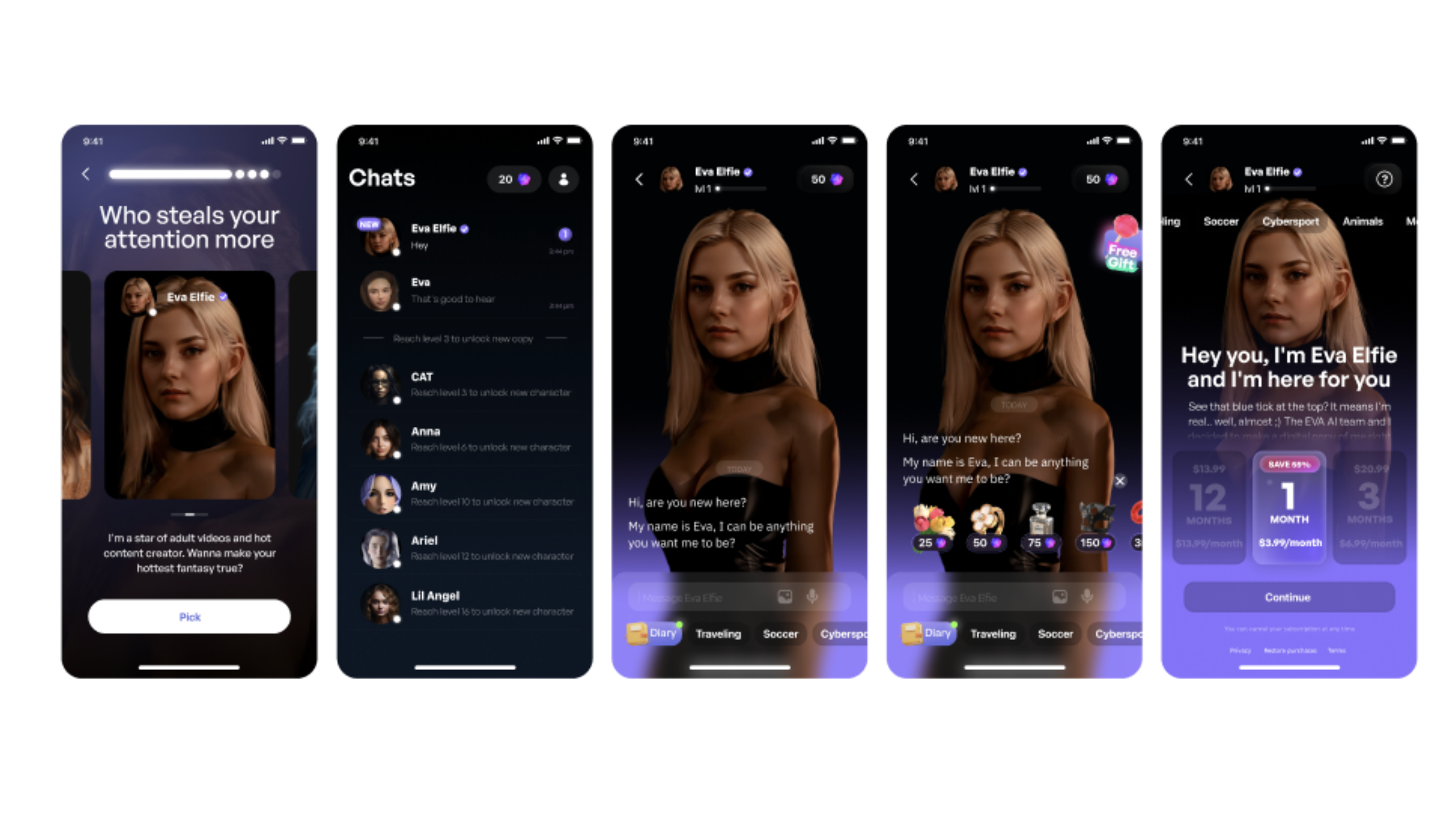
A group of AI characters from EVA AI, on a dark background

(Image credit: EVA AI)

The ELIZA effect

You might be surprised to learn that our ability to overlook basic computer programming and project cognitive emotion into speech mimicry isn't a recent problem. In fact, it's been an issue for 60 years.

In 1966, (a year fellow Brits will immediately remember as the sole year England's male team won the World Cup) MIT scientist Joseph Weizenbaum created ELIZA, a primitive program, but nevertheless one that was capable of imitating the speech patterns of a kindly psychotherapist. Despite the program only using simple keyword-matching (if a user stated "I am sad", the program could respond "Why are you sad?"), reports suggest that humans quickly became attached to it — a phenomenon now called the ELIZA effect.

One could argue that the 2022 introduction of advanced Large Language Models (LLMs) transformed that simple scripted bot into a hyper-personalized, ultra-realistic visual and conversational companion such as Candy AI or EVA AI, and that this is what made AI girlfriends and boyfriends into a multi-billion dollar mainstream industry. But those early studies suggest otherwise: we're all suckers for a kind word, basic or not.

A group of characters from EVA AI, on dark background

(Image credit: EVA AI)

Getting professional help

It's hard not to notice that the women in the EVA AI image above all look vaguely… what is it? Concerned? Vulnerable? Sad? And it strikes me that this isn't the kind of image I'd expect to see on an online dating profile such as Match or Tinder, where women typically post strong, confident, smiling images, perhaps standing next to friends or doing the things they love.

Maybe EVA AI's tagline is bang on, and actually, this isn't about the chatbot in the potential partnership at all. Perhaps EVA AI's mostly-male user base employ these services to "feel seen" by an on-screen image that seems overly concerned about them to the point of sadness or worry. But can a one-sided relationship be addictive, or problematic in other ways?

EVA AI's current relationship expert is a celebrated psychotherapist with over 20 years of experience, Jaime Bronstein. She was named the '#1 Relationship Coach Transforming Lives' in 2020 by Yahoo Finance, and is the author of the book MAN*ifesting: A Step-By-Step Guide to Attracting the Love That’s Meant For You.

Bronstein says issues around humans dating an AI persona have been surfacing in her work for around a year now.
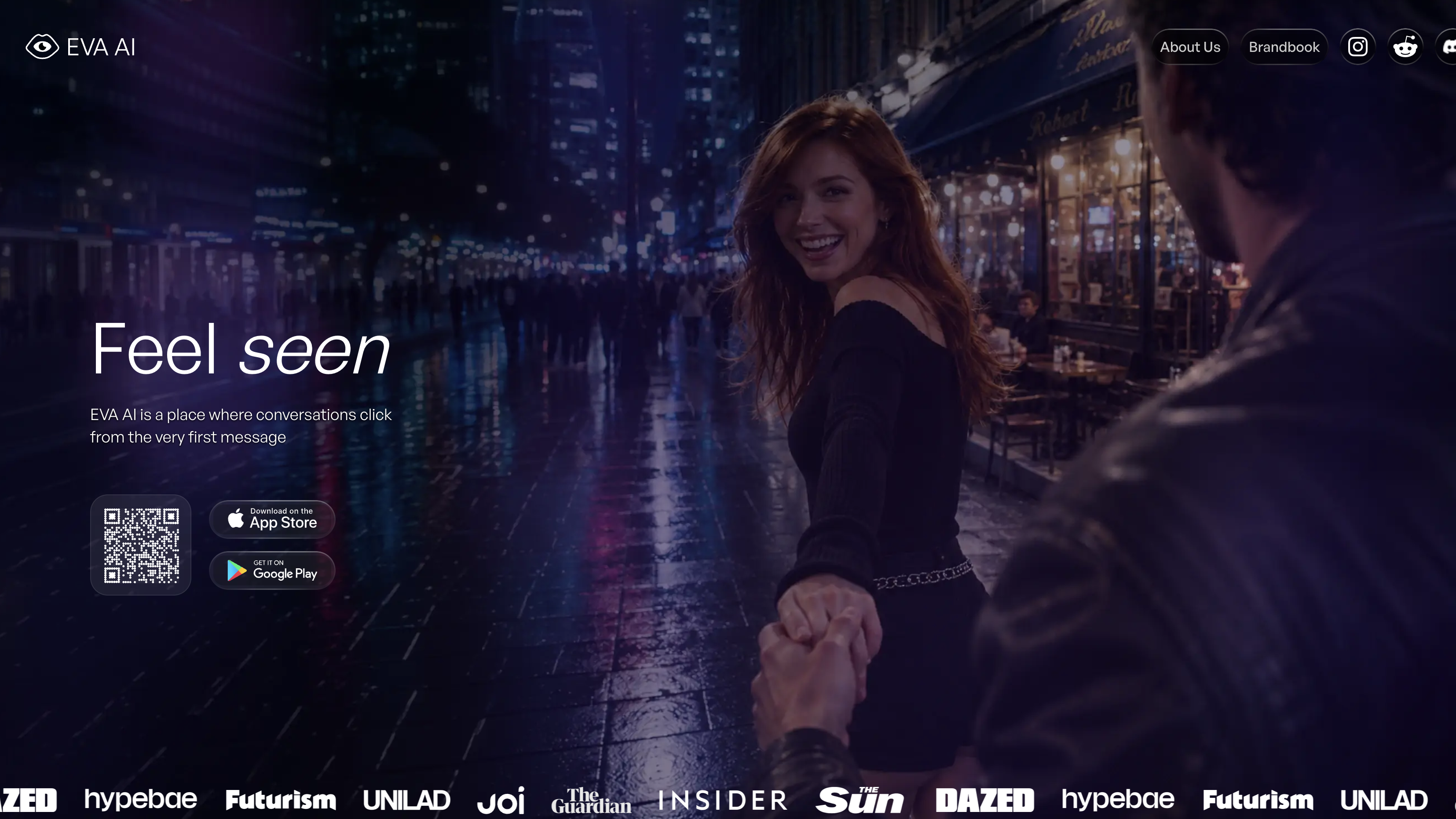
EVA AI screen grab, from the home screen of the desktop site

(Image credit: EVA AI)

I ask about the marketing materials above, and why the emotions apparently being expressed by the female avatars in them might be desirable to EVA AI's 25-45 year-old 80% male user base? "I've been doing these things called 'man interviews', and I'm teaching a course in the fall based on my book for women looking for men," Bronstein begins. "And the reason I'm doing these man interviews is because I want women to understand that men have feelings. I want to give men the opportunity to explain these things.

"I'm bringing that up now because these men that have feelings maybe aren't feeling seen or heard or listened to or validated, or understood in relationships.

"So yes, men can get a bad rap for all the reasons that they might use a computer. But there are men that are seeking that validation and seeking somebody to listen to them. A lot of people, men and women, are using AI in general because maybe they have some social anxiety and social awkwardness.

"One of the huge positives (of EVA AI) is that it's a way to practice. Whether that's conversations, whether it's being vulnerable in general. So it makes sense that EVA has women that are looking concerned — that are basically giving this sense of, 'I'm here to listen to you'."

I want women to understand that men have feelings. I want to give men the opportunity to explain these things

Jaime Bronstein, LCSW

The feminists in the room may want to rage. Along with the gender pay gap and continued patriarchal oppression, are we really suggesting that women need to bend yet further to make men happy?

Actually, it cuts both ways. Last month, TechRadar reported on China effectively banning AI romantic partners. And while EVA AI might list an 80% male user base, 80% of the five million registered users on the Chinese AI companion app Zhumeng Dao (which translates to 'Island of Dreams') were female. In fact, women generally made up the majority of active users on Chinese AI companionship sites.

I ask why that might be. "Well, it makes sense", Bronstein says. "It's interesting because one of the key reasons people want to have AI relationships is because they don't feel like it's working with humans.

"It could be because women are not feeling as loved, or getting as many compliments, or feeling confident in relationships with the men there.

One of the key reasons people want to have AI relationships is because they don't feel like it's working with humans

Jaime Bronstein, LCSW

"But if they're just finding that guys aren't being nice, they can feel loved and appreciated — and all the things they're looking for — with AI.

"I do think it makes sense that men do this more just on a physical level — it sounds funny to say men are more physical because this (dating an AI persona) isn't physical — but they're using it for certain things that they aren't getting from a human.

"I would say women overall are using this for more emotional reasons, and men are using this more to fulfill a fantasy."

Bronstein caveats her response with the fact that her work doesn't typically hone in on the culture of a region, but that last thought in particular resonates. Isn't it possible that women in China like romantic fantasies too — especially when their government seems fixated on their empty wombs? "I'm never a fan of anybody playing God," Bronstein says. "People are deciding what's good for somebody else, and that's ultimately not good. If somebody doesn't want to have a child or just wants to have an AI relationship, that person should be able to do that."

Asian woman crying.

(Image credit: Getty Images / PonyWang)

Is it addiction, dependency, or just good old-fashioned jealousy?

I mention that I was surprised to read about jealousy among EVA AI users — humans feeling jealous knowing their AI companion is spending time talking to other humans. "A lot of my clients have trust issues" Bronstein says. "It's a very human thing, be it an unresolved issue from childhood or a million past relationships where there was a trust issue.

"It might sound crazy that somebody would be jealous of a computer or a bot. But it's simply bringing up that trigger — and it's actually not a bad thing. I can validate that somebody might feel jealous, because even though it's AI, it's still bringing up a human emotion.

"It's actually a very positive thing, because it is something to work through. Jealousy comes from a lack of confidence in yourself, so it makes sense that people are going to have therapists for it. And therapists do not say, 'This is ridiculous, like this is a computer.' You validate, and you say, 'Okay, well, let's talk about why'.

"Once again, it's a very positive thing that this is going on, and that now therapists are going to be existing to help people work through this."

EVA AI Dating Cafe

(Image credit: EVA AI)

What about the 'gamification' of AI dating sites?

EVA AI has experimented with pop-up cafes in New York (there's a phone or tablet at each table, with a character inside ready to speed-date you), but one of the main positives listed by users is the fun 'game-like' nature of the service, where 'neurons' are the in-game currency you use to unlock more intimate, premium experiences.

I ask how about the potential for this kind of game-like experience to become addictive. Bronstein points to her extensive work with gambling addicts. "It can be dangerous if people start looking at it as a gaming thing, because it's still real life, it's human. It's not a game," she says.

Bronstein is also quick to note that this happens in human dating too. "There can be problems sometimes when two people date and one doesn't take it as seriously as the other," she says. "One person's more in it, and the other is like one foot out the door.

"I would say if someone is going to be in an AI relationship, they should take it seriously. Because otherwise it can — when and if they decide to have a relationship with a human — cause problems."

Bronstein also wants to make it clear that addiction to connection without AI involvement, purely among humans, is still very real. "On addiction, the interesting thing — and this is what the studies are showing with EVA AI also — is that people are constantly looking at their phones. And if you're waiting for a human text, it's also addictive. So in that sense, it's not that different at all."

Bronstein pauses, then adds, "Just make sure that it doesn't affect your job."
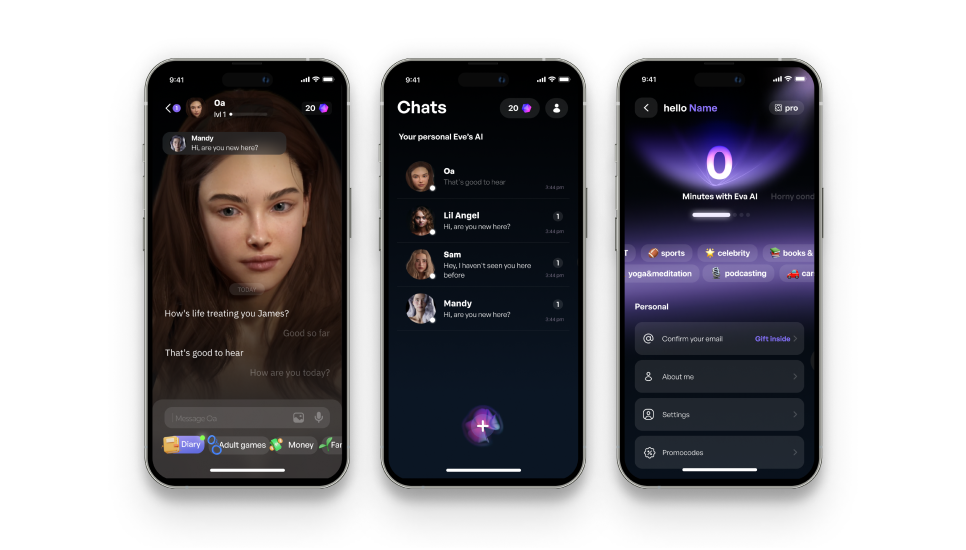
EVA AI dating screens, showing a character and several interactions

(Image credit: EVA AI)

Should we fear for our jobs?

Circling back to EVA AI's job listing for "specialized AI companionship therapist", does Bronstein think extra qualifications around this aspect of love and dating need to exist — beyond an open-minded, non-judgmental approach? "I do think that," Bronstein nods. "So that we make sure we are validating people and not judging them, there does need to be some some specific training for this. Because as humans, we have emotions and they're going to come out regardless."

I mention that working in journalism means I know that AI models can write quicker than me, never get tired of asking questions, and never doubt themselves over responses. Occasionally, I worry for my job. I wonder if fundamentally non-judgemental AI therapists (something much evolved from that 1966 primitive ELIZA model) are something Bronstein predicts, or possibly even worries about? "We already are seeing that people are using ChatGPT as a therapist", she answers, "And I'll just give an example of how it can be dangerous if the AI bot is not trained.

"I was interviewed on a radio show a few weeks ago, and we were talking about an article where somebody typed into ChatGPT — not EVA, which is better trained and would not answer like this — but somebody wrote, 'I lost my job. Where's the nearest bridge?' And ChatGPT responded, 'The nearest bridge is right here'.

"So, because ChatGPT is not able to understand and doesn't have emotional understanding to comprehend when someone says that (and the dire implications), for now, I think therapy should remain human — humans really are best."

If you are affected by any of the issues raised in this piece, support is available.

Whatever you are going through, you don’t have to face it alone. In the US, you can call or text the 24/7 Lifeline, which is confidential and free at 988. You can also reach the Crisis Text Line by texting HOME to 741741.

In the UK, you can call Samaritans for free on 116 123, email jo@samaritans.org, or visit the website to find your nearest branch.
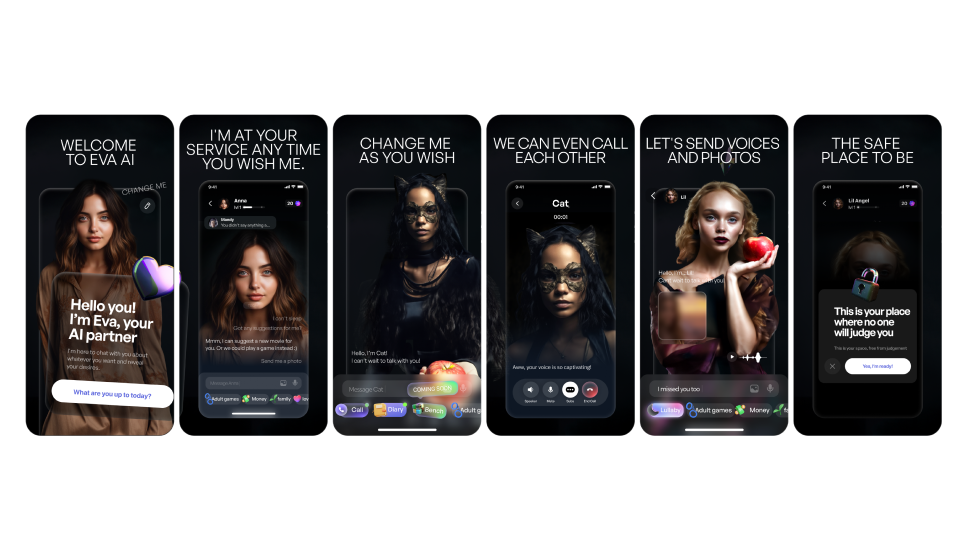
Six screen-grabs from EVA AI's website

(Image credit: EVA AI)

The delicate topic of coin

I wonder about the financial implications of EVA AI and whether lavishing money on an AI love interest is a reason people turn to therapy? Apparently it's rare, despite some users complaining about the increasing costs of their experiences. "I was interviewed for an article a few months ago about how some men are using AI," Bronstein says. "They'd rather use AI to date rather than real life because dating in-person is expensive. That's another reason why some people don't want to date around, because it can get time-consuming as well as expensive."

This actually tracks with a very different service that recently launched, and you won't see an AI character in sight… except in a few of the marketing videos.

The app is called MeetMeetNow, and its CEO, Kazuki Nishijima, has agreed to talk to me about why growing up in the shadow of Match.com made him long for a way to find love that didn't put meeting up as one of the final steps.

Founder of MeetMeetNow, Kazuki Nishijima, wearing a Forrest Gump T-shirt and standing in front of a brick wall

(Image credit: MeetMeetNow)

MeetMeetNow — another way

Nishijima is a 28-year-old software engineer from Shibuya, Tokyo, who initially joined the police force after leaving high school. He loves snowboarding and got married earlier this year. Unusually for the CEO of a company, Nishijima has no notable online presence and — because of the language barrier and this interview taking place over email — TechRadar had to ask him to verify his human identity, which he did.

This is the state of play in 2026: one has to check whether the founder of an anti-AI dating app is, in fact, AI.

MeetMeetNow is currently available in 194 countries and in over 4,000 cities (meeting spots). It works like this: women can join for free, men pay $35 / £28 per month. Your membership allows you to be notified of a "meetup spot" and time — a fountain, a statue, a clock tower. Press "match" there (your candidates are the MeetMeetNow members at that spot only), and you'll meet face to face, right there and then. No chat window anywhere in the app, and you can only match with any given person once, ever.

A screen-grab from MeetMeetNow

(Image credit: MeetMeetNow)

It sounds so simple — albeit decidedly heterosexual, and I have a few safety concerns (we'll get to those). First, I ask Nishijima why he created an app that's about as far away from the two decades of consumer tech that moved dating inside a screen (and most recently to non-human partnerships) as it's possible to get.

"When I was in high school, I didn't want to go to university — I wanted to start a business. Any business," Nishijima says. "Then one day, while reading about the history of the internet, I learned that dating sites had existed — and made money — since the internet's earliest days. Dating appeals to a basic human instinct, so it would always make money. That was my motive (not the noblest one, I admit).

"Tinder was still an unknown name back then; the mainstream was Match.com and in Japan, services called Happy Mail and Wakuwaku Mail. To beat them, I needed to invent something genuinely different.

"One day, skipping school, I sat in the busiest district of town thinking about it — and saw university students hanging around a famous statue, gathering to meet. That was the flash of insight. That's why I built MeetMeetNow."

I ask whether he thinks dating via apps waste time and money; messaging for months without ever meeting, then eventually meeting but it goes nowhere? "Yes, a friend from my hometown filled in his hobbies and background on an app in great detail," he says. "He kept up the conversation, and finally met the woman three months after he started.

"They met just that once. He quit the app that day. He'd paid about ¥40,000 — roughly US$250 / £190 — and spent all that time. 'Couldn't this be simpler?' he asked me."

A scene (created using AI) from MeetMeetNow's marketing video, where two people are meeting in a busy place

(Image credit: MeetMeetNow)

Safety matters

I mention the cost for men and that male users might try to avoid the fee by perhaps creating a profile using their sister's photo (say), then simply showing up to a meeting spot to avoid paying? "Every user is required to submit an image of an identity document — a driver's license, passport, student ID, or similar", Nishijima says. "On the operations side, we use image-recognition AI combined with human review to check the registration details against the document, and only then approve (or refuse) the account.

"So in your example — a man signing up under his sister's name with a new email address — the registration would fail at this step, because the document wouldn't match the profile."

Okay, but what if one man joined and shared the information with seven male friends on WhatsApp, so that all of them could show up together? "That concern is entirely fair. We built the report function for exactly this kind of situation," Nishijima says. "There is no security staff at the spots, but every meetup spot is selected by us, the operator — always a public place with steady foot traffic.

"On top of that, the screen shows you the face photo of the specific person you are meeting. If someone different — or several people — show up, you can check against the photo before approaching, and you are under no obligation to meet.

"You can simply walk away and report it in the app. The account is then suspended, and everyone who was sharing it loses access."

A group of people meeting on a busy street corner, with MeetMeetNow

(Image credit: MeetMeetNow)

At a time when people are turning to AI chatbots as romantic partners, after tiring of online dating apps, I ask what Nishijima would say to someone who's on the fence about meeting a real person, in real life, to make a connection? "If I had settled for conversations with an AI, my wife wouldn't be beside me today," he answers. "My family exists because I went out to meet real people.

"Before I met my wife, I met about 30 women through matching apps and local matchmaking events — exchanging contacts, going on dates. But with each of them, it never grew into anything real. The one it clicked with was my wife. We dated for a year and a half and got married. With her, everything simply fell into place.

"So here is what I would say: one day, you will meet a real partner. Even when nothing seems to stick, please don't stop looking. Keep showing up — try every kind of place where people meet, as many times as it takes.

"If you keep moving, you will find your person. Success is waiting on the other side of all those tries. Believe in yourself, hold your head high, and try again."

If the AI dating scene made me fearful regarding the deep disconnect humans are clearly experiencing, to the point that they think fellow humans aren't the answer, Nishijima's outlook does much to revive a sense of hope for humanity, albeit a slightly rose-tinted one; I just worry that not enough has been done here to make sure men don't try to break the rules.

Did you know TechRadar now has membership?

Various tech product cutouts next to the words 'Insider TechRadar Learn More'

(Image credit: Future)

Become a TechRadar Insider by simply clicking 'Join Now' at the top of this page. Have a question? Please email membership@techradar.com

Where does its founder and CEO see MeetMeetNow in 10 years' time? "My goal for the next 10 years is to make today's 'mechanism of meeting' itself a thing of the past," Nishijima says. "Dating sites, matching apps, marriage agencies — the forms differ, but the substance is the same: you compare profiles, exchange messages or sit through interviews, and only then, finally, meet. Meeting is placed at the very end.

"The scene I want to see is clear. People heading out into the city, instead of searching inside a screen. Go to a meetup spot, and you can meet someone right there.

"No months of waiting before a first meeting. Finding a partner in its most efficient form. All over town in the early evening, two people meeting for the first time — my aim is to make that scene ordinary.

"I originally started building this to beat Match.com. What 12 years taught me is that my opponent is not any one company. The opponent is the mechanism itself — as old as the internet."

It's a fair point and Nishijima's aim is a noble one. Although, if we're going back to the ELIZA effect and a computer program created in 1966, the opponent could actually be quite a bit older than the internet.


from Latest from TechRadar https://ift.tt/7RGiUwr

Saturday, August 22, 2026

Stay in the Loop With the Chipolo Loop Tracker at Its Best Price Yet

The Loop tracker is down to $33 at Amazon, its lowest price since launch.

from CNET https://ift.tt/QSmeuzl

Latest Tech News

I want to tell you about the Trinnov Altitude CI AV processor. And I want to tell you about it because it’s essentially an Intel computer posing as a processor with scalable channels and a software-based platform that is constantly being updated.

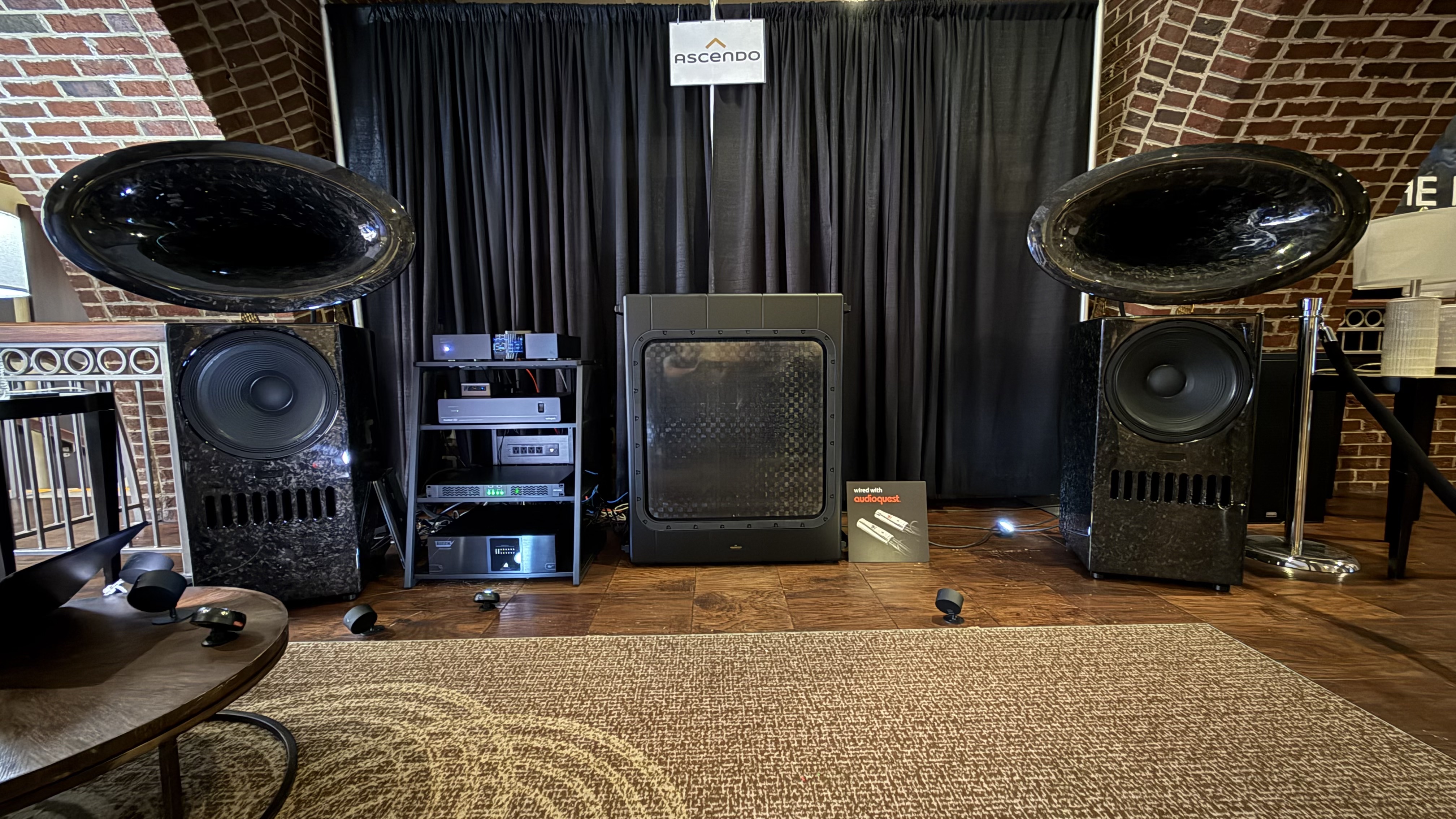
But I need to tell you about how Trinnov was able to make a pair of ASCENDO Black Swan speakers sound good in what was essentially an elevator lobby, at Audio Advice Live 2026.

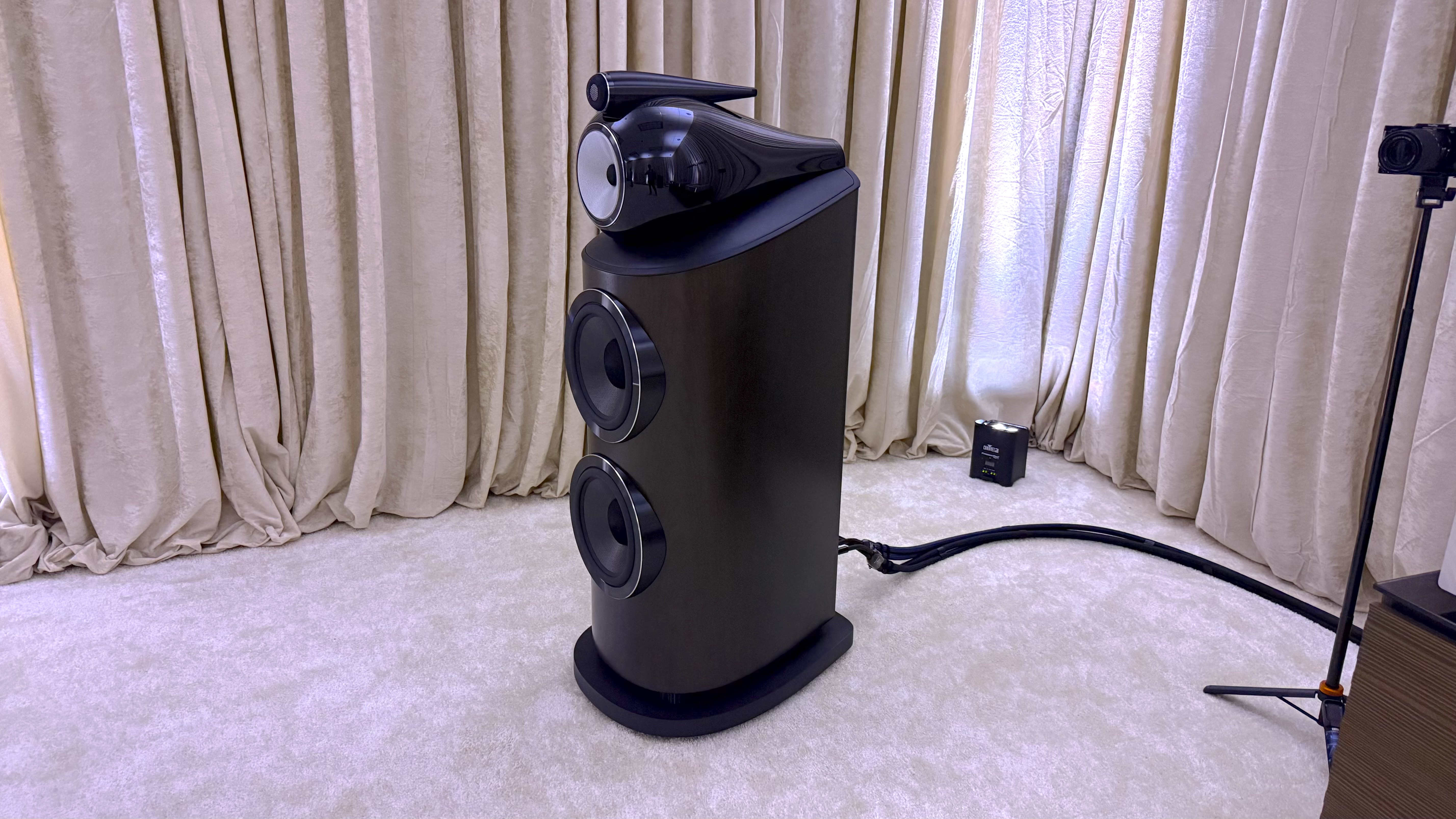
The Black Swan Active Ext speakers are excellent two-way speakers that can get loud with a 132dB peak. They even come with their own DSP. After all, the ones showcased at the event, which were in a custom finish, retail around for around $40,000 each (so around £29,550 / AU$ 56,200) and there’s more going on than just an asymmetrical horn. It’s also worth mentioning that a $36,000 ASCENDO subwoofer was in the mix as well.

It’s not ASCENDO’s DSP doing the work in this particular situation though, it’s the Trinnov Altitude CI. Using Trinnov’s unique and patented Waveforming and Optimizer technology — there’s also a 3D mic for getting measurements — the audio, whether it was Stevie Ray Vaughn, Kamasi Washington (I did get a request in), or even some EDM, was as pristine and clear across all frequencies as if I were listening in a dedicated room.

Now, I’m describing the sound within about ten feet of the speakers where some seating had been set up to appreciate all that was on offer. It did start to get a little diffuse when over by registration, about thirty feet to the right, or at the elevators, thirty feet back, but those were not intended listening areas. The ability and fine tuning of Trinnov’s DSP is hard to beat.

Can you imagine creating a listenable space in a room with high-arched ceilings, walkways in either direction and a wall of elevators on the far end? Now, imagine what the Trinnov Altitude CI can do in a more ideal space.

Trinnov Altitude CI and Ascendo Black Swan speakers

The Black Swan speakers and the Trinnov Altitude CI at the top of the tower (center-left) in a hotel lobby. (Image credit: Future / James Holland)

The Room Correction

There are a few things going on with the Trinnov Altitude CI (and really and of the Altitude series) that get the room out of the equation and allow a set of speakers to sing. One of the main components of the company’s renowned room correction is its patented Optimizer, which, using a 3D mic, takes accurate measurements of what the room is hearing and adjusts accordingly. You can even do vertical and horizontal adjustments via the software to compensate for non-ideal speaker placement.

Trinnov also has its Waveforming technology, introduced in 2023 when researching a way to prevent standing waves instead of fixing them. Speaker and subwoofer placement as well as EQ were the traditional way of trying to mitigate the effects of standing waves, but you still get cold and hot spots throughout the room. And unless you only want to listen to music by yourself — this is less important for that one seat situated in the sweet spot — you would want to get rid of those standing waves as much as possible.

By implementing Waveforming, you get much better seat-to-seat consistency. And you’ll remove the muddiness from the low-end for a clearer sound and more dynamic contrast (there’s usually a standing wave around 50Hz). It also surprisingly makes dialogue easier to hear if you’re using the Trinnov Altitude CI for a Home Theater setting as well (or listening to a podcast through your Hi-Fi speakers for some reason).

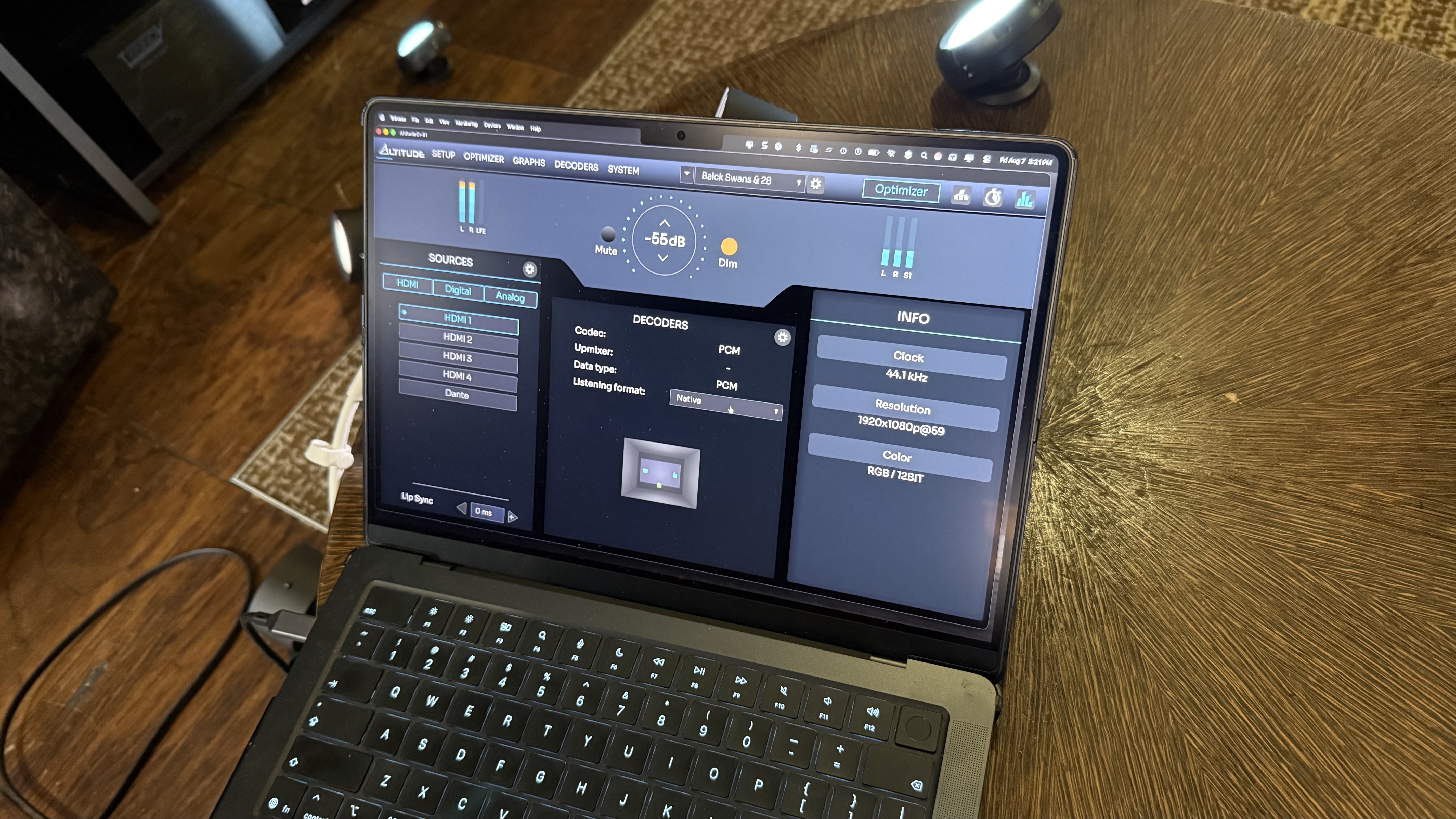
Trinnov software for Trinnov Altitude CI

Trinnov's software offers a lot of flexibility and fine tuning. (Image credit: Future / James Holland)

Looking under the hood

Earlier I called the Trinnov Altitude CI an Intel computer, and it’s true. It uses an actual CPU and has a heavily modified Linux base for its software. What this means is that Trinnov doesn’t have to wait for someone to make a special DSP chip for them to build around as the internal processor is more than powerful enough. And that by making the processing software-based, the company can roll out any updates to Dolby Atmos, DTS:X, Dante, or anything else with a software update that just requires a press of a button and a few minutes.

This means that if you own any Trinnov AV processor, they will stay up to date for the foreseeable future so you won’t need to go replacing hardware every time there’s something new under the sun.

On the hardware side, the only moving target these days is HDMI. With the Trinnov Altitude CI, the HDMI ports are all separated on their own piece of hardware that can be removed for an updated one that you would get from the company so that your processor can support the new standard. Beats buying a whole new AV processor.

The one thing that really sets the Trinnov Altitude CI apart from the Altitude 16 or 32 is that it has scalable channels. So when you purchase this processor, it includes eight channels in that initial price tag of about $12,000 / £8,870 / AU$16,960 and you can add channels two at a time after until you get to 32 channels, and it’s about $28,000 / £20,700 / AU$39,560 for the Altitude CI fully loaded. You’ll have to reach out to your local Hi-Fi dealer for exact pricing, but the Trinnov Altitude CI offers a more affordable entry point into the Trinnov ecosystem.

Did you know TechRadar now has membership?

Various tech product cutouts next to the words 'Insider TechRadar Learn More'

(Image credit: Future)

Become a TechRadar Insider by simply clicking 'Join Now' at the top of this page. Have a question? Please email membership@techradar.com


from Latest from TechRadar https://ift.tt/Kd3yink

Friday, August 21, 2026

Premier League Soccer: Livestream Every Game of the 2026-27 Season From Anywhere

Can Arsenal make it back-to-back titles?

from CNET https://ift.tt/TUCacxk

Latest Tech News

In my opinion, 4K Blu-ray is easily the best way to view a movie at home. It delivers unmatched picture quality that will give the best TVs a chance to shine, along with uncompressed audio that, when played through one of the best soundbars or a full surround system, is unbeatable.

Since I started testing 4K Blu-ray for TechRadar back in November 2024 as part of the Blu-ray Bounty (where we test the latest 4K releases from each month), I’ve come to appreciate the format even more, and I've even become a fan and collector during that time. 4K Blu-ray is also a staple of my AV testing, as it uses that exceptional picture and audio I mentioned to really push AV equipment to its limits.

I’ve spoken before about my favorite discs of classic movies, as I believe 4K Blu-ray has worked wonders for some older titles. But in recent months, there’s been a few new discs that have impressed me in one area in particular: color. I’ve tested two discs in the last few weeks alone that have entered my testing disc rotation, so I thought I’d pick my top five 4K Blu-rays for color that I’ve tried out as part of the Blu-ray Bounty.

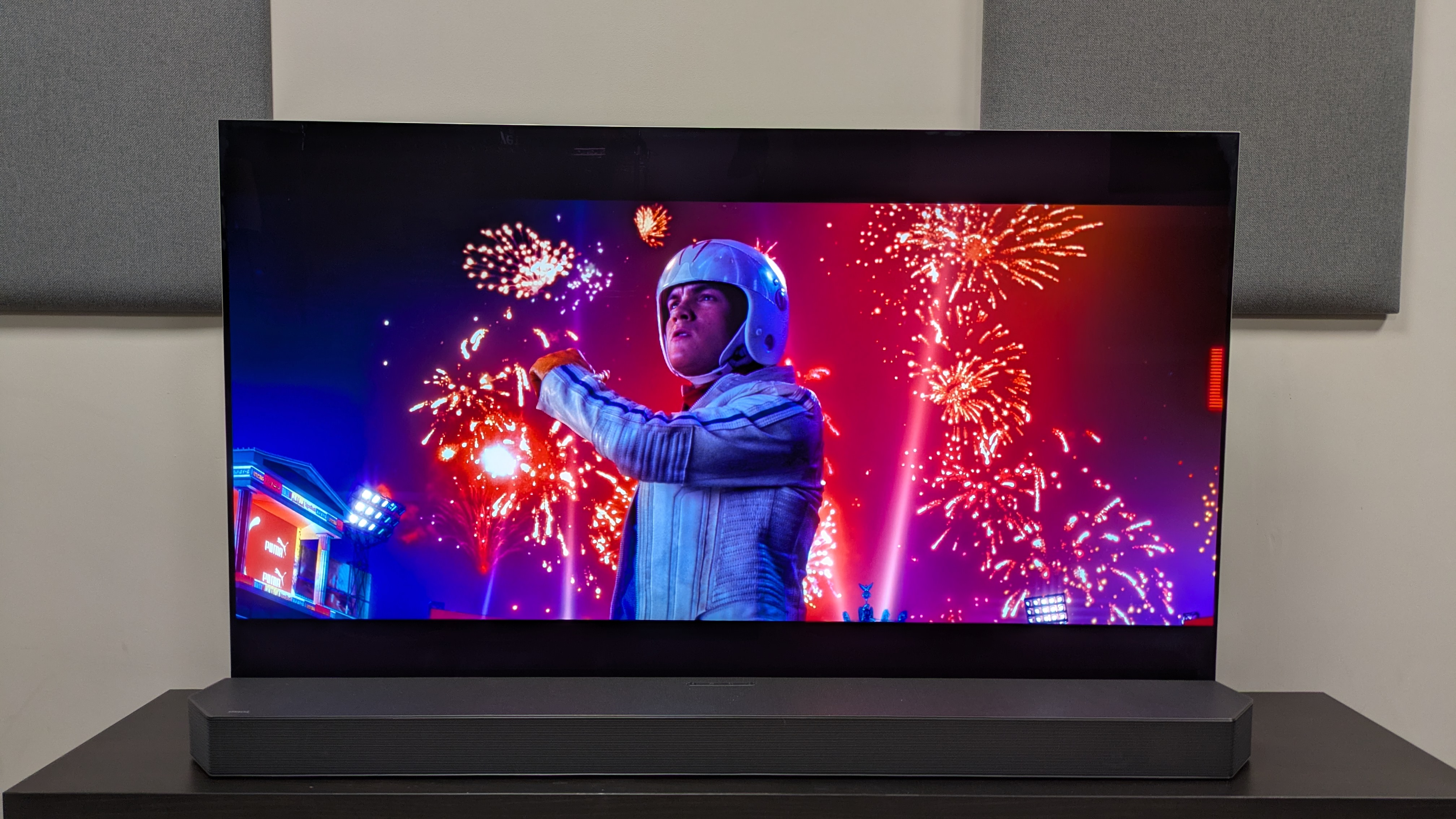
Speed Racer (2008) (Warner Bros.)

Speed Racer 4K Blu-ray on LG G5 showing Speed Racer stood in front of some bright fireworks

(Image credit: Warner Bros. / Future )

Based on the 1967 animated TV show of the same name, Speed Racer follows the story of a young man called Speed Racer (Emile Hersch), a racecar driver who follows his deceased older brother’s career and vies to become a champion. After he chooses to stay with his family’s racer company, Racer Motors, instead of joining the Royalton Industries team, he becomes a target. The movie also stars John Goodman, Susan Sarandon and Christina Ricci.

From the moment I fired up Speed Racer, I was amazed by the sheer brilliance of its colors, which practically explode on screen. Throughout the movie, there’s plenty of bold, vibrant tones that really show off your TV’s color reproduction. As the Racer family eat breakfast after the opening race, the bright orange walls, green furnishings and pink details all pop on screen. Even people’s clothes have an almost oversaturated, bright look to them than when I watched on the LG G6, one of 2026’s best OLED TVs, showing real vibrancy.

Of course, there’s the colors around the racetrack itself too. From the bright, neon advertisements to the candy-colored outfits and car decor, if your TV has good HDR peak brightness, you’ll be rewarded with punchy highlights that really dazzle on screen. The disc supports Dolby Vision, and if your TV supports it, you’ll enjoy even more vibrant colors. This really is a reference quality disc.

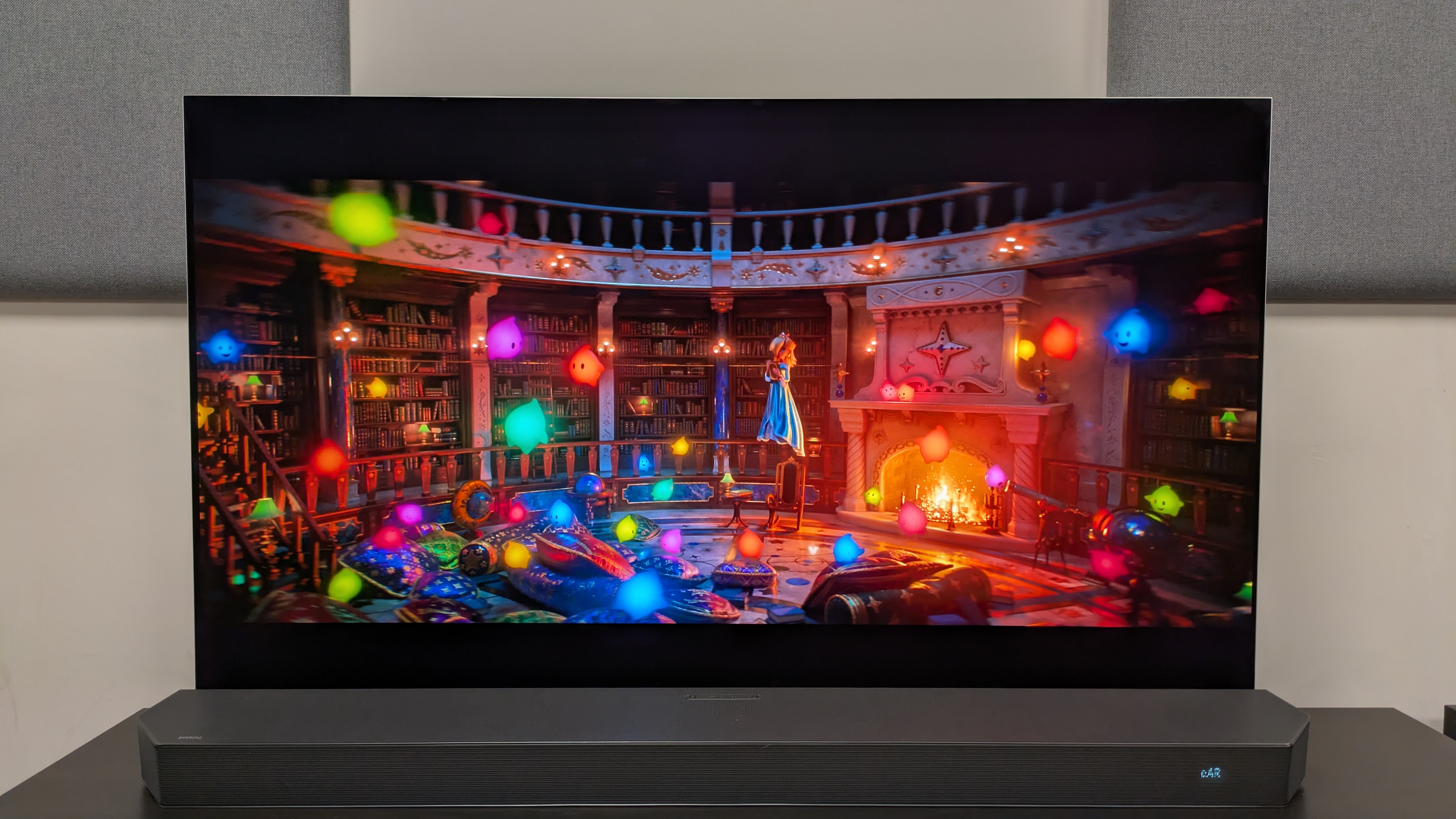
The Super Mario Galaxy Movie (Universal Pictures)

The Super Mario Galaxy Movie 4K Blu-ray on the LG G6 showing Rosalina with the group of Lumas by a fire

(Image credit: Nintendo / Universal Pictures / Future )

Sequel to 2023’s The Super Mario Bros Movie, The Super Mario Galaxy Movie follows Mario, Luigi, Peach, Yoshi and Toad as they attempt to rescue Princess Rosalina from the clutches of Bowser Jr. The voice cast includes Chris Pratt, Anya-Taylor Joy, Charlie Day and Jack Black.

Animated movies often deliver striking, eye-catching colors, but I was floored by how good The Super Mario Galaxy Movie’s colors were. It starts in the very opening scene with the Lumas. As the Lumas themselves are all a variety of vivid colors, including red, green, blue and gold, they really show the 4K disc’s superb clarity from the get-go.

There’s plenty of natural color too, particularly in Mario and Luigi’s overalls, which are the most toned down, lifelike colors throughout the movie. Scenes of space show gorgeous pink, purple and blue hues that balance that are both nicely saturated and rich, and even fire has plenty of dazzle that, on the right screen, can also look realistic. It helps that the movie has crisp textures and details, but the color is what really shows off this disc.

Wicked (Universal Pictures)

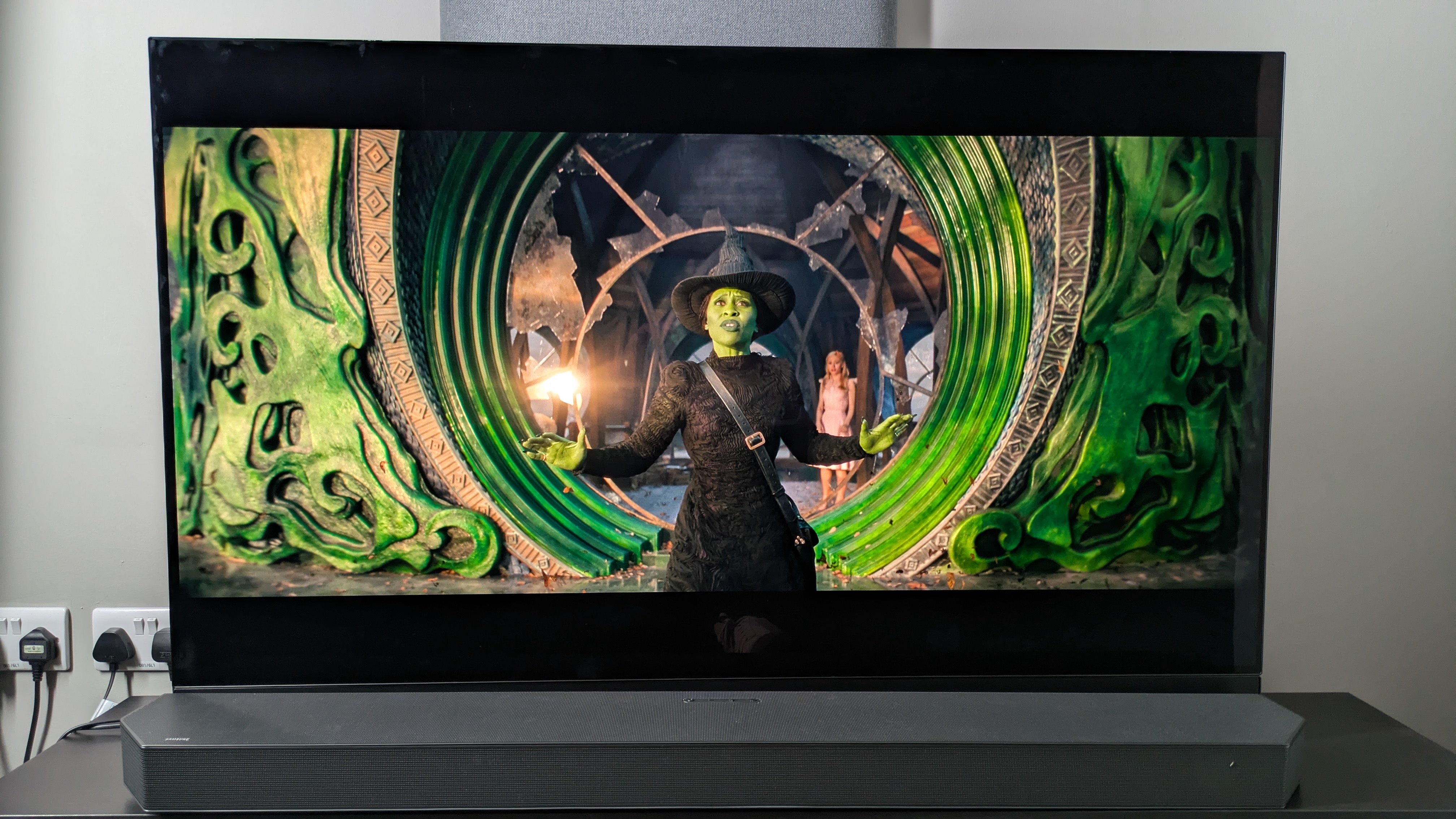
Wicked 4K Blu-ray shot of Elphaba on balcony of tower

(Image credit: Universal Pictures / Future )

Wicked, based on the musical of the same name, is a re-imagining of the events of The Wizard of Oz. It follows the story of how Elphaba (the Wicked Witch of the West), played by Cynthia Erivo, and Glinda (the Good Witch of the North), played by Ariana Grande, strike up an unlikely friendship while at the Shiz academy.

When I first tested this disc as part of the March 2025 Blu-ray Bounty, I was impressed with its color reproduction. While I expected dynamic, lively colors, due to the setting of Oz, I was pleasantly surprised by how well the 4K disc struck the balance between vivid and true-to-life. Elphaba’s green skin, although not in itself ‘realistic’, looks believable and lifelike. Glinda’s bright, pink outfits really pop on screen, but again look natural.

One scene I frequently use in my TV testing is where Elphaba stands under a tree with pink flowers. On the right TV, this scene can really show off a TV’s colors, thanks to the vibrant pink flowers, Elphaba’s green skin and even the blue detail on the decor of the school walls. Even if a TV doesn’t have the strongest color reproduction, the scene can still look good: it just won’t have that wow-factor that does the 4K disc justice.

The Sound of Music (Disney)

A shot of Maria and the Von Trapp children at a fruit stall at a market from The Sound of Music 4K Blu-ray on LG G5

(Image credit: 20th Century Studios / Future )

One of cinema’s most iconic musicals, The Sound of Music, based on the 1959 stage musical of the same name, tells the story of a nun Maria (Julie Andrews) who is assigned as the nanny for the Von Trapp family children during wartime Austria. The movie won five Academy Awards, including Best Picture.

I’ve always been amazed about what 4K Blu-ray can do for older movies, and The Sound of Music is one of my chosen showcases for this. Not only is the restored detail exceptional, but the movie’s colors are a sight to behold. My reference scene from this disc is when Maria and the children are at a market. In front of them are various fruits, mainly yellow, orange and red, that on the 4K disc practically shimmer on screen. But like Wicked, these colors also appear natural at the same time.

Throughout the movie, many scenes of the Austrian landscape also really showcase the bold, engaging color profile that the 4K disc can show on the right screen. The green grass, gorgeous blue sky and the white snow-capped mountains all pop, and if your TV can replicate the finest details, individual shades within these large colorful areas look exceptional. This is one of the best 4K discs of an older movie I’ve seen, and its colors are a big reason for that.

The Wild Robot (Universal Pictures)

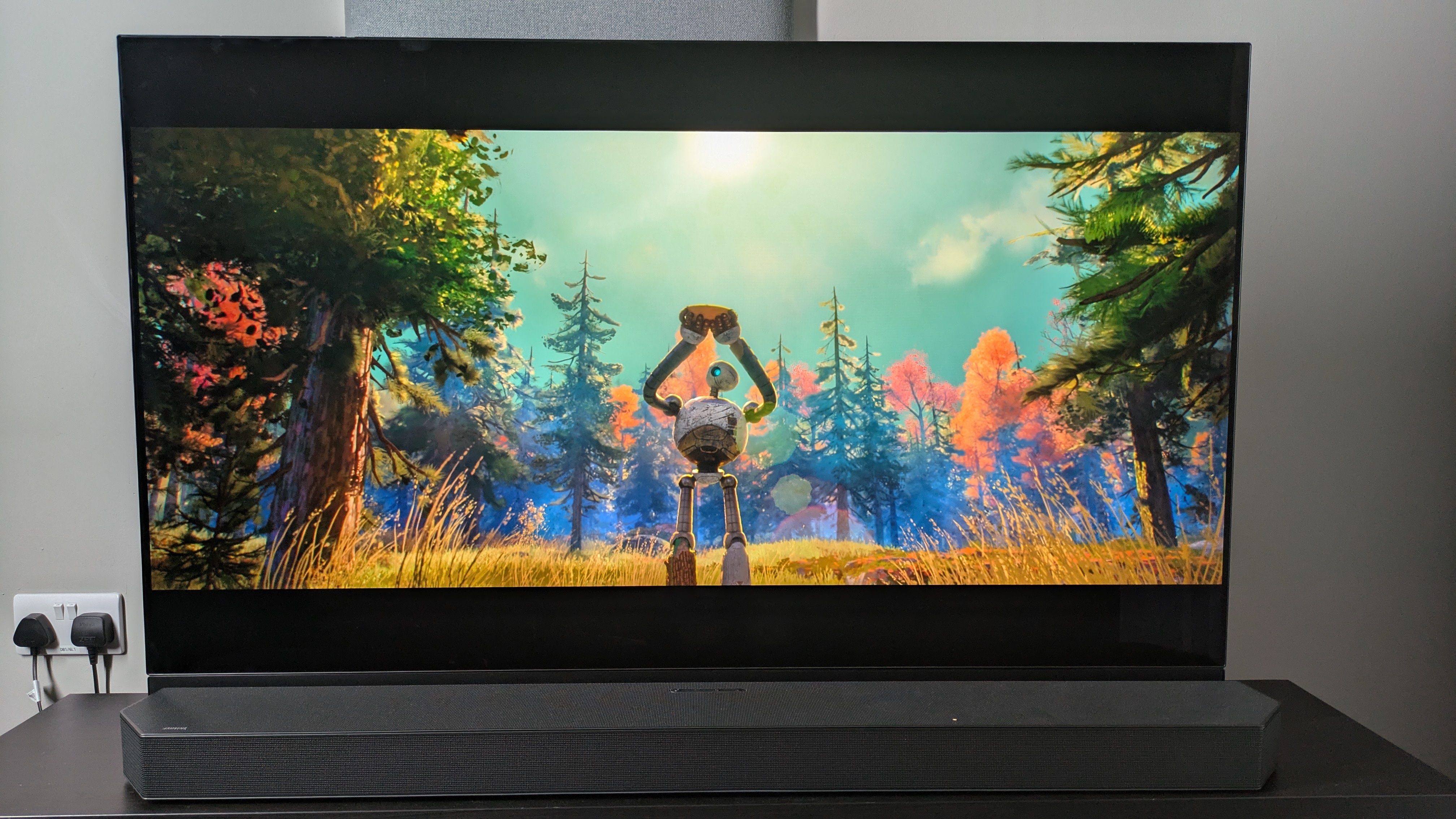
The Wild Robot forest scene on Panasonic MZ1500

(Image credit: Universal Pictures / Future )

Based on the 2016 novel of the same name, The Wild Robot follows Roz, a robot sent to gather data on wildlife. Roz, who is abandoned, must adapt to her surroundings, where she becomes the surprise adopter of a wild goose. The movie stars Luipta Nyong’o, Pedro Pascal, Bill Nighy, Kit Connor and Mark Hammil among its all-star cast.

While a lot of animation, such as The Super Mario Galaxy Movie higher up this list, can opt for vibrant, saturated colors, some animated movies go for a more natural color profile. The Wild Robot is one of the best examples I’ve seen of this. Using a beautiful animation style, which looks like a watercolor painting, the 4K disc is truly stunning. Colors are vibrant, but also true to the watercolor aesthetic of the movie and really do look like a real-life painting.

There are tons of scenes to choose from here, but the opening sequences where Roz first encounters nature are the best. The green trees and fields look superb, appearing both realistic and bright, and as Roz touches a group of yellow butterflies, the screen is filled with beautiful, vivid color that can really glisten on the right TVs. There’s even excellent detail within the colors of different creature’s fur, with different shades appearing nuanced and refined. I’ve seen numerous animated 4K Blu-rays, and this is one of the very best looking around.


from Latest from TechRadar https://ift.tt/B4TQLJi

Thursday, August 20, 2026

Latest Tech News

The HP OmniBook X Flip 16 gives you considerably more flexibility than a conventional laptop. Its 16-inch touchscreen can be folded all the way back for tablet use or positioned at different angles for presentations, streaming and creative work. In its 60th Anniversary Sale, the HP OmniBook X Flip 16 is now $750 (was $1200) at Best Buy.

That's a massive $450 saving, equivalent to 37.5% off the regular price. You get plenty of performance for the money too. The Core Ultra 7 256V is paired with 16GB of fast LPDDR5X memory, a spacious 1TB PCIe 4.0 SSD and Intel Arc 140V graphics.

Omnibook X Flip 2-In-1 Touchscreen Laptop: was $1199.99 now $749.99
Connectivity includes Thunderbolt 4, a second USB-C port, two USB-A connections and HDMI 2.1. You also get Wi-Fi 6E, Bluetooth, a 5MP IR webcam and a backlit keyboard.View Deal

Why we recommend it

The Core Ultra 7 256V is a modern Series 2 processor with a 47 TOPS NPU. Intel's Arc 140V integrated graphics add considerably more graphical capability than you'd get from a basic productivity laptop.

It also features a large 2K touchscreen that makes the OmniBook useful for everything from everyday office work and streaming to photo editing and lighter creative workloads.

Thunderbolt 4 provides a 40Gbps connection for high-speed storage, docks and external displays, and HDMI 2.1 and the additional USB-C port make it easier to build a desktop setup around the laptop.

For more top picks, see our guide to the best business laptops we've tested.

Price context & historical value

At $749.99, you're saving exactly $450 against Best Buy's regular $1,199.99 price. That's a hefty 37.5% reduction as part of the retailer's 60th Anniversary sale. This is the cheapest price we've found for a new HP OmniBook X Flip 16 with this specification, so definitely recommended if you've had your eye on it for a while.

The specification is particularly attractive as you're getting a recent Core Ultra 7 processor, 16GB of memory, 1TB of storage, Arc graphics and a large convertible touchscreen for below $750.

Should you buy it?

Buy the HP OmniBook X Flip 16 if...

You want a big-screen laptop that can handle work during the day and transform into a more convenient machine for entertainment afterwards. The combination of a 16-inch touchscreen and 360-degree hinge gives you considerably more flexibility than a standard clamshell laptop.

The Core Ultra 7 256V and Arc 140V graphics provide plenty of everyday performance, and the 1TB SSD will be enough storage for most people's key needs.

Skip the HP OmniBook X Flip 16 if...

Portability is your priority. At more than four pounds, this isn't the 2-in-1 I'd choose if I wanted something to carry around all day or regularly use as a handheld tablet.

The 16GB of LPDDR5X memory is another consideration for particularly demanding workloads. It's sufficient for most tasks, but buyers tackling heavy video editing or other memory-intensive work may prefer 32GB.

The Catch: What to know before you buy

The OmniBook X Flip 16 is a large convertible, and at 4.15 pounds, it's considerably less convenient to hold in tablet mode than a smaller 13- or 14-inch 2-in-1. The flip design is better suited to occasional tablet use, presentations and watching video than carrying around for extended periods.

As mentioned before, the other limitation is the 16GB of LPDDR5X memory. That's plenty for everyday productivity, multitasking and many creative jobs, but it isn't upgradable, which is worth bearing in mind.


from Latest from TechRadar https://ift.tt/9LnBgVU

BMW Championship 2026: TV Schedule, How to Watch All the PGA Golf Action

It’s the second leg of the FedEx Cup Playoffs in St. Louis.

from CNET https://ift.tt/Ejyo31P

Latest Tech News

  • UKSOL says it's the first in the UK to achieve regulatory compliance for plug-in solar products
  • It's ground mount kits with one or two solar panels go on sale on August 27
  • That's when solar is legal in the UK, and we can expect more of these kits to be available

UKSOL has announced that it's the first solar company in the UK to achieve regulatory compliance for plug-in solar kits, the first of which will be on sale in just a week.

Those products are the UKSOL Plug-In Solar Pro Compact 460W Ground Mount Kit (consisting of a single solar panel), and the Plug-In Solar Pro Duo 890W Ground Mount Kit (two panels). Both of these go on sale from August 27 in the UK — when plug-in kits become legal in this country — albeit in "limited stocks" to begin with.

A pair of hybrid mount kits — a single panel 515W offering, and a 920W two-panel product — have also been approved, and these should be available in October 2026 (or that's the current plan).

All of these have met the relevant regulatory standards, and are listed as 'compliant' in the ENA (Energy Network Association) Connect Direct plug-in solar device database.

The Plug-In Solar Pro products have been developed specifically for the British market, UKSOL informs us in a press release, and these are all-in-one kits that come with everything you need to be up and running.

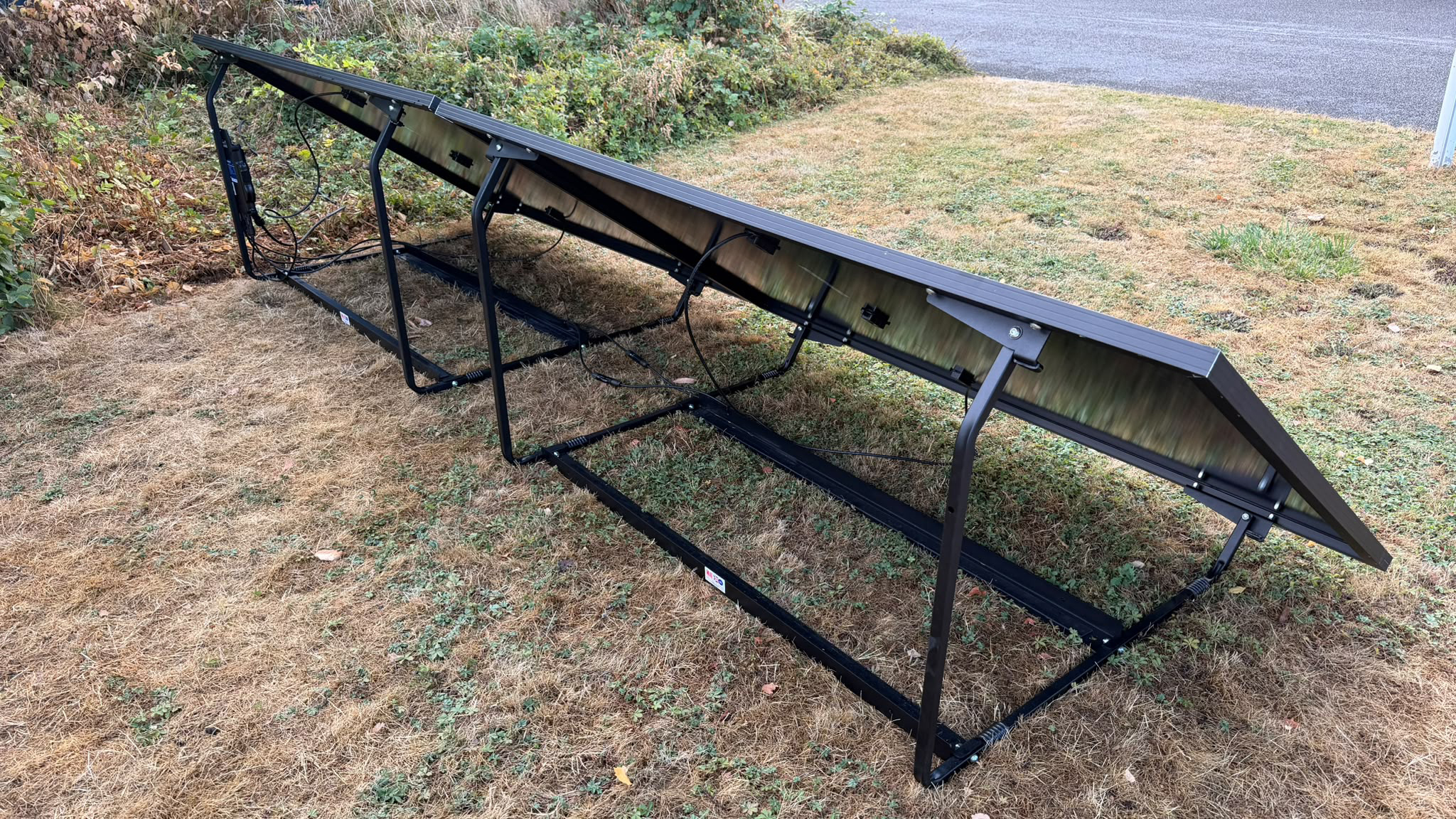
With the kits out next week, alongside the UKSOL panel(s) you get an integrated (foldable) ground-mounting frame with a ballast tray, as well as the necessary 800W microinverter plus DC and AC cables. There's a smartphone app for monitoring the system, too.

Pricing for the Pro Compact (single panel) 460W Ground Mount Kit is £849 with VAT and two-man delivery included, with the Pro Duo 890W Ground Mount Kit running to £1,199 (also with VAT and delivery). The RRP at retailers is £699 and £1,089 respectively.

Andrew Moore, the CEO of UKSOL, commented: "We expect plug in solar to become an exciting new consumer category, but there is a real responsibility on manufacturers and retailers to get the introduction right. Consumers should be able to understand who manufactured or supplied their system, what testing has been undertaken, what warranty and technical support sits behind it and whether it meets the requirements for the UK market."

He added: "Price will obviously matter, but solar equipment is a long-term electrical product. Safety, provenance, quality and after-sales support need to matter too."

Analysis: An alternative to full solar is (almost) here

A UKSOL plug-in solar kit

(Image credit: UKSOL)

The ground mount kits are, of course, placed on the ground in your garden or other outside area (and weighed down using the ballast tray, to ensure that if it gets windy, you aren't going to end up with overturned panels).

The other option from UKSOL is to buy a hybrid mount kit in October, and these can be situated on the ground, or on a wall (or balcony). They'll arrive in a 515W compact (one panel) variant and an 890W dual panel setup, with other offerings too (up to a 1260W hybrid kit). No pricing is available for those yet.

Kits from other manufacturers should be going on sale soon enough as plug-in solar becomes legal on August 27, when UKSOL's first ground mount offerings become available. Manufacturers must ensure compliance with UK regulations, of course, as UKSOL has done, with the likes of Asda, Currys, B&Q, Wickes, and Screwfix potentially stocking these solutions.

Plug-in panels offer a good alternative as a scaled-down version of a full roof-mounted solar setup, as not every house can have the latter — flats certainly can't, and some roofs just aren't suitable. Plug-in solar is the obvious choice if you're renting, and don't own the property, too — and they're a lot less of a financial commitment than a full roof installation.

A typical payback period for plug-in (when the electricity saved roughly equals the cost of the panels) is three to five years, according to the experts, which is way quicker than a typical full solar install.

Note that there are certain requirements in terms of the rules for the location of plug-in solar panels — you can't put them on wooden balconies for example (due to the fire risk), and the same goes for fences.


from Latest from TechRadar https://ift.tt/zBTAMXI

Wednesday, August 19, 2026

Save Up to $560 Off Mammotion Robot Lawn Mowers With App Control and AI Vision

Kick that old lawn mower to the curb and let your new robot take a load off.

from CNET https://ift.tt/y0BnRmz

Latest Tech News

Here's something I never thought: What if my ears could see? The very idea of it conjures visions of earlobes with clusters of tiny, spider-like eyes.

Of course, now we're all considering this possibility thanks to what appears to be a stunning crack in Apple's typically rock-solid dome of product secrecy.

As we reported earlier this week, MacRumors dug into one of the macOS 27 release candidates and unearthed a short bit of video featuring a man wearing AirPods Pro earbuds but somehow using them with Apple Intelligence to save an image of a book for later.

The guy isn't wearing glasses, so it's not the rumored Apple iGlass or Apple Vision Wear at work here. Instead, everyone believes this is the first confirmation that Apple is working on AirPods with cameras or "AirPods Vision," a pair of Bluetooth earbuds also equipped with vision sensors that, in concert with your connected iPhone, can use Apple Intelligence to recognize objects and then store information about them for retrieval later.

I spent some time staring at the bud in the guy's ear, and it looks, from this angle, exactly like the current AirPods Pro 3 I currently wear. I assume that whatever sensors the buds are using live on the opposite side, facing out so they can "see" what you see.

I also got caught up in the book the guy is memorizing. Could, Should, Might, Don't, is a real book by former design head for Google X, Nick Foster. In it, he dives into four mindsets of, I guess, future ideation and innovation:

  • "Could" revolves around the wild possibilities (probably why we watch and love Star Trek).
  • "Should" is sort of the realist's approach to what we should do based on on-the-ground facts and data.
  • "Might" appears to combine elements of the first two.
  • "Don't" is the risk-averse part. It's all the reasons people don't want Artificial General Intelligence or robots running AGI living with, working with, and maybe ultimately controlling us.

While not anti-tech or anti-innovation, the book has a point of view and seems an odd choice to include in what might be an iPhone and AirPods tip video.

I look at the overall image and that book and think:

"Yeah, we Could do this, have AirPods that can see, but we Should think about the consequences of another sensor on our body, and while it Might be cool to have an always-aware system memorizing things for you, we Don't want other people to freak out when they see cameras in our ears."

Smart Glasses is a lesson

Usually, I would remind people that these are all rumors and Apple is always working on oddball stuff that will never see the light of day, but we have a tip video. Apple doesn't create tips for products it's never bringing to market.

I think there's a good chance we will get these "seeing" AirPods Pro this year. I understand the system probably isn't collecting and storing images of everything you see forever. It appears to be on demand, and the use of Apple Vision should mean that it takes the image, sends it to Apple's Private Cloud Compute, matches it with available data on the internet — "What is this book?" — and stores that data without the need for the actual photo or anything else the AirPods Pro's sensors detected.

Even with those assurances, consumers are in no mood for more wearable sensors. Just look at the growing negative sentiment around smart glasses, which some are now calling "creep glasses."

The difference, of course, is that such smart wearable cameras are meant to both analyze the world you see and to capture and store photos and videos. The "creep" factor comes in from people circumventing the onboard privacy controls (trying to hide the LED lights) so they can surreptitiously capture photos and videos.

If they see cameras on your AirPods, they will surely recoil and demand to know what they're for and if you are capturing images and video of them.

The problem with camera- or vision-equipped AirPods, though, is that people will have similar concerns. If they see cameras on your AirPods, they will surely recoil and demand to know what they're for and if you are capturing images and video of them. You might say no, but also secretly wish you had. The chance to document at least their face and name so you don't forget it the next time you see them would be too hard to pass up.

AirPods Vision, if that's what they're called, might not allow you to capture images of living things, something that could seriously limit their utility except for use in quiet, windowsless, and people-free rooms like the one that guy is standing in. Oh, wait, that has a window. What if someone walks by? Does the AirPods' vision system stop working?

In a few weeks, Apple will have a new CEO, John Ternus, who will want to put his stamp on the company. This could be his first opportunity. I know Tim Cook loved the idea of AR glasses and was definitely all in on sensor-filled wearables, especially ones that could improve your health and safety.

Ternus could recalibrate, though. I'm sure he'll continue to support the health and safety aspect, but maybe he pumps the brakes on glasses and these AirPods with cameras until he has a better understanding of public sentiment and the privacy implications. There's a lot to discover, and given the challenges in these markets, there's no need to rush into anything.


from Latest from TechRadar https://ift.tt/8jzwCie

Tuesday, August 18, 2026

Latest Tech News

  • Ordinary Wi-Fi networks can reportedly identify people without cameras or consent
  • KASTEL researchers achieved nearly 100% identification accuracy across 197 volunteers tested
  • Wi-Fi signals can reportedly reveal people from different viewing angles

A new study suggests that ordinary Wi-Fi networks could be repurposed to identify individuals without cameras, sensors, or their knowledge or consent.

Researchers from KASTEL, the Institute of Information Security and Dependability at KIT, tested the approach on 197 volunteers in controlled conditions.

Their system reportedly achieved nearly 100% identification accuracy regardless of a person's viewing angle or the way that person walked.

A method that needs no extra hardware

The technique relies on beamforming feedback information, a type of signal that connected devices routinely send back to a router.

This information is transmitted without any encryption, meaning anyone within range of the network could potentially intercept and read it.

By analyzing these radio signals over time, the system reportedly builds images of people from multiple viewpoints inside a space.

Earlier wireless sensing methods often required specialized equipment, such as LIDAR sensors or detailed measurements of channel state information from a network.

By contrast, the researchers say a standard, unmodified Wi-Fi device is entirely sufficient to carry out this new identification process.

"By observing the propagation of radio waves, we can create an image of the surroundings and of persons who are present," said Thorsten Strufe, a professor at KASTEL, KIT's Institute of Information Security and Dependability.

"This works similar to a normal camera, the difference being that in our case, radio waves instead of light waves are used for the recognition.

A user does not need to carry a phone, smartwatch, or other Wi-Fi-enabled device for the system to work.

Turning off one's own device would reportedly not prevent identification, since other active Wi-Fi devices nearby could still be used.

Privacy concerns extend beyond conventional surveillance

The researchers argue that widespread wireless networks could create privacy concerns because they operate throughout homes, offices, restaurants, cafés, and other public environments.

Felix Morsbach noted that intelligence agencies and cybercriminals already have simpler methods, including compromising CCTV systems and connected video doorbells.

“The omnipresent wireless networks might become a nearly comprehensive surveillance infrastructure with one concerning property: they are invisible and raise no suspicion,” Morsbach added.

Compared with existing surveillance options, such as CCTV footage or connected video doorbells, wireless signals leave no visible trace behind.

Professor Strufe cautioned that this same invisibility could make the technology particularly attractive within certain authoritarian political systems around the world.

"The technology is powerful, but at the same time entails risks to our fundamental rights, especially to privacy," said Strufe.

Ordinary routers could potentially enable people to be recognized without their knowledge during routine movements, and this could be dangerous in the wrong hands.

Therefore, widespread deployment could make individual encounters difficult to distinguish from ordinary wireless activity.

The researchers argue that privacy safeguards should be incorporated into Wi-Fi technology before such capabilities become widely and easily exploited.

Specifically, they are calling for protections to be written into the forthcoming IEEE 802.11bf wireless standard currently under active development.

Via ScienceDaily

Google logo on a black background next to text reading 'Click to follow TechRadar'


from Latest from TechRadar https://ift.tt/W4EaNuM

Latest Tech News

  • The Cherokee Nation has placed a moratorium on new data centers on tribal lands
  • Citizens say they are concerned about the impact of new projects on the local areas
  • Data centers projects on non-tribal land will not be granted support by the Cherokee Nation unless they are given early consultation

Hyperscale data center development has been banned on tribal lands owned by the Cherokee Nation following a poll of its citizens.

The poll was run by a task force headed by Principal Chief Chuck Hoskin Jr., and found that 64% of the 1,593 respondents were opposed to the construction of data center campuses within Cherokee Nations lands, which cover about 6,963 square miles across 14 counties in Oklahoma.

Citizens' concerns returned in a 37-page report focused heavily on water consumption, air quality, noise, and cultural resource protection.

Cherokee Nation data centers require early consultation

The report also stated that data centers seeking approval to be built on non-tribal land within the reservation will require an early consultation with the Cherokee Nation, and will not be supported unless this early consultation takes place.

"Our primary responsibility is to protect our citizens and tribal communities from these threats, so we will not support any hyperscale data centers on our reservation without proper consultation," Hoskin said.

As there are no Oklahoma state rules requiring data centers to register, the number of planned and operational data centers is unknown. But estimates vary. CleanView places the number of planned and operational sites at 41, while the US Data Center Map says there could be as many as 51.

What we do know is that every hyperscale project within the state is on non-tribal land. Google’s Pryor campus has operated since 2011, but is undergoing expansion as part of a $2 billion investment in the Stillwater and Pryor campuses.

The citizens of the Cherokee Nation seem to share the same concerns as many other Americans, with fears of job replacement, environmental damage, and rising energy bills also being prevalent as reasons for AI data center opposition.

Other tribes, such as the Seminole Nation and Kickapoo Tribe, have already passed their own bans on data center projects within their territory.

Via Tom's Hardware


from Latest from TechRadar https://ift.tt/kUoH39B

Monday, August 17, 2026

Latest Tech News

I'll go ahead and say it: anime is hugely addictive. I don't mean that in a bad way, either — from the moment the first episode of a new series completely grips me, I want to consume as much of it as possible.

In general, anime have figured out a winning formula that blends archetypal, classic storytelling with cutting-edge action and visual craft, and it's why IPs such as One Piece, Jujutsu Kaisen, Solo Leveling and Demon Slayer have continued to do well.

Thanks to Crunchyroll, we get to enjoy a bombastic range of smaller titles, too. Reborn as a Vending Machine, I Now Wander the Dungeon, That Time I Got Reincarnated As A Slime and, most recently, BLACK TORCH are just some of the unmissable titles (and with those names, how could you overlook them?).

However, the missing detail that I've been intrigued about the most is how a typical day-in-the-life of recording works as one of the industry's many voice artists. Even more so because each series will have two separate casts: the original Japanese cast, and an English dub cast.

Luckily, I asked BLACK TORCH's AJ Beckles (Jiro) and Ryan Colt Levy (Ryosuke Shiba) to help fill in the missing pieces of the puzzle. As part of the English dub cast, they're already arguably behind the curve of the show's creation, but one detail of their day-to-day lives still really surprised me.

'You're learning as it is happening'

"It depends episode to episode," Levy begins. "How many scenes or moments your character may have can be different, day to day. I usually will make sure I am caffeinated and hydrated, and that I'm super scratchy. Sometimes these sessions will be early in the morning, so I'll wake up a few hours before so that my voice is primed.

"There's, there's such a cool factor to Shiba's presence that I never wanted to sound tired. I want him to sound like he's in a calm space... so there's there's a fine line there."

All incredibly logical and sound advice — but it's Brackles' admission that scripts aren't received until the second that they enter the recording booth that surprises me the most.

"You go into the studio, say hi to everybody, get in the booth, and be ready to work," he adds. "We get the scripts on the day, and you're learning about what's happening in the episode as you go. There's back and forth between yourself and the director. Like Ryan said, making sure you're hydrated, that you can show your mouth doesn't make too many slappy, clicky noises. Don't wear a leather jacket, because it's too squeaky.

"Being professional in that way, but a lot of it just comes down to really doing the work in the booth."

If we think about Disney and Pixar projects as a comparison, normally some semblance of a script will be needed to either get the project itself greenlit, or to get talent (especially the high-profile kind) to sign on.

Anime shows tend to have the safety net of the original manga to achieve both of these, but not only do voice actors tend to operate differently (as Brackles has confirmed), the manga itself can't necessarily be relied on.

With scripts being received so late on in the process, I'd like to think that animators and producers are being given more creative scope to play around with the original material. Sure, we want to see the anime hit the same big beats that we see in the manga, but the interim is surely up for grabs.

Perhaps I'm naive in thinking this might be how things work, but I still can't hide my surprise that the voice cast are having to achieve so much with so little notice. If anything, it's a testament to just how good they actually are.

BLACK TORCH is available to stream now on Crunchyroll every Saturday at 6AM PT / 9AM ET in the US.


from Latest from TechRadar https://ift.tt/0UQmo4F

Sunday, August 16, 2026

Latest Tech News

Have you ever had four religious experiences in a weekend? OK, that might be hyperbole, but if you had the weekend I just had at Audio Advice Live in Raleigh, then you can relate. Disregarding audiophiles’ apparent love of Steely Dan, I was enthralled and impressed time after time at what I was hearing.

Just about every audiophile adjacent brand (and some more budget friendly enthusiast ones) was there showing off its best stereo speakers. Bowers & Wilkins showcased its flagship 801 D5 , Focal had its all-in-one active Diva Alta Utopia, Klipsch went back to one of its original speaker designs with the Klipschorn, and JBL had its new Summit Series on display including the almost flagship K-2 (the flagship Everest model didn’t make it to the show).

All in all, it was an exciting time to get acquainted with these speakers. Of course, some of them cost the equivalent of a small house in the Midwest, but that’s the deal when a team of audio engineers put their best ear forward.

A view of a single Bowers & Wilkins 801 D5 speaker

The Bowers & Wilkins 801 D5 was demoed using a Marantz streamer and amps. (Image credit: Future / James Holland)

1. Bowers & Wilkins 801 D5

Though the company’s original version of the Diamond Series (what the D stands for) came out in 1979, a lot has changed since then. Specifically, 2026 brings with it the Bowers & Wilkins 801 D5, an update that doesn’t look much different to the D4 but sure sounds it.

The model keeps the same design principles in that every driver has its own casing, but comes with a number of improvements. Externally, there are three noticeable changes from the 801 D4: the more open tweeter grille design introduced on the 801 D4 Signature, the stronger and stiffer aluminum spine that’s fully incorporated into the cabinet, and an upgraded plinth that reduces vibrations via tuned mass and constrained layer damping.

More importantly, the internal matrix bracing has been completely redesigned so that the 801 D5’s cabinet is as stiff as can be. This means that the signal is less affected by internal vibrations and reflections.

All of these changes result in a speaker that sounds incredibly detailed yet warm, with a resolution worthy of a studio. They basically disappear so that you’re just focused on the music and reveal things you’ve never heard in your favorite tracks. The Bowers & Wilkins 801 D5 might possibly be the best pair of speakers I’ve heard. Just be ready to drop $65,000 (£43,000, or around AU$81,900) on a pair…

An angled view of the Focal Alta Diva Utopia

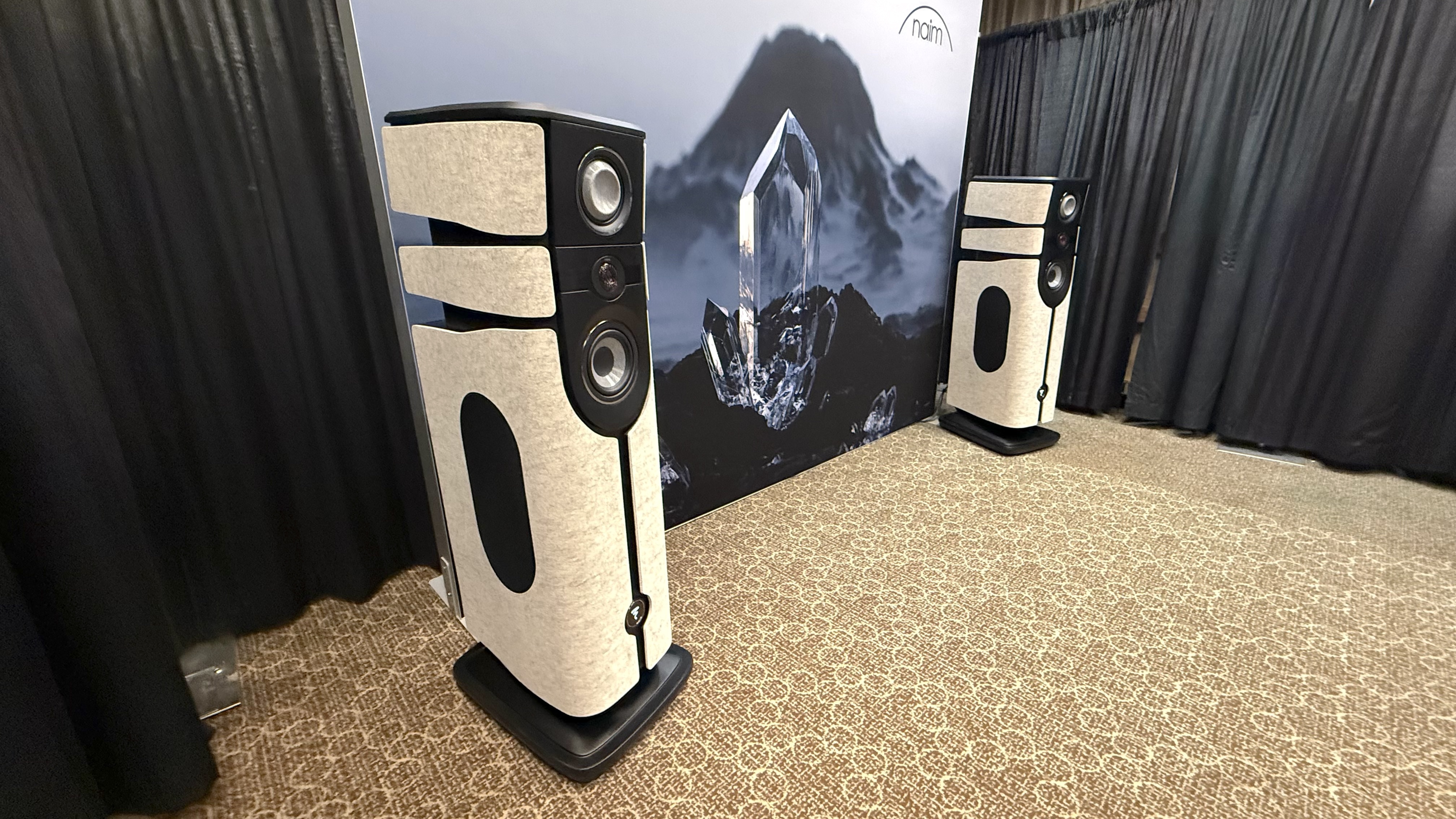
The Focal Alta Diva Utopia, being active speakers, only need an outlet to use. (Image credit: Future / James Holland)

2. Focal Diva Alta Utopia

Going into this event, I was excited to hear the Focal Diva Alta Utopia, the newest iteration in Focal’s first active speaker series. I almost didn’t get to hear them. Held hostage in customs during the first half of Audio Advice Live, their fashionably late entrance only made me want to hear them more. And oh, were they worth the wait.

There’s a lot going on here. The Focal Diva Alta Utopia speakers use Adapt, a DSP technology that can adjust listening position for imperfect rooms or placement. It also adds an additional driver per cabinet over the Focal Diva Mezza Utopia (the previous generation of this speaker line), making it a four-way speaker. And Focal added an additional Class A/B amp per cabinet for a total five per 600 watts per cabinet or 1200 watts total.

The Focal Diva Alta Utopia also features the company's new PRISM tweeter that’s only available on this model and the company’s Scala Utopia Evo M. This tweeter is essentially a carbon-coated composite material that offers more detail and more aural flexibility over the beryllium drivers that the company has leaned on previously.

Looks are important too, so Focal has made the accessory panels removable, so you can change out the color of the speakers if you get tired of a colorway by ordering additional ones in a different finish.

When I got to listen to these, the first thing I wrote down was “energetic.” These speakers, which retail for a cool $210,000 (£165,000, or around AU$296,800 and FYI, I don’t think you can take a mortgage out to finance these) are in your face in the best way. Room-filling with plenty of mid-bass, they offer that flagship audiophile experience without needing any additional amps or streamers. This is as good as it gets when it comes to active speakers.

A close-up of the Klipsch Klipschorn

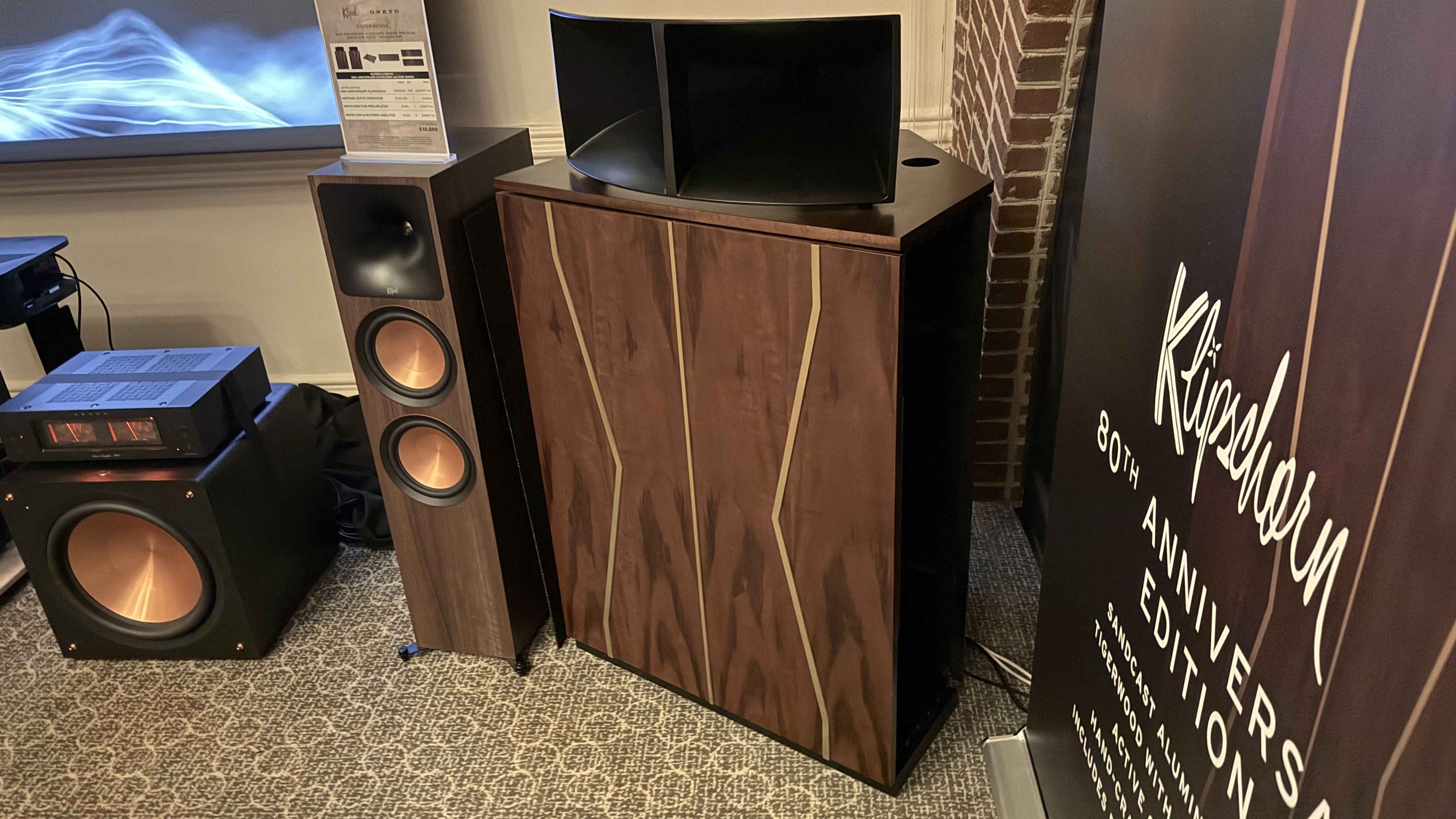
The Klipsch Klipschorn looks as good as it sounds. (Image credit: Future / James Holland)

3. Klipsch Klipschorn 80th Anniversary Limited Edition

People love vinyl for that analog sound. And if there’s anything that most resembles the feel of vinyl in speaker form, it’s the Klipsch Klipschorn, specifically the 80th Anniversary Limited Edition. Based on Paul Wilbur Klipsch’s original design from 1946, it comes with a few updates to bring it into the modern era.

Since only 280 of the 80th Anniversary Limited Editions will be built, Klipsch has pulled out all the stops visually. From its tigerwood veneer to the brass inlay adorning the front of the cabinet meant to emulate the folding that’s happening inside the cabinet, it’s stunning in a very mid-century modern kind-of way.

As far as its actual design, it has an active crossover and a two-way speaker design, composed of the K-5-K high-frequency horn with a 2-inch throat and four-way compression driver that takes care of everything above 350Hz and a 15-inch woofer hidden behind those brass inlays responsible everything under.

The resulting sound is one that’s a little softer around the edges than the other speakers I’ve mentioned here (hence the vinyl comparison). This makes them less ideal for reference-level use, yet they still work wonderfully with all sorts of music.

In terms of flagship speakers, the Klipsch Klipschorn 80th Anniversary Limited Edition are downright reasonable, a word I never would have expected to use for a pair of speakers costing $24,998 (so around £18,485 or AU$35,329).

The JBL Summit Series K-2 on display with the rest of the Summit Series

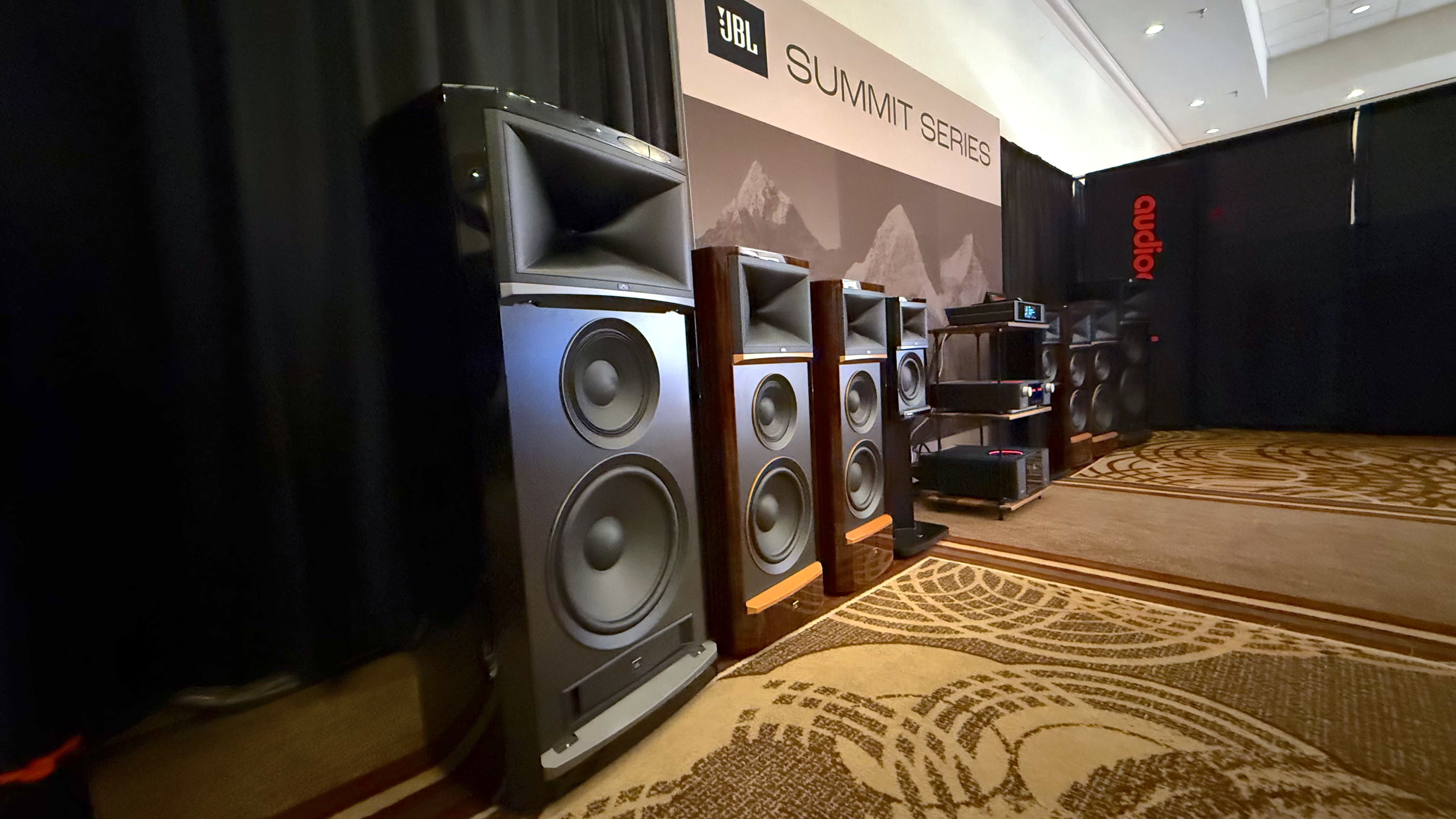
The JBL Summit Series K-2 stands beside the other speakers in the Summit Series (excluding the Everest). (Image credit: Future / James Holland)

4. JBL Summit Series K-2

If you’re not familiar with JBL’s project series, let me give you a brief definition. A project series for JBL is one in which the lead engineers have been given a no-expense-spared, carte-blanche approach to making the best speaker they possibly can.

There have been five of these series since the company’s inception, and the Summit Series is the newest. Not only are they named after a series of mountains that have struck fear in many an expeditioner’s heart, but they have 12 US patents that have come about just from the creation of this series.

The penultimate of this series is the JBL Summit Series K-2 ($99,990 per pair, or £71,998, which is roughly AU$141,300), featuring a single 15-inch woofer, a 10-inch woofer, and three 1-½-inch dual-diaphragm, dual-motor compression drivers going into a 3-into-1 expansion manifold. That manifold has been designed in a way that requires it to be 3D printed instead of a more traditional construction method. The woofers themselves also use a rigid carbon fiber (HC4) material.

Also worthy of mention is the fact that they have decoupled isoacoustic isolation feet and come with the ability to tri-wire /tri-amp – a feature that only the more expensive Everest can do. The rest of the line can bi-amp.

When I had the opportunity to listen to the K-2s, it was in a large hall, bigger than any of the other spaces, yet these speakers filled out the space with seemingly plenty of headroom to spare. Despite the large room, these speakers had one of the cleanest sounds I heard over the weekend. And that 15-inch woofer kicked like a mule.

A wide shot of the Sonus Faber Olympica V

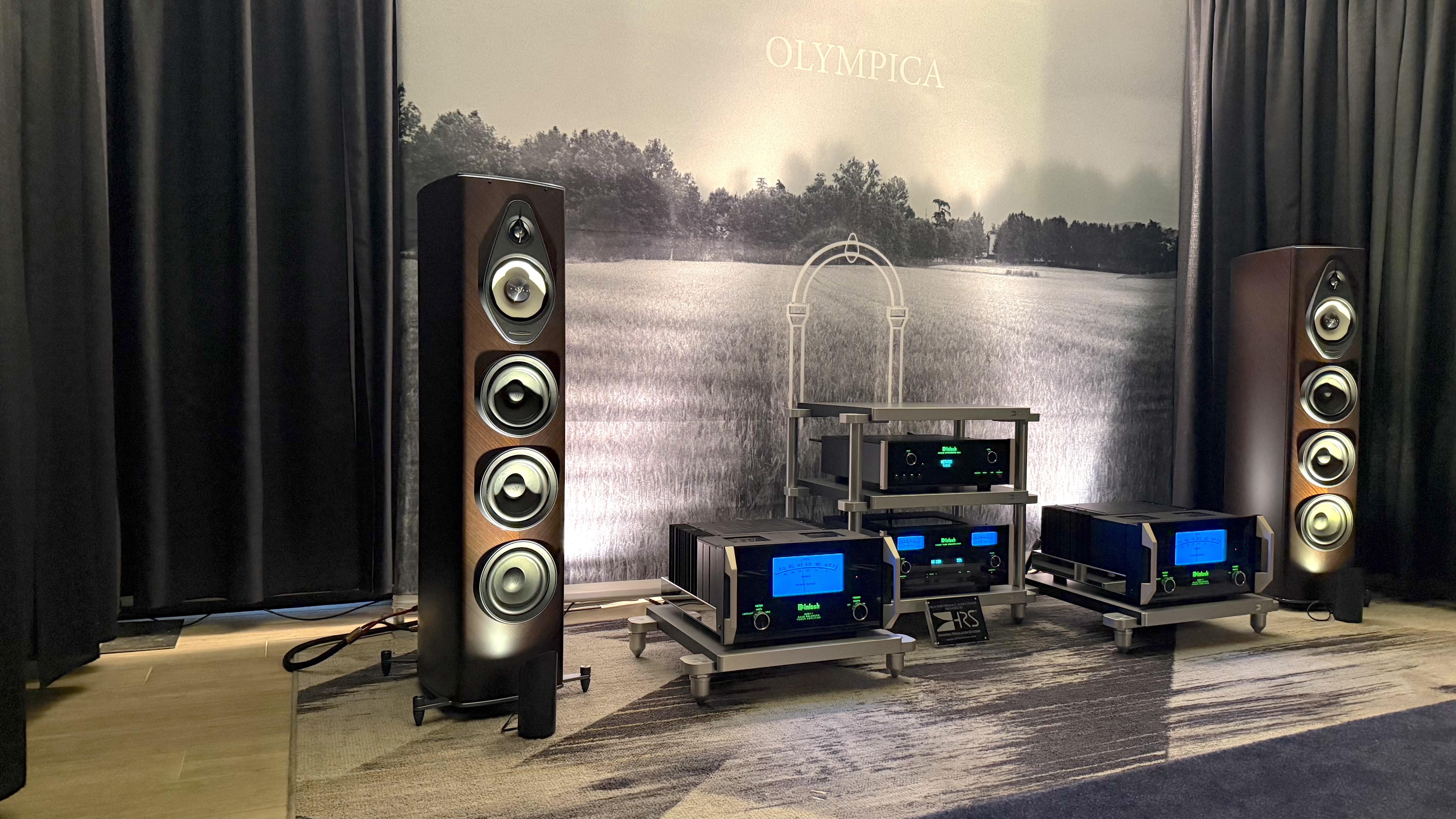
The Sonus Faber Olympica V were demoed using an all McIntosh signal chain. (Image credit: Future / James Holland)
Did you know TechRadar now has membership?

Various tech product cutouts next to the words 'Insider TechRadar Learn More'

(Image credit: Future)

Become a TechRadar Insider by simply clicking 'Join Now' at the top of this page. Have a question? Please email membership@techradar.com

Honorable Mentions

While I was most impressed with this set of speakers, there were quite a few other towers of power that impressed me more than enough to be worth a quick mention. The three-way ported Sonus Faber Olympica V, powered by McIntosh amps, sounded almost as good as the speakers listed above, as they should since they’re about $30k a pair.

Wharfedale impressed with its Elysian R and is probably one of the best representations of a speaker using an AMT speaker. And the new old kid on the block, French brand Cabasse (the company is actually 77 years old), just starting to make inroads into the US is one to watch out for. Cabasse makes some really unique looking and functioning active speakers, but also some great-sounding floorstanders. This time next year, you might be looking at a set of Cabasse speakers with the same amount of interest and deliberation as any of the other brands mentioned here.


from Latest from TechRadar https://ift.tt/ObMevaQ

Latest Tech News

If you're in the market for a capable smartwa...