Showing posts with label opinion. Show all posts

Sunday, August 31, 2025

Latest Tech News

  • Microsoft has revealed how it protects Azure with an Integrated HSM chip
  • Azure security stack includes Azure Boost, Hydra BMC and Caliptra 2.0
  • Cybercrime reportedly worth $10.2 trillion annually, making it the world’s third-largest economy in 2025

Microsoft has revealed more on the custom-built security chip it deploys across every Azure server, aiming to counter what it calls a cybercrime “pandemic” now costing $10 trillion annually.

The Azure Integrated HSM, which was first announced in late 2024, is the centerpiece of a wider security architecture the company outlined at the recent Hot Chips 2025 event.

A slide Microsoft showed there claims the global cost of cybercrime is currently $10.2 trillion - meaning it now ranks as the equivalent of the third-largest economy in the world.

Cybercrime is third largest GDP

(Image credit: Microsoft)

Azure security measures

The trillion-dollar estimate places cybercrime behind the United States and China, but ahead of Germany and Japan, and also far bigger than the entire AI market.

Microsoft said the scale of the threat requires both architectural and operational changes.

As ServeTheHome reports, the company listed a number of statistics at the event, including that Azure already spans more than 70 regions and 400 data centers, supported by 275,000 miles of fiber and 190 network points of presence, along with employing 34,000 engineers dedicated to security.

To take on the cybersecurity problem at a hardware level, Microsoft moved from a centralized hardware security module model to its own Azure Integrated HSM.

The custom ASIC is designed to meet FIPS 140-3 Level 3 requirements, providing tamper resistance and local key protection within servers.

By embedding the chip in each system, cryptographic functions no longer need to pass through a centralized cluster, reducing latency while enabling tasks such as AES, PKE and intrusion detection locally.

ServeTheHome noted building an in-house chip required trade-offs. Instead of scaling hardware security modules at a cluster level, Microsoft had to size them for individual servers.

The result, the company argued, was a balance between performance, efficiency and resilience.

The tech giant also presented its “Secure by Design” architecture at Hot Chips, part of its Secure Future Initiative.

This includes Azure Boost, which offloads control plane services to a dedicated controller and isolates them from customer workloads, and the Datacenter Secure Control Module, which integrates Hydra BMC, and enforces a silicon root of trust on management interfaces.

Confidential computing, backed by trusted execution environments, extends protection to workloads in multi-tenant environments.

Caliptra 2.0, developed in collaboration with AMD, Google and Nvidia, anchors security in silicon and now incorporates post-quantum cryptography through the Adams Bridge project.

Microsoft Secure by Design

(Image credit: Microsoft)

You might also like


from Latest from TechRadar US in News,opinion https://ift.tt/ut26Ffd

Saturday, August 30, 2025

Latest Tech News

  • The iconic floppy disk is reborn as a storage case for today's terabyte-packing SD cards
  • From 1.44MB past to terabyte present, the new design bridges eras creatively
  • Fun artwork references glitch aesthetics and retro computing

Floppy disks are unquestionably a relic from the past, although they still keep resurfacing in unusual places - most recently, surfacing in the American prison service, and an enterprising YouTuber set out to build a floppy disk from scratch.

If you're of a certain age, you'll no doubt still remember the feeling of sliding a floppy disk into a computer, hearing that quiet click, and waiting as files loaded bit by bit. That memory will come rushing back with the Floppy Disk-Inspired SD Card Packaging, a design concept created by Indian industrial designer Ayushmaan Singh Jodha for SanDisk.

It takes the iconic 3.5-inch floppy and reimagines it as a different kind of storage device - as a case for today’s SD cards.

floppy disk concept

(Image credit: Ayushmaan Singh Jodha )

From megabytes to terabytes

Where a floppy once held 1.44MB, this design protects cards that now carry gigabytes or even terabytes.

The idea bridges eras of technology in a fun way, but with a serious practical purpose.

SD cards can easily get lost, slipping out of pockets during a shoot, hiding beneath clutter in a busy studio, or disappearing into the depths of a travel bag. I’ve lost a good number of them over the years.

The floppy case provides a larger, sturdier object to hold onto, making it easier to keep track of the tiny cards that store important work.

The packaging keeps the same square profile and iconic shutter, transforming an obsolete form into a fresh, modern tool.

The design showcases artwork that references early computer culture, glitchy error screens, and retro sci-fi themes. The idea is turn the cases into collectible pieces that creatives may want to keep on display, not tucked away in drawers.

The sliding shutter reveals the hidden compartment where the SD card is stored, adding a small sense of interaction to an otherwise simple task.

Is it truly practical? No, but it’s fun and something I’d love to own.

Via Yanko Design

You might also like


from Latest from TechRadar US in News,opinion https://ift.tt/9G8oI3P

Latest Tech News

  • 5G phones can be silently downgraded to insecure 4G, leaving the device exposed
  • The exploit works without setting up expensive and complex fake towers
  • Tested smartphones include flagship models from Samsung, Google, Huawei, and OnePlus

In late 2023, researchers uncovered a set of flaws in 5G modem firmware from major chipmakers, including MediaTek and Qualcomm, collectively named 5Ghoul.

A group of academics at the Singapore University of Technology and Design (SUTD) has now shown how 5G phones can be tricked into falling back to 4G networks through a method that avoids the need for a fake base station.

Instead, it targets a vulnerable stage of communication between phone and tower, where critical messages remain unencrypted.

How the toolkit works in practice

The SNI5GECT toolkit, short for “Sniffing 5G Inject,” makes use of the tiny time window at the start of a connection attempt.

It targets the pre-authentication phase, when the data passing between the tower and the phone remains unencrypted.

Because of this gap, attackers can intercept and inject messages without needing to know the phone’s private credentials.

During this stage, the system can capture identifiers sent from the tower and use them to read and modify messages.

With such access, the attacker can force a modem crash, map a device fingerprint, or trigger a switch from 5G to 4G.

Since 4G carries long-known flaws, the forced downgrade leaves the target open to older tracking or location attacks.

The tests revealed a success rate between 70% and 90% when attempted from around twenty meters away, suggesting the method works in realistic conditions.

The academics tested the framework on several smartphones, including popular models from Samsung, Google, Huawei, and OnePlus.

In these cases, the researchers were able to intercept both uplink and downlink traffic with notable accuracy.

Importantly, the method avoids the complexity of setting up a rogue base station, something that has long limited practical attacks on mobile networks.

The Global System for Mobile Communications Association (GSMA) has since confirmed the issue and assigned it the identifier CVD-2024-0096, marking it as a downgrade risk.

The claim from the team is that their toolkit is not meant for criminal use but for further research into wireless security.

They argue it could help with the development of packet-level detection and new forms of 5G protection.

Still, the ability to crash devices or silently downgrade them raises questions about the resilience of current networks.

While no clear reports exist of real-world abuse so far, the method is public and the software is open source, so the risk remains that skilled actors could adapt it.

Unfortunately, users have few direct options to block such low-level exploits, though broader digital hygiene may help limit downstream risks.

However, running updated antivirus software, securing credentials with a password manager, and enabling an authenticator app for accounts can reduce the impact of secondary attacks that might follow from a network downgrade.

Via The Hacker News

You might also like


from Latest from TechRadar US in News,opinion https://ift.tt/Nqp3lSf

Friday, August 29, 2025

Latest Tech News

  • SK Telecom suffered a data breach that was discovered in April 2025
  • It affected roughly 27 million people
  • The company was fined for it, and will need to make significant changes to its operations

SK Telecom (SKT), one of the biggest telecommunications services providers in South Korea, was fined almost $100 million for failing to protect user data.

In April 2025, the company discovered a malware breach that allowed threat actors to lurk within its systems for years. Some researchers even claim the attack started in August 2021.

The miscreants targeted SKT’s Home Subscriber Server (HSS) and other critical infrastructure, exposing sensitive subscriber data, including USIM authentication keys (KI), International Mobile Subscriber Identity (IMSI) numbers, IMEI device identifiers, phone numbers, email addresses, and possibly other personal data.

"Very weak condition"

Approximately 27 million people were affected by the breach.

Now, Reuters reports that the government-run Personal Information Protection Commission issued a statement, confirming the fine of about 134 billion won ($96.53 million) for “neglecting its duty to take safety measures” and for “delays in notifying the leak to customers”.

The statement also claims SKT’s systems were in a “very weak condition” which allowed threat actors to access the company’s intranet. There were no passwords, or other safety measures, defending the servers from outside influence, and operating systems were outdated and running without the latest security patches.

Besides being forced to pay the fine, the company will also have to “strengthen safety rules on information protection” and revamp its governance.

Responding to a Reuters inquiry, SK Telecom said it “felt a grave responsibility” and will make protecting customer information a “top priority”.

In response, it launched an “Information Security Innovation Plan”, that includes implementing zero-trust architecture, expanding encryption, forming a red team, elevating the CISO role to report directly to the CEO, and adding cybersecurity experts to the board.

Customers received free USIM card replacements, and were offered 50% off August subscription fees. Furthermore, whoever wanted to cancel their contract prematurely was allowed to do so without extra fees.

Via Reuters

You might also like


from Latest from TechRadar US in News,opinion https://ift.tt/bteAFWE

Thursday, August 28, 2025

Latest Tech News

  • Nvidia Jetson Thor is framed as the robot brain for physical AI
  • Major robotics companies are already listed as early adopters worldwide
  • Nvidia Jetson Thor offers 2,070 FP4 teraflops within a 130-watt power envelope

Nvidia has released the Jetson AGX Thor developer kit, calling it the next step toward robotics systems which can function in real time.

The system, built on the Blackwell GPU line, is framed as a platform for “physical AI” and advanced robotic functions across manufacturing, logistics, healthcare, farming, retail, and transport.

Nvidia says it can deliver up to 7.5 times more AI compute and over three times the energy efficiency of its Jetson Orin line, which has been in wide use since 2022.

Offers supercomputer-level capacity

Nvidia went on to describe Jetson Thor as “the ultimate supercomputer to drive the age of physical AI and general robotics.”

“We’ve built Jetson Thor for the millions of developers working on robotic systems that interact with and increasingly shape the physical world,” said Jensen Huang, founder and CEO of Nvidia.

“With unmatched performance and energy efficiency, and the ability to run multiple generative AI models at the edge, Jetson Thor is the ultimate supercomputer to drive the age of physical AI and general robotics.”

With a quoted figure of 2,070 FP4 teraflops in a 130-watt envelope, it is positioned as powerful enough to run multiple generative models at once.

It supports vision-language-action models like Isaac GR00T N1.5, along with other LLM systems.

The device also integrates 128GB of memory, which is expected to make it capable of handling larger AI workflows at the edge.

Several robotics players are already listed as early adopters, including Agility Robotics, Amazon Robotics, Boston Dynamics, Caterpillar, Hexagon, and Medtronic.

Meta has also been named as an early partner, while companies such as John Deere, OpenAI, and Physical Intelligence are said to be testing the system.

“Nvidia Jetson Thor offers the computational horsepower and energy efficiency necessary to develop and scale the next generation of AI-powered robots that can operate safely and effectively in dynamic, real-world environments, transforming how we move and manage goods globally,” said Tye Brady, chief technologist at Amazon Robotics.

Nvidia notes more than two million developers already use its robotics stack, with over 7,000 customers having deployed Jetson Orin hardware in edge AI projects.

Jetson Thor runs on the Nvidia Jetson software platform, which is designed to support multiple AI tools at once.

The package integrates with Nvidia Isaac for simulation, Metropolis for vision AI, and Holoscan for real-time sensor processing.

This arrangement is intended to allow one system-on-module to support many AI writer models and workflows, rather than requiring several separate chips.

The developer kit is available now at $3,499 and the production systems, including carrier boards, will be distributed worldwide through its partners.

You might also like


from Latest from TechRadar US in News,opinion https://ift.tt/Z5jDASw

Wednesday, August 27, 2025

Latest Tech News

  • Nvidia’s H20 chip became collateral in a heated geopolitical clash
  • Nvidia’s revenue stream risks serious disruption with the Chinese market tightening
  • Chinese tech giants hesitate to abandon Nvidia hardware for weaker alternatives

China’s recent decision to tighten restrictions on Nvidia’s H20 chip sales has drawn attention not only because of the technology involved, but also because of the circumstances which triggered it.

Reports indicate comments made by U. Commerce Secretary Howard Lutnick in mid-July 2025 were viewed as both “insulting” and brash by China's government.

In a televised interview, Lutnick stated Washington’s strategy was to ensure Chinese developers became “addicted” to the American technology stack.

Rising tensions after controversial remarks

“We don’t sell them our best stuff, not our second-best stuff, not even our third-best,” Lutnick had told CNBC.

“You want to sell the Chinese enough that their developers get addicted to the American technology stack, that’s the thinking,” he added.

The Chinese considered this remark unnecessarily arrogant, and it is now engineering a move that presents sustained sales headwinds for Nvidia, a company that has long viewed the country as a major market.

The H20 chip, developed specifically for China after export controls restricted access to more advanced models, had become a key product for local AI firms.

Nvidia CEO Jensen Huang visited Beijing recently, and stressed the firm’s commitment to staying competitive in the region.

Still, with China accounting for at least 15% of Nvidia’s total revenue, any disruption to H20 orders represents a serious challenge.

Washington and Beijing had previously struck a framework agreement earlier in 2025 allowing H20 sales to resume in China while Beijing restored some rare earth exports.

That deal was interpreted as a step toward stabilizing relations. Yet by late July 2025, Chinese regulators such as the Cyberspace Administration of China and the Ministry of Industry and Technology began advising firms to halt new H20 orders.

This guidance, framed as a response to Lutnick’s remarks, highlights the fragility of recent progress.

Alongside the restrictions, Beijing has promoted the use of domestic chips, including those from Huawei.

However, doubts remain about their effectiveness, and DeepSeek had to delay the launch of its new R2 model after difficulties training with Huawei Ascend processors.

Chinese tech giants like Alibaba, Baidu, and ByteDance have also been reluctant to fully switch, citing stronger performance from Nvidia hardware compared with local alternatives.

The episode illustrates how political statements can rapidly alter corporate fortunes, especially when national security and technology leadership are at stake.

While Nvidia has disputed claims of security risks tied to its products, Beijing’s regulators appear determined to limit reliance on US-made chips.

Whether Chinese firms can scale up to fill the gap remains uncertain, but what is clear is that Lutnick’s words have accelerated a process of decoupling that may unfold far quicker than industry analysts initially expected.

Via Financial Times

You might also like


from Latest from TechRadar US in News,opinion https://ift.tt/Uu2Efxs

Tuesday, August 26, 2025

Latest Tech News

  • Google has rolled out a Messages feature in beta that lets you use QR codes to verify the device of the person you're texting
  • It's Google Messages' new security measure, which is designed to prevent impersonation scams
  • Google revealed last year that it would be rolled out to users in 2025

It seems as though a new security measure is on the way to Google Messages, as the company has begun rolling out a new QR code feature in the latest beta, which verifies the device of the person you’re chatting with.

First spotted by 9to5Google, Google’s new verification tool in Messages aims to prevent impersonation scams. Before, you could verify contacts by tapping ‘Verify encryption’, presenting an 80-digit code that you can share with the other person to verify your device and vice versa.

While Google Messages has always had a verification feature, its new QR code approach provides a more convenient way to prove the identity of the person you’re texting with. In that case, if someone were to break into a conversation pretending to be a contact, Google can check if their device is verified and alert you if it’s suspicious of odd activity.

The outlet also states that Google will be bringing it to Android 9+ devices this year, but where can you find it in the beta?

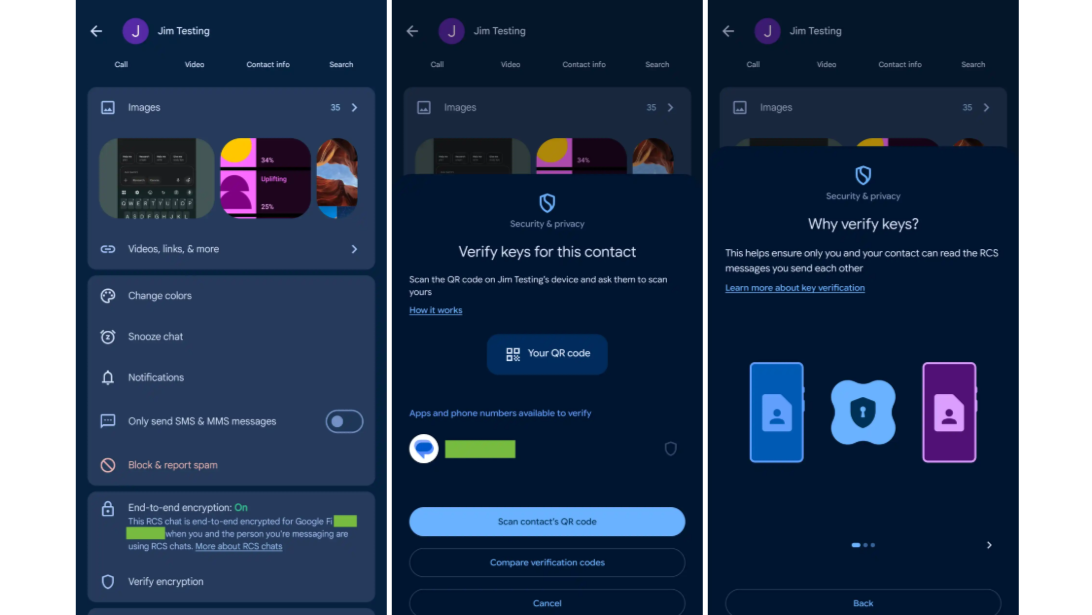
Three screenshots showing how to access the QR verifying tool in Google Messages

(Image credit: 9to5Google)

If you have access, open the Google Messages app and click into a conversation. When you tap the contact’s name, it will open the Details page, which displays the ‘End-to-end encryption’ section – and you’ll want to tap ‘Verify encryption’.

In addition to the existing 80-digit code option, there’ll also be an option to scan your contact’s QR code. Messages will also prompt you to ask the other person to scan your QR code in return, allowing Google to verify each device. To view the verification status, you can view them in the ‘Connected apps’ section of your device’s Contacts app; however, this integration hasn’t gone live yet, according to 9to5Google.

Recently, the company has been working around the clock to give its Messages service much-needed upgrades – like its new ‘Delete for everyone’ function – and now it’s doubling down on its security measures.

In October last year, Google unveiled plans to improve spam protection in Messages, following the addition of an unsubscribe button to prevent unwanted spam messages and a sensitive content warning tool, both of which rolled out in April. We’d expect the QR function to arrive before the end of the year, but an exact date hasn’t been revealed yet.

You might also like


from Latest from TechRadar US in News,opinion https://ift.tt/TxwhaM9

Sunday, August 24, 2025

Latest Tech News

  • State-backed rivals have made open source 3D printing nearly impossible
  • Chinese subsidies shift global competition in desktop 3D printer production
  • Cheap Chinese patents create obstacles far beyond Europe’s market borders

The open source movement in 3D printing once thrived on shared designs, community projects, and collaboration across borders.

However, Josef Prusa, head of Prusa Research, has announced, “open hardware desktop 3D printing is dead.”

The remark stands out because his company long championed open designs, sharing files and innovations with the wider community.

Economic support and patent challenges

Prusa built his early business in a small basement in Prague, packing frames into pizza boxes while relying on contributions from others who shared his philosophy.

What has changed, he now argues, is not consumer demand but the imbalance created when the Chinese government labeled 3D printing a “strategic industry” in 2020.

In his blog post, Prusa cites a study from the Rhodium Group which describes how China backs its firms with grants, subsidies, and easier credit.

This makes it much cheaper to manufacture machines there than in Europe or North America.

The issue grows more complicated when looking at patents. In China, registering a claim costs as little as $125, while challenging one ranges from $12,000 to $75,000.

This gap has encouraged a surge of local filings, often on designs that trace back to open source projects.

Prusa’s earlier machines, such as the Original i3, proudly displayed components from partners like E3D and Noctua, embodying a spirit of community, but were also easy to copy, with entire guides appearing online just months after release.

The newest Prusa printers, including the MK4 and Core ONE, now restrict access to key electronic designs, even while offering STL files for printed parts.

The Nextruder system is fully proprietary, marking a clear retreat from total openness.

Prusa argues Chinese firms are effectively locking down technology the community meant to share - as while a patent in China does not block his company from selling in Europe, it prevents access to the Chinese market.

A bigger risk emerges when agencies like the US Patent Office treat such patents as “prior art,” creating hurdles that are expensive and time-consuming to clear.

Prusa cited the case of the Chinese company, Anycubic, securing a US patent on a multicolor hub that appears similar to the MMU system his company first released in 2016.

Years earlier, Bambu Lab introduced its A1 series, also drawing inspiration from the same concept.

Anycubic now sells the Kobra 3 Combo with this feature, raising questions about how agencies award patents and who holds legitimate claims.

Meanwhile, Bambu Lab faces separate legal battles with Stratasys, the American pioneer whose patents once kept 3D printing confined to costly industrial use.

Declaring the end of open hardware may be dramatic, but the pressures are real.

Between state subsidies, permissive patent rules, and rising disputes, the foundation of open collaboration is eroding.

Via Toms Hardware

You might also like


from Latest from TechRadar US in News,opinion https://ift.tt/Rt1YSpL

Latest Tech News

  • Data centers in England use far less water than many expected
  • TechUK survey shows nearly two-thirds of facilities consume modest water amounts
  • Closed-loop cooling systems reduce dependence on traditional water-intensive methods

The world's expanding network of data centers has often been linked with heavy environmental costs, especially when it comes to water.

These facilities form the base for cloud services, LLM training, and the many AI tools now embedded across industries.

However a new survey by techUK, conducted with the UK Environment Agency, has claimed data centers are “not intensive water users” as many people think.

Very few sites with industry-level water usage

The report found nearly two-thirds (64%) of commercial sites in England consume less than 10,000 cubic meters of water per year.

This level of demand is described as lower than that of a “typical leisure center” and similar to the water requirements of a Premier League football club.

Only 4% of facilities reported usage over 100,000 cubic meters annually, a figure associated more with industrial production.

Cooling has long been considered the driver of data center water consumption, although the industry is now moving toward alternatives such as waterless and closed-loop systems.

More than half of the facilities surveyed already rely on waterless cooling, while many others use direct-to-chip techniques that recycle water within sealed systems.

In fact, 89% of operators said they no longer track consumption because their systems use “no water beyond the regular functioning of any building.”

While the report stresses operators are “actively innovating” to cut demand, skepticism remains.

Questions also remain over whether reported figures capture the full lifecycle of water use, including indirect impacts from energy generation.

TechUK argues that data centers are vital for the UK economy, contributing billions in annual value and enabling ambitions in AI and digital innovation.

The trade body is calling for stronger planning frameworks, including a proposed “water exploitation index” to track local stress levels.

“I am encouraged by the work techUK has undertaken to better understand water usage, and the findings suggest UK data centers are using a range of cooling technologies and becoming more water conscious,” said Richard Thompson, Deputy Director for Water Resources at the Environment Agency.

“It is vital the sector puts sustainability at its heart, and minimizes water use in line with evolving standards."

You might also like


from Latest from TechRadar US in News,opinion https://ift.tt/wvcOHX6

Saturday, August 23, 2025

Latest Tech News

  • Geekom mini PC combines AMD Ryzen AI 9 processor with Radeon 890M graphics
  • Ships with 32GB RAM, 2TB SSD, expandable to 128GB RAM and 8TB storage
  • Wide port selection includes USB4, HDMI 2.1, and support for four 8K monitors

Geekom has launched the A9 Max, a compact desktop usually priced at $1,199 but currently available for $999.

The PC combines AMD’s latest Ryzen AI 9 HX370 processor with Radeon 890M graphics, 32GB of DDR5 memory, a 2TB PCIe Gen4 SSD, and support for up to four 8K monitors.

The HX370, based on AMD’s Zen 5 architecture, is built on TSMC’s 4nm FinFET process and features 12 cores and 24 threads, a maximum boost clock of 5.1GHz, and 24MB of L3 cache, with a configurable TDP of up to 54W.

Plenty of ports

It integrates a dedicated AI engine capable of 80 TOPS, making the A9 Max well suited for on-device AI acceleration in workflows such as content creation and professional applications that benefit from local processing power.

The Radeon 890M integrated GPU is based on RDNA 3.5 and offers performance typically beyond what most mini PCs have provided in the past.

It comes with 32GB of dual-channel DDR5 RAM (expandable up to 128GB) and a 2TB PCIe Gen4 SSD. Two PCIe 4.0 slots allow storage expansion up to 8TB.

As you'd expect from a modern mini PC, the A9 Max offers a good selection of ports. On the front panel, there’s a 3.5mm headphone jack, three USB 3.2 Gen 2 Type-A ports, and one USB 3.2 Gen 2 Type-A that remains powered even when the system is off.

The rear panel includes two HDMI 2.1 ports, two USB4 Type-C ports with DisplayPort Alt-mode and power delivery, another USB 3.2 Gen 2 Type-A, and one USB 2.0 Type-A.

It also includes dual 2.5Gbps RJ45 Ethernet ports, Wi-Fi 7 and Bluetooth 5.4, as well as an SD card reader and a Kensington lock.

The chassis is built from metal, keeping the form factor small while maintaining durability. Geekom says it can endure up to 200kg of pressure without bending.

The IceBlast 2.0 Cooling System with a large copper heatsink, dual heat pipes, and high- performance fan, should keep things cool even when under load or during prolonged use.

Compact systems like the A9 Max show how mini PCs are now powerful enough to replace traditional desktops for many users.

They save space, reduce clutter, and still provide the memory, storage, and processing power needed for both professional and everyday work.

A9 Max comes with Windows 11 Pro installed, a three-year warranty, and 24/7 support. It is available to buy from Geekom’s site and Amazon now.

Geekom A9 Max mini PC

(Image credit: Geekom)

You might also like


from Latest from TechRadar US in News,opinion https://ift.tt/bhxqgGY

Friday, August 22, 2025

Latest Tech News

  • GPD Win 5 is an unusual gaming handheld and ultra mobile workstation hybrid
  • It's powered by AMD's Ryzen AI Max+ 395 APU with 16 cores and Radeon 8060S
  • Compact 565g device includes 7-inch 120Hz touchscreen and dual-fan cooling system

GPD has unveiled the Win 5, a handheld PC that straddles the line between portable gaming console and mobile workstation.

With its compact form factor, the device is powered by AMD’s powerful Ryzen AI Max+ 395 APU (Strix Halo), a processor that so far has mostly appeared in mini PCs and only a handful of laptops, including HP’s ZBook Ultra 14 G1a, Asus’s ROG Flow Z13 and Emdoor’s EM-959-NM16ASH-1.

While the Win 5 looks good and packs a lot of power, its expected price tag - around $2000 - will put it firmly in enthusiast territory.

Dual-fan cooling

The Ryzen AI Max+ 395 is built on TSMC’s 4nm process and features 16 Zen 5 CPU cores and 32 threads, clocking up to 5.1GHz. There’s a Radeon 8060S GPU with 40 compute units running at 2.9GHz.

The chip also offers AI acceleration, with 16 TOPS from its NPU and 38 TOPS combined with CPU performance.

To keep that hardware under control, the Win 5 uses a dual-fan cooling system, which delivers consistent thermal management even under heavy loads, which would otherwise be a concern for a device this small.

The handheld supports up to 128GB of LPDDR5X RAM at 8000MHz and NVMe PCIe 4.0 SSD storage options ranging from 1TB to 4TB.

Storage can be swapped from the rear panel, and microSD plus mini SSD expansion slots are included.

The display is a 7-inch H-IPS touchscreen at 1920x1080 resolution with a 120Hz refresh rate and FreeSync Premium support.

Wireless connectivity includes WiFi 6E and Bluetooth 5.3. Ports include two USB-C (one at USB 3.2 speeds and another at USB 4 with support for external GPUs), a 3.5mm audio jack, and card slots.

Despite its undoubted power, the device weighs just 565 grams and measures 267 x 111mm, making it smaller than a Steam Deck.

The 80Wh battery supports fast charging up to 180W.

The Win 5 looks like a standard handheld games system, with dual analog sticks, a D-Pad, triggers, and action buttons, but includes extras like a fingerprint reader.

GPD Win 5 mobile workstation PC will be available to buy globally from October 17 2025.

More from TechRadar Pro


from Latest from TechRadar US in News,opinion https://ift.tt/rtJz0IK

Thursday, August 21, 2025

Latest Tech News

  • Blackview Active 12 Pro rugged tablet has a built-in projector and 108MP camera
  • Tablet includes detachable kickstand, plus 400 lumen LED camping light on rear
  • Tablet’s huge 30,000mAh battery supports extended use in the field

Blackview has launched the Active 12 Pro, a rugged Android tablet which combines an 11-inch screen with unusual extras, including a built-in projector, camping light, and a 108-megapixel camera sensor.

PCWatch reviewed the device, and called it one of the boldest tablets Blackview has ever produced.

The Active 12 Pro runs Android 15 on a MediaTek Dimensity 7300 processor with up to 16GB of RAM and 1TB of storage.

Big battery

We’ve seen a good number of rugged tablets with integrated projectors in recent years, including the 8849 TANK Pad, and the one in this tablet is capable of displaying a full HD image up to 120 inches.

With 200 lumens of brightness, autofocus, and keystone correction, it’s designed for entertainment and small presentations.

The tablet has a huge 30,000mAh battery, which in PCWatch’s testing supported extended video playback without rapid drain. Unlike many portable projectors, the image remained bright and usable in a dimly lit room.

The rugged tablet is IP68 and IP69K rated for water and dust resistance and meets MIL-STD-810H standards for durability.

At over 1.5kg it is far heavier than most 11-inch devices, but the tradeoff is a chassis that can withstand drops, pressure, and temperature extremes.

A detachable kickstand and optional straps give it flexibility for outdoor or field use.

The display itself is a 1920x1200 IPS panel with a 90Hz refresh rate. Alongside the 108-megapixel Samsung rear camera, a 50-megapixel front camera is included for video calls and photography.

The rear is also home to a large LED camping light with up to 400 lumens of brightness, further adding to the Active 12 Pro’s outdoor credentials.

In PCWatch’s performance benchmarks, the tablet handled demanding mobile games at medium settings without slowdown, aided by advanced cooling with heat pipes and a built-in fan.

Despite its slightly unusual design, the device delivered a credible mix of performance and versatility.

Pricing for the Active 12 Pro starts at around $768 for the 12GB/256GB model or $826 for the 16GB/1TB version on AliExpress, with discounts available.

While it is perhaps not aimed at casual users, the Active 12 Pro shows how rugged tablets are evolving into multi-purpose devices.

You may also like


from Latest from TechRadar US in News,opinion https://ift.tt/d7XqSjm

Wednesday, August 20, 2025

Latest Tech News

  • AI queries worldwide pile pressure directly onto the American electricity grid
  • Utilities pass grid upgrade costs onto households while data centers stall
  • Electricity demand projections show data centers tripling U.S. consumption by 2028

The accelerating demand for computing power has pushed artificial intelligence into the center of the US energy debate.

Data centers used to support cloud services, streaming platforms, and online storage already consume large amounts of electricity, but the rise of AI tools has magnified those needs.

According to federal projections, the share of national electricity use from data centers could rise from 4% in 2023 to 12% by 2028.

AI’s energy appetite intensifies demand

Since running an AI writer or hosting an LLM is more energy-intensive than typical web activity, the growth curve is steep.

This expansion is not only changing the relationship between technology firms and utilities, but it is also reshaping how electricity costs are distributed across society.

Electricity prices in the US have already climbed more than 30% since 2020, and a Carnegie Mellon–North Carolina State study warns of another 8% nationwide rise by 2030.

In states such as Virginia, the increase could reach 25%. Utilities argue that grid upgrades are essential, but the concern is who will pay for them.

This is only the beginning, because when a French person asks ChatGPT when the next strike is planned, Americans pay more for electricity.

How? When anyone anywhere in the world asks ChatGPT an everyday question, the extra energy consumed by that query is absorbed into U.S. grid demand.

This is because the ChatGPT system runs on US-based servers, hosted in American data centers and powered by the US electricity grid.

If technology firms secure large capacity allocations and delay projects, households and small businesses may be left paying for unused infrastructure.

The case of Unicorn Interests in Virginia, where a delayed facility left nearby customers covering millions in upgrade expenses, underscores this risk.

To counter such problems, American Electric Power in Ohio proposed a rate plan requiring data centers to pay for 85% of the requested capacity regardless of actual use.

The state’s regulators approved the measure despite opposition from cloud service providers, who offered a 75% minimum instead.

Some companies have sought to bypass traditional utilities by generating their own power.

Amazon, Microsoft, Google, and Meta already operate renewable installations, gas turbines, and diesel backup generators, and some are planning nuclear facilities.

These companies not only produce electricity for their own operations but also sell surplus energy into wholesale markets, creating competition with traditional suppliers.

In recent years, such sales have generated billions, giving major cloud providers influence over both supply and price in certain regions.

The volatile consumption patterns of AI training, which can swing sharply between peaks and lows, pose another challenge.

Even a 10% shift in demand can destabilize networks, forcing utilities to intervene with dummy workloads.

With households already paying more each month in some states, the concern is that consumers will end up covering the cost of keeping LLM hosting and AI writer systems online.

Via Toms Hardware

You might also like


from Latest from TechRadar US in News,opinion https://ift.tt/RCm4B5a

Latest Tech News

Emily in Paris season 5 is returning to Netflix on December 18, 2025, and if you ask me, I’m shocked that it’s coming back so soon. It’s been less than a year since we saw the second half of season 4, with the upcoming 10 episodes in season 5 turned around in lightning speed (well, at least according to the streaming service’s track record). As creator Darren Star told them: “This season is a Tale of Two Cities: Rome and Paris. Straddling both, Emily takes love and life to the next level,” which sort of doesn’t answer any questions we currently have.

When we left off, Emily (Lily Collins) was getting ready to leave the French capital behind for good, taking a job as the head of Agence Grateau Rome while simultaneously falling in love with the dashing Marcello (Eugenio Franceschini). Logically, season 5 should be Emily in Rome, but “a big secret threatens one of her closest relationships,” drawing her back. Emily is set to suffer heartbreak, work problems and career setbacks, so just another typical day in her life.

But for fans of cozy dramas on Netflix, there’s a problem here that you might not have noticed. It’s great that we’re getting Emily in Paris season 5 so quickly (not to mention the fact that it’s dropping all in one go), but this means Virgin River season 7 definitely won’t be released at the same time. Most likely, we’re looking at a 2026 release for the latter, and that’s a much longer wait than we’ve had to put up with for years.

Emily in Paris season 5 takes December release date away from Virgin River season 7

How do I know this? The answer is in Virgin River's track record. Netflix's longest-running original series has been released in December for the last two years, essentially making the show synonymous with the winter season. With an early season 8 renewal now locked in, we also know season 7 has wrapped filming. Logistically, another December release would have been a shoo in, but Netflix would never release two of its best-performing dramas in the genre at the same time Why compete with yourself if you don't have to?

I think Emily in Paris season 5 is most likely going first simply because it was ready earlier. Much like Virgin River season 8, Emily in Paris season 5 was renewed before season 4 had finished being released, with Italian promo shots for the announcement ready to go by the time we all found out. Given the cast and crew were already on location in Italy, I wouldn't be surprised if a chunk of the new season was filmed back-to-back with season 4 episodes, to make best use of time and budget.

However it happened, it's a huge win for Emily in Paris fans. I'm desperate to catch up with how she's settling into her new life in Rome, and I really hope she's staying with Marcello rather than ending up with Gabriel (Lucas Bravo) for the millionth time. I've got a horrible feeling that I'm not going to get what I want, but a girl can dream.

You might also like


from Latest from TechRadar US in News,opinion https://ift.tt/XAxtD1Z

Tuesday, August 19, 2025

Latest Tech News

  • Draft messages are much easier to find in iOS 26
  • Leaked code also suggests iOS 26 will bring a huge security boost
  • Apple is apparently testing end-to-end encryption for RCS messages

How many times have you started to write a text in iOS’s Messages app and then left it for later, only to forget who you were messaging and what you were saying a few hours down the line?

It’s a common occurrence, but iOS 26 includes a new feature that will make it much easier to find those unfinished texts – and it’s almost shocking Apple hasn’t implemented it sooner.

If you’re running the iOS 26 public beta, you’ll now be able to filter your texts by draft status. All you need to do is open the messages app, tap the hamburger menu in the top-right corner, then select Drafts under the Filter By header. Your Messages inbox will now show only draft texts and nothing else, saving you a bunch of time tapping into all your existing threads in a vain attempt to find the elusive draft.

There are filters for other situations, too. If you’ve scheduled messages for another time, you’ll see a Send Later filter, for example, while there’s an Unread filter for any message you haven’t gotten around to reading yet.

Note that these filters only show up if there is a relevant message to filter. If you don’t have any drafts, for example, you won’t see the Drafts filter. And these filters work regardless of whether you’re using Apple’s iPhone-to-iPhone iMessage standard or RCS/SMS messages sent to Android devices. Blue bubbles or green bubbles, it works.

Stronger security

Text Messaging

(Image credit: Shutterstock)

Speaking of RCS messages, iOS 26 might include a significant security boost when it comes to sending texts between an iPhone and an Android device, and it could address a flaw that’s gone unaddressed for too long.

According to Apple code reportedly discovered by Android Authority, iOS 26 will implement end-to-end encryption when sending messages using the RCS protocol between iOS and Android. Although you can currently send RCS messages between these two platforms (something that Apple finally brought about in iOS 18), the standard is not end-to-end encrypted. While iMessage has featured this security technology for years, the GSM Association (GSMA) – which implements and updates RCS – has taken a while to add this toughened-up encryption.

That changed in March of 2025, when the GSMA said end-to-end encryption would be added to RCS. And although Apple has previously outlined that end-to-end encryption would be coming to RCS on the iPhone in “future software updates,” it didn’t set a date for the change.

Yet Android Authority says it’s seen code that includes the string “GisRCSEncryptionEnabled,” which suggests that RCS encryption is undergoing internal testing at Apple. Further code snippets also include the string “mls-rcs-server,” which could imply Apple is assessing the MLS encryption that Google has added to Google Messages.

Despite the promising signs, there’s no guarantee that iOS 26 will implement RCS encryption. Apple took a long time to implement RCS in the first place – partly due to its weaker security compared to iMessage – and it might simply be testing its updated functionality. But the fact that these strings are present in iOS 26 code gives us hope that RCS encryption could be on the way, making cross-platform texting safer for iOS and Android users alike.

You might also like


from Latest from TechRadar US in News,opinion https://ift.tt/R6XBKZ2

Monday, August 18, 2025

Latest Tech News

  • Samsung could be adding a more vivid camera filter in OneUI 8
  • According to IceUniverse, the feature will force a watermark on your image
  • There's no release date yet

Samsung’s camera app is set to get a new vivid filter, according to leaks, which showcase it producing more striking and vibrant images. The catch? It’ll force you to watermark your photo.

Photo filters are nothing new, but one feature you might not be taking advantage of is that Samsung’s camera app can pre-apply filters to your snap – helping you to better visualize the final product in the moment.

It recently updated the tool to tweak the existing filters and allow you to create a custom filter based on another photo, thanks to AI assistance.

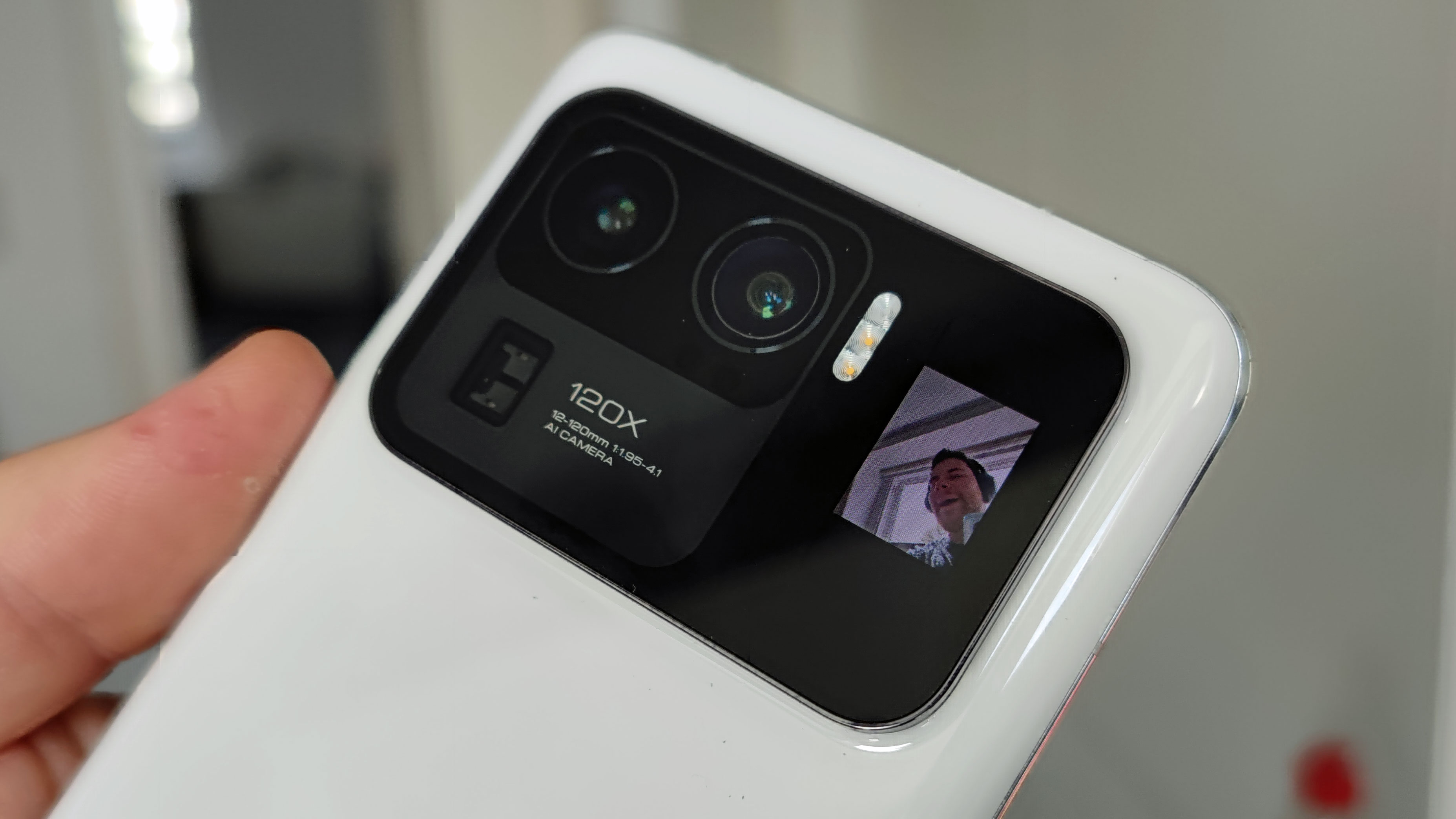
Another change is apparently set to launch with a OneUI 8 update in the future, according to tipster IceUniverse. The update will usher in a new, vivid photo filter profile, but it will also put a border around your snap in a so-called “Chinese-style photo watermark.”

The border makes the snap look kinda like a Polaroid, with a thick bar at the bottom including info like the camera settings, date, and time when the picture was taken, as well as a note saying it was taken on a Samsung Galaxy phone.

This kind of watermark is common on phones from Chinese brands like Xiaomi and OnePlus.

Xiaomi Mi 11 Ultra

(Image credit: Future)

Some people think the extra information is handy; unfortunately, for me, I’m not in that boat. I believe the watermark comes across as a blatant hijacking of my photos for marketing.

So, as a Samsung Z Fold 7 user, I’ll be steering clear of the vivid filter if this update rolls out as expected. I say that because, as with all leaks, we don’t know how the software update will materialize until it launches.

I’ll also hope the other filters aren’t ruined by a watermark, but we’ll have to wait and see what Samsung delivers.

You might also like


from Latest from TechRadar US in News,opinion https://ift.tt/8j3mcPG

Latest Tech News

  • First portable color ePaper monitor offers 13.3-inch screen, wireless connections and stand
  • Bigme B13 provides multiple refresh modes, adjustable lighting and dual audio options
  • Priced at $699, B13 targets early adopters seeking eye-friendly portable productivity

The world’s first portable color ePaper monitor has gone on sale, marking a new step for ePaper beyond e-readers like the Amazon Kindle.

The Bigme B13 is a 13.3-inch device that combines the familiar look of paper with the flexibility of a modern monitor.

Unlike LCD or OLED panels, ePaper is easier on the eyes for long use, making it appealing for work and study. The B13 supports both wired and wireless connections. It can be connected to a laptop, desktop or mobile device using HDMI or USB-C, or it can mirror content wirelessly.

Different user modes

If you require a dual-screen experience, an optional stand allows the monitor to magnetically attach to a laptop, for a compact portable productivity setup.

The stand is adjustable, with a universal backplate designed to fit laptops between 13 and 17 inches. Auto gravity adaptation means the screen rotates automatically when repositioned.

With its 4:3 aspect ratio and 3200x2400 resolution, the monitor is built for reading documents, editing text and browsing the web.

It won't be of interest to people whose work depends on creative projects, advanced data visualization, or tasks requiring color-critical business displays, but professionals handling reports, contracts, and lengthy text documents may find it useful.

Color output is rated at 150PPI while black and white reaches 300PPI. At 660g and just 6mm at its thinnest point, the B13 remains lightweight and highly portable.

Different modes allow you to adjust performance depending on the task. Text mode sharpens words, web mode smooths scrolling, image mode boosts color richness and video mode improves motion handling.

If ghosting occurs, which is a possibility, the refresh button clears the screen instantly. A 30Hz refresh rate helps the panel handle video playback with greater clarity than older ePaper screens.

The B13 includes a front light that can be customized for brightness and warmth, ranging from cool white to warm yellow. This light can also be turned off entirely, depending on your needs.

The monitor has built-in dual speakers and a headphone jack for video calls or casual audio playback without extra equipment.

The Bigme B13 is positioned as an early adopter product and priced at $699 although you can save 15% off the price using coupon code B13SAVE.

You might also like


from Latest from TechRadar US in News,opinion https://ift.tt/7aFTbVe

Sunday, August 17, 2025

Latest Tech News

  • KeyGo 12.8-inch screen offers sharp visuals despite a compressed 1440p layout for multitasking
  • Scissor-switch keys provide a tactile typing experience suitable for serious work or long sessions
  • RGB lighting enhances visibility in low-light conditions while allowing personal customization

Small external screens have steadily become essential for those seeking flexible workflows and improved multitasking capabilities.

Yanko Design's new KeyGo keyboard merges a 12.8-inch touchscreen monitor with a full-size keyboard.

It aims to create a hybrid device that extends the traditional workspace without requiring a full desktop setup.

A screen built for precision

This concept is ambitious, but its practicality is limited by the absence of a built-in battery, meaning users must remain connected to a power source for extended use.

The integrated display delivers a resolution of 1920x720 at 60Hz, which might initially raise eyebrows among those accustomed to conventional 1080p monitors.

However, the design essentially compresses a 1440p screen across a wider layout, producing a pixel density that keeps text sharp and visuals reasonably crisp.

For professionals who rely on portable monitors or a monitor for video editing, this width-oriented resolution provides a usable secondary screen for reference materials, timelines, or notifications, even if it cannot fully replace a main 4K display.

The keyboard uses scissor-switch keys, which offer a responsive typing experience comparable to high-end laptops.

This design minimizes the often-criticized “mushy” feel of cheaper units, enabling fast and accurate typing.

RGB lighting is integrated with three modes, supporting work in dimly lit environments and allowing a degree of personalization.

While the visual flair may appeal to gamers, business users may appreciate the practicality of illuminated keys during extended work sessions.

Connectivity is handled through USB-C, simplifying connections to laptops, tablets, or smartphones across Windows and macOS platforms.

The single-cable solution handles both power and data, which reduces clutter and streamlines setup for mobile professionals.

Despite its thin CNC-machined aluminum build, which gives it a premium feel, the device remains somewhat limited by its dependence on external power.

It also comes with a 180-degree hinge, allowing users to orient the touchscreen above the keys or stand it fully upright as a second monitor.

While the KeyGo revisits ideas reminiscent of Apple’s Touch Bar, it expands the concept into a standalone, multi-touch interface.

Pricing begins at $538, although early backers can purchase the KeyGo for $249, representing a 54% discount.

The product also includes global shipping and a one-year warranty, and the company claims only 23 of 200 units remain.

You might also like


from Latest from TechRadar US in News,opinion https://ift.tt/ZtywG5x

Latest Tech News

  • Lumma Stealer malware hides in a fake Telegram Premium site, launching without user clicks
  • Executable uses cryptor obfuscation to bypass most traditional antivirus scanning techniques entirely
  • Malware connects to real Telegram servers while secretly sending stolen data to hidden domains

A malicious campaign is targeting users through a fraudulent Telegram Premium website, delivering a dangerous variant of the Lumma Stealer malware.

A report from Cyfirma claims the domain telegrampremium[.]app closely mimics the legitimate Telegram Premium brand and hosts a file named start.exe.

This executable, built in C/C++, is automatically downloaded upon visiting the site, requiring no user interaction.

A closer look at the malware delivery

Once executed, it harvests sensitive data, including browser-stored credentials, cryptocurrency wallet details, and system information, increasing risks such as identity theft.

The fake site operates as a drive-by download mechanism, a method where malicious payloads are delivered automatically without explicit consent.

The high entropy of the executable suggests the use of a cryptor for obfuscation, which complicates detection by traditional security suites.

Static analysis shows that the malware imports numerous Windows API functions, enabling it to manipulate files, modify the registry, access the clipboard, execute additional payloads, and evade detection.

The malware also initiates DNS queries via Google’s public DNS server, circumventing internal network controls.

It communicates with both legitimate services like Telegram and Steam Community for possible command-and-control purposes and with algorithmically generated domains to evade domain takedowns.

These techniques allow the malware to maintain communication channels while avoiding detection by firewalls and conventional monitoring tools.

The domain involved is newly registered, with hosting characteristics suggesting it was set up for short-lived, targeted activity.

The malware drops multiple disguised files in the %TEMP% directory, including encrypted payloads masquerading as image files.

Some are later renamed and executed as obfuscated scripts, enabling the malware to clean its traces.

It uses functions like Sleep to delay execution and LoadLibraryExW to stealthily load DLLs, making it more difficult for analysts to detect its presence during initial inspection.

Staying safe from threats of this nature requires a combination of technical measures and user awareness.

How to stay safe

  • Organizations should implement endpoint detection and response solutions capable of identifying suspicious behavior patterns associated with Lumma Stealer
  • Block all access to malicious domains
  • Enforce strict download controls to prevent payload delivery
  • Multi-factor authentication is essential to limit damage if credentials are compromised
  • Regular credential rotation helps reduce the risk of long-term access by attackers
  • Continuous monitoring for suspicious activity allows faster detection and response to potential breaches

You might also like


from Latest from TechRadar US in News,opinion https://ift.tt/pdE3ZXj

Saturday, August 16, 2025

Latest Tech News

  • Floppy disks were officially deemed obsolete in 2010, yet persisted in surprising places for years
  • Polymatt used CNC machining and PET film to craft a functioning magnetic storage disk
  • Iron oxide coating allowed the handmade disk to store and retrieve basic magnetic data

Floppy disks, once a staple of personal and professional computing, have been phased out for over a decade - but while the technology was officially declared obsolete in 2010, some organizations kept using it surprisingly long.

The Japanese government only moved away from the format in 2024, while the German Navy followed suit the same year. In the United States, the last official use of 8-inch floppy disks for nuclear launch coordination ended in 2019, with San Franciso's government also finally cutting ties with floppies in 2024.

Against this backdrop of obsolescence, a YouTuber known as polymatt decided to recreate one from scratch, using modern tools and consumer-grade equipment.

Engineering a working floppy from the ground up

Polymatt began the project by carefully measuring and modeling the disk enclosure and internal components using Shapr3D and MakeraCAM software.

He then cut aluminum parts with a Carvera Air CNC machine, ensuring precise tolerances for the mechanical structure.

For the magnetic disk surface, he laser-cut PET film and coated it with a suspension of iron oxide powder, replicating the material properties needed for magnetic data storage.

After assembling the components, he managed to magnetize the disk and write to it.

While the data handling capabilities were basic, the fact that a functioning magnetic storage medium emerged from raw materials marked a notable technical achievement.

The process was not without difficulties, but persistence and methodical experimentation allowed him to complete the build.

Today, cloud storage services allow vast amounts of data to be accessed from anywhere, without the physical limitations of older media.

SSDs deliver high-speed and durable storage in compact formats, while an external SSD offers portable capacity far exceeding what was once possible with floppy disks.

A single modern SSD can store millions of times more data than the recreated floppy, with speeds that make the older medium seem impractically slow by comparison.

While polymatt’s recreation is unlikely to be used in practical applications, it demonstrates the enduring appeal of hands-on engineering projects.

Building a floppy disk in 2025 serves more as a tribute to a pivotal era in computing than as a viable alternative to current storage methods.

For those who once relied on them, the familiar clunk of a floppy drive reading data is part of a technological heritage that shaped modern computing.

You might also like


from Latest from TechRadar US in News,opinion https://ift.tt/TMcrqys

With Beef at Record-High Prices, I Asked Butchers About the Best Cheap Steak Cuts

High costs don't mean you have to take beef off the table. Here are the best budget cuts, according to experts. from CNET https://ift....