- UKSOL says it's the first in the UK to achieve regulatory compliance for plug-in solar products
- It's ground mount kits with one or two solar panels go on sale on August 27
- That's when solar is legal in the UK, and we can expect more of these kits to be available
UKSOL has announced that it's the first solar company in the UK to achieve regulatory compliance for plug-in solar kits, the first of which will be on sale in just a week.
Those products are the UKSOL Plug-In Solar Pro Compact 460W Ground Mount Kit (consisting of a single solar panel), and the Plug-In Solar Pro Duo 890W Ground Mount Kit (two panels). Both of these go on sale from August 27 in the UK — when plug-in kits become legal in this country — albeit in "limited stocks" to begin with.
A pair of hybrid mount kits — a single panel 515W offering, and a 920W two-panel product — have also been approved, and these should be available in October 2026 (or that's the current plan).
All of these have met the relevant regulatory standards, and are listed as 'compliant' in the ENA (Energy Network Association) Connect Direct plug-in solar device database.
The Plug-In Solar Pro products have been developed specifically for the British market, UKSOL informs us in a press release, and these are all-in-one kits that come with everything you need to be up and running.
With the kits out next week, alongside the UKSOL panel(s) you get an integrated (foldable) ground-mounting frame with a ballast tray, as well as the necessary 800W microinverter plus DC and AC cables. There's a smartphone app for monitoring the system, too.
Pricing for the Pro Compact (single panel) 460W Ground Mount Kit is £849 with VAT and two-man delivery included, with the Pro Duo 890W Ground Mount Kit running to £1,199 (also with VAT and delivery). The RRP at retailers is £699 and £1,089 respectively.
Andrew Moore, the CEO of UKSOL, commented: "We expect plug in solar to become an exciting new consumer category, but there is a real responsibility on manufacturers and retailers to get the introduction right. Consumers should be able to understand who manufactured or supplied their system, what testing has been undertaken, what warranty and technical support sits behind it and whether it meets the requirements for the UK market."
He added: "Price will obviously matter, but solar equipment is a long-term electrical product. Safety, provenance, quality and after-sales support need to matter too."
Analysis: An alternative to full solar is (almost) here
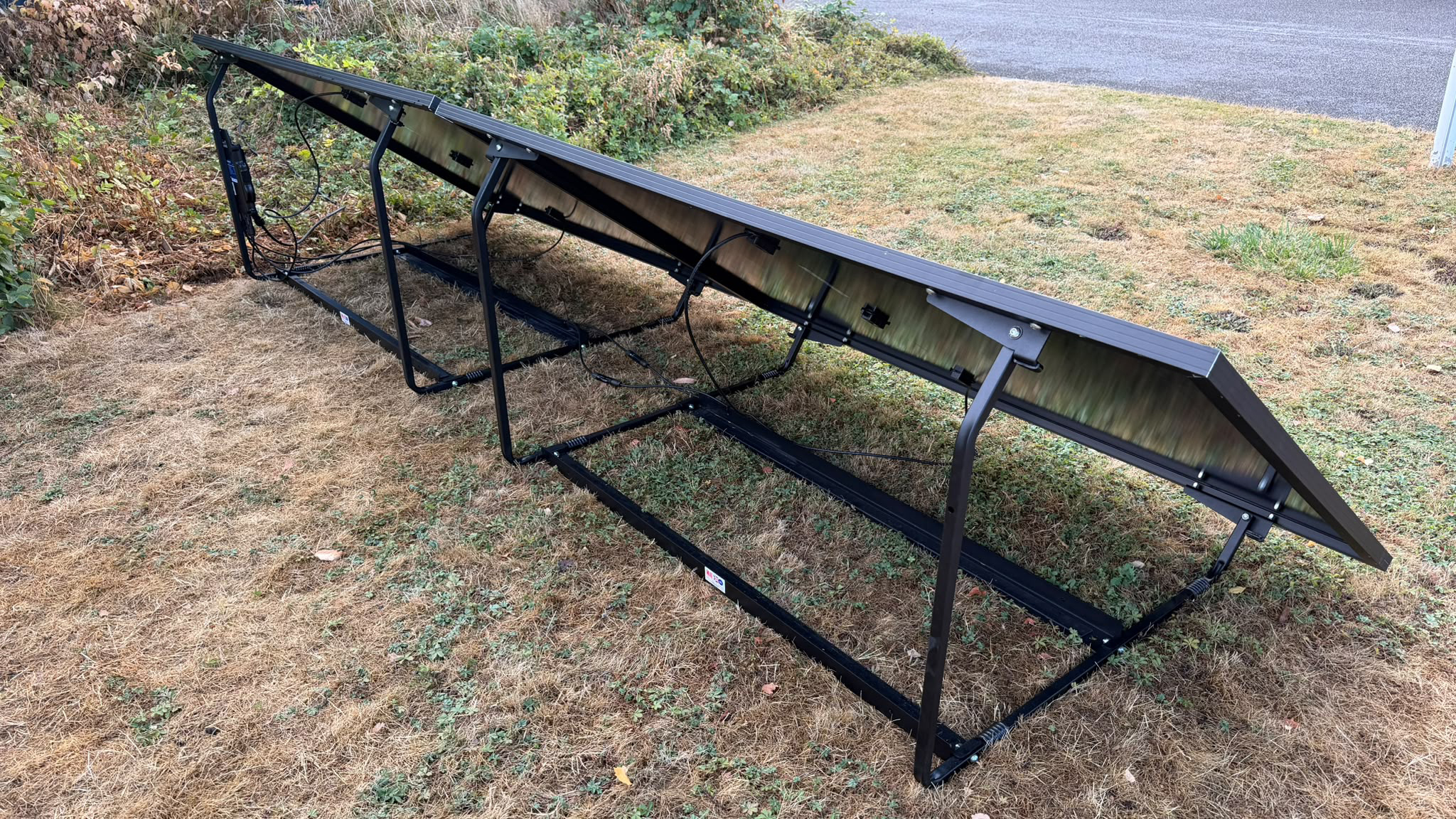
The ground mount kits are, of course, placed on the ground in your garden or other outside area (and weighed down using the ballast tray, to ensure that if it gets windy, you aren't going to end up with overturned panels).
The other option from UKSOL is to buy a hybrid mount kit in October, and these can be situated on the ground, or on a wall (or balcony). They'll arrive in a 515W compact (one panel) variant and an 890W dual panel setup, with other offerings too (up to a 1260W hybrid kit). No pricing is available for those yet.
Kits from other manufacturers should be going on sale soon enough as plug-in solar becomes legal on August 27, when UKSOL's first ground mount offerings become available. Manufacturers must ensure compliance with UK regulations, of course, as UKSOL has done, with the likes of Asda, Currys, B&Q, Wickes, and Screwfix potentially stocking these solutions.
Plug-in panels offer a good alternative as a scaled-down version of a full roof-mounted solar setup, as not every house can have the latter — flats certainly can't, and some roofs just aren't suitable. Plug-in solar is the obvious choice if you're renting, and don't own the property, too — and they're a lot less of a financial commitment than a full roof installation.
A typical payback period for plug-in (when the electricity saved roughly equals the cost of the panels) is three to five years, according to the experts, which is way quicker than a typical full solar install.
Note that there are certain requirements in terms of the rules for the location of plug-in solar panels — you can't put them on wooden balconies for example (due to the fire risk), and the same goes for fences.
from Latest from TechRadar https://ift.tt/zBTAMXI


No comments:
Post a Comment