Tuesday, August 26, 2025

Latest Tech News

  • Google has rolled out a Messages feature in beta that lets you use QR codes to verify the device of the person you're texting
  • It's Google Messages' new security measure, which is designed to prevent impersonation scams
  • Google revealed last year that it would be rolled out to users in 2025

It seems as though a new security measure is on the way to Google Messages, as the company has begun rolling out a new QR code feature in the latest beta, which verifies the device of the person you’re chatting with.

First spotted by 9to5Google, Google’s new verification tool in Messages aims to prevent impersonation scams. Before, you could verify contacts by tapping ‘Verify encryption’, presenting an 80-digit code that you can share with the other person to verify your device and vice versa.

While Google Messages has always had a verification feature, its new QR code approach provides a more convenient way to prove the identity of the person you’re texting with. In that case, if someone were to break into a conversation pretending to be a contact, Google can check if their device is verified and alert you if it’s suspicious of odd activity.

The outlet also states that Google will be bringing it to Android 9+ devices this year, but where can you find it in the beta?
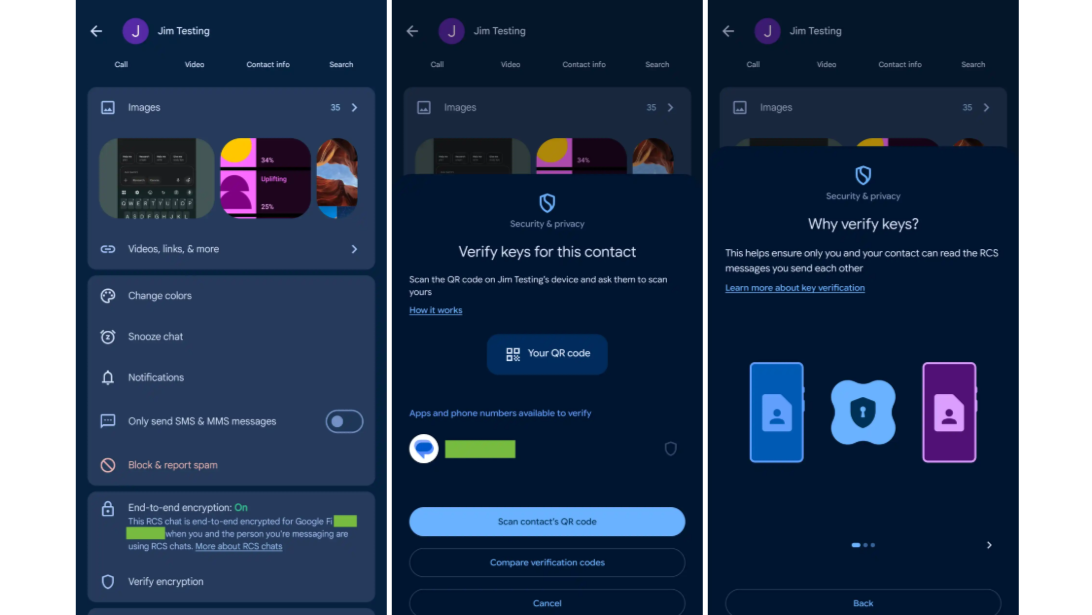
Three screenshots showing how to access the QR verifying tool in Google Messages

(Image credit: 9to5Google)

If you have access, open the Google Messages app and click into a conversation. When you tap the contact’s name, it will open the Details page, which displays the ‘End-to-end encryption’ section – and you’ll want to tap ‘Verify encryption’.

In addition to the existing 80-digit code option, there’ll also be an option to scan your contact’s QR code. Messages will also prompt you to ask the other person to scan your QR code in return, allowing Google to verify each device. To view the verification status, you can view them in the ‘Connected apps’ section of your device’s Contacts app; however, this integration hasn’t gone live yet, according to 9to5Google.

Recently, the company has been working around the clock to give its Messages service much-needed upgrades – like its new ‘Delete for everyone’ function – and now it’s doubling down on its security measures.

In October last year, Google unveiled plans to improve spam protection in Messages, following the addition of an unsubscribe button to prevent unwanted spam messages and a sensitive content warning tool, both of which rolled out in April. We’d expect the QR function to arrive before the end of the year, but an exact date hasn’t been revealed yet.

You might also like


from Latest from TechRadar US in News,opinion https://ift.tt/TxwhaM9

Monday, August 25, 2025

Waymo Gets the Green Light to Test in New York City. Everything to Know About the Robotaxi

The company has been granted a permit to test its self-driving vehicles in the Big Apple. Here's everywhere Waymo operates now, and where it's set to arrive soon.

from CNET https://ift.tt/3G2kTUz

Sunday, August 24, 2025

Today's Wordle Hints, Answer and Help for Aug. 25, #1528

Here are hints and the answer for today's Wordle for Aug. 25, No. 1,528.

from CNET https://ift.tt/tfmiszg

Latest Tech News

  • State-backed rivals have made open source 3D printing nearly impossible
  • Chinese subsidies shift global competition in desktop 3D printer production
  • Cheap Chinese patents create obstacles far beyond Europe’s market borders

The open source movement in 3D printing once thrived on shared designs, community projects, and collaboration across borders.

However, Josef Prusa, head of Prusa Research, has announced, “open hardware desktop 3D printing is dead.”

The remark stands out because his company long championed open designs, sharing files and innovations with the wider community.

Economic support and patent challenges

Prusa built his early business in a small basement in Prague, packing frames into pizza boxes while relying on contributions from others who shared his philosophy.

What has changed, he now argues, is not consumer demand but the imbalance created when the Chinese government labeled 3D printing a “strategic industry” in 2020.

In his blog post, Prusa cites a study from the Rhodium Group which describes how China backs its firms with grants, subsidies, and easier credit.

This makes it much cheaper to manufacture machines there than in Europe or North America.

The issue grows more complicated when looking at patents. In China, registering a claim costs as little as $125, while challenging one ranges from $12,000 to $75,000.

This gap has encouraged a surge of local filings, often on designs that trace back to open source projects.

Prusa’s earlier machines, such as the Original i3, proudly displayed components from partners like E3D and Noctua, embodying a spirit of community, but were also easy to copy, with entire guides appearing online just months after release.

The newest Prusa printers, including the MK4 and Core ONE, now restrict access to key electronic designs, even while offering STL files for printed parts.

The Nextruder system is fully proprietary, marking a clear retreat from total openness.

Prusa argues Chinese firms are effectively locking down technology the community meant to share - as while a patent in China does not block his company from selling in Europe, it prevents access to the Chinese market.

A bigger risk emerges when agencies like the US Patent Office treat such patents as “prior art,” creating hurdles that are expensive and time-consuming to clear.

Prusa cited the case of the Chinese company, Anycubic, securing a US patent on a multicolor hub that appears similar to the MMU system his company first released in 2016.

Years earlier, Bambu Lab introduced its A1 series, also drawing inspiration from the same concept.

Anycubic now sells the Kobra 3 Combo with this feature, raising questions about how agencies award patents and who holds legitimate claims.

Meanwhile, Bambu Lab faces separate legal battles with Stratasys, the American pioneer whose patents once kept 3D printing confined to costly industrial use.

Declaring the end of open hardware may be dramatic, but the pressures are real.

Between state subsidies, permissive patent rules, and rising disputes, the foundation of open collaboration is eroding.

Via Toms Hardware

You might also like


from Latest from TechRadar US in News,opinion https://ift.tt/Rt1YSpL

Latest Tech News

  • Data centers in England use far less water than many expected
  • TechUK survey shows nearly two-thirds of facilities consume modest water amounts
  • Closed-loop cooling systems reduce dependence on traditional water-intensive methods

The world's expanding network of data centers has often been linked with heavy environmental costs, especially when it comes to water.

These facilities form the base for cloud services, LLM training, and the many AI tools now embedded across industries.

However a new survey by techUK, conducted with the UK Environment Agency, has claimed data centers are “not intensive water users” as many people think.

Very few sites with industry-level water usage

The report found nearly two-thirds (64%) of commercial sites in England consume less than 10,000 cubic meters of water per year.

This level of demand is described as lower than that of a “typical leisure center” and similar to the water requirements of a Premier League football club.

Only 4% of facilities reported usage over 100,000 cubic meters annually, a figure associated more with industrial production.

Cooling has long been considered the driver of data center water consumption, although the industry is now moving toward alternatives such as waterless and closed-loop systems.

More than half of the facilities surveyed already rely on waterless cooling, while many others use direct-to-chip techniques that recycle water within sealed systems.

In fact, 89% of operators said they no longer track consumption because their systems use “no water beyond the regular functioning of any building.”

While the report stresses operators are “actively innovating” to cut demand, skepticism remains.

Questions also remain over whether reported figures capture the full lifecycle of water use, including indirect impacts from energy generation.

TechUK argues that data centers are vital for the UK economy, contributing billions in annual value and enabling ambitions in AI and digital innovation.

The trade body is calling for stronger planning frameworks, including a proposed “water exploitation index” to track local stress levels.

“I am encouraged by the work techUK has undertaken to better understand water usage, and the findings suggest UK data centers are using a range of cooling technologies and becoming more water conscious,” said Richard Thompson, Deputy Director for Water Resources at the Environment Agency.

“It is vital the sector puts sustainability at its heart, and minimizes water use in line with evolving standards."

You might also like


from Latest from TechRadar US in News,opinion https://ift.tt/wvcOHX6

Saturday, August 23, 2025

Latest Tech News

  • Geekom mini PC combines AMD Ryzen AI 9 processor with Radeon 890M graphics
  • Ships with 32GB RAM, 2TB SSD, expandable to 128GB RAM and 8TB storage
  • Wide port selection includes USB4, HDMI 2.1, and support for four 8K monitors

Geekom has launched the A9 Max, a compact desktop usually priced at $1,199 but currently available for $999.

The PC combines AMD’s latest Ryzen AI 9 HX370 processor with Radeon 890M graphics, 32GB of DDR5 memory, a 2TB PCIe Gen4 SSD, and support for up to four 8K monitors.

The HX370, based on AMD’s Zen 5 architecture, is built on TSMC’s 4nm FinFET process and features 12 cores and 24 threads, a maximum boost clock of 5.1GHz, and 24MB of L3 cache, with a configurable TDP of up to 54W.

Plenty of ports

It integrates a dedicated AI engine capable of 80 TOPS, making the A9 Max well suited for on-device AI acceleration in workflows such as content creation and professional applications that benefit from local processing power.

The Radeon 890M integrated GPU is based on RDNA 3.5 and offers performance typically beyond what most mini PCs have provided in the past.

It comes with 32GB of dual-channel DDR5 RAM (expandable up to 128GB) and a 2TB PCIe Gen4 SSD. Two PCIe 4.0 slots allow storage expansion up to 8TB.

As you'd expect from a modern mini PC, the A9 Max offers a good selection of ports. On the front panel, there’s a 3.5mm headphone jack, three USB 3.2 Gen 2 Type-A ports, and one USB 3.2 Gen 2 Type-A that remains powered even when the system is off.

The rear panel includes two HDMI 2.1 ports, two USB4 Type-C ports with DisplayPort Alt-mode and power delivery, another USB 3.2 Gen 2 Type-A, and one USB 2.0 Type-A.

It also includes dual 2.5Gbps RJ45 Ethernet ports, Wi-Fi 7 and Bluetooth 5.4, as well as an SD card reader and a Kensington lock.

The chassis is built from metal, keeping the form factor small while maintaining durability. Geekom says it can endure up to 200kg of pressure without bending.

The IceBlast 2.0 Cooling System with a large copper heatsink, dual heat pipes, and high- performance fan, should keep things cool even when under load or during prolonged use.

Compact systems like the A9 Max show how mini PCs are now powerful enough to replace traditional desktops for many users.

They save space, reduce clutter, and still provide the memory, storage, and processing power needed for both professional and everyday work.

A9 Max comes with Windows 11 Pro installed, a three-year warranty, and 24/7 support. It is available to buy from Geekom’s site and Amazon now.

Geekom A9 Max mini PC

(Image credit: Geekom)

You might also like


from Latest from TechRadar US in News,opinion https://ift.tt/bhxqgGY

The 12 Best Foods to Eat for Eye Health

A nutrient-rich diet plays a bigger role in your vision than you might think.

from CNET https://ift.tt/hVdOMIp

Friday, August 22, 2025

Have You Ever Seen a Black Moon? Neither Have We, but One Is Coming This Weekend

You've no doubt heard of supermoons, blue moons, mini moons and blood moons, but have you ever heard of a black moon?

from CNET https://ift.tt/bUki491

Latest Tech News

  • GPD Win 5 is an unusual gaming handheld and ultra mobile workstation hybrid
  • It's powered by AMD's Ryzen AI Max+ 395 APU with 16 cores and Radeon 8060S
  • Compact 565g device includes 7-inch 120Hz touchscreen and dual-fan cooling system

GPD has unveiled the Win 5, a handheld PC that straddles the line between portable gaming console and mobile workstation.

With its compact form factor, the device is powered by AMD’s powerful Ryzen AI Max+ 395 APU (Strix Halo), a processor that so far has mostly appeared in mini PCs and only a handful of laptops, including HP’s ZBook Ultra 14 G1a, Asus’s ROG Flow Z13 and Emdoor’s EM-959-NM16ASH-1.

While the Win 5 looks good and packs a lot of power, its expected price tag - around $2000 - will put it firmly in enthusiast territory.

Dual-fan cooling

The Ryzen AI Max+ 395 is built on TSMC’s 4nm process and features 16 Zen 5 CPU cores and 32 threads, clocking up to 5.1GHz. There’s a Radeon 8060S GPU with 40 compute units running at 2.9GHz.

The chip also offers AI acceleration, with 16 TOPS from its NPU and 38 TOPS combined with CPU performance.

To keep that hardware under control, the Win 5 uses a dual-fan cooling system, which delivers consistent thermal management even under heavy loads, which would otherwise be a concern for a device this small.

The handheld supports up to 128GB of LPDDR5X RAM at 8000MHz and NVMe PCIe 4.0 SSD storage options ranging from 1TB to 4TB.

Storage can be swapped from the rear panel, and microSD plus mini SSD expansion slots are included.

The display is a 7-inch H-IPS touchscreen at 1920x1080 resolution with a 120Hz refresh rate and FreeSync Premium support.

Wireless connectivity includes WiFi 6E and Bluetooth 5.3. Ports include two USB-C (one at USB 3.2 speeds and another at USB 4 with support for external GPUs), a 3.5mm audio jack, and card slots.

Despite its undoubted power, the device weighs just 565 grams and measures 267 x 111mm, making it smaller than a Steam Deck.

The 80Wh battery supports fast charging up to 180W.

The Win 5 looks like a standard handheld games system, with dual analog sticks, a D-Pad, triggers, and action buttons, but includes extras like a fingerprint reader.

GPD Win 5 mobile workstation PC will be available to buy globally from October 17 2025.

More from TechRadar Pro


from Latest from TechRadar US in News,opinion https://ift.tt/rtJz0IK

Thursday, August 21, 2025

Latest Tech News

  • Blackview Active 12 Pro rugged tablet has a built-in projector and 108MP camera
  • Tablet includes detachable kickstand, plus 400 lumen LED camping light on rear
  • Tablet’s huge 30,000mAh battery supports extended use in the field

Blackview has launched the Active 12 Pro, a rugged Android tablet which combines an 11-inch screen with unusual extras, including a built-in projector, camping light, and a 108-megapixel camera sensor.

PCWatch reviewed the device, and called it one of the boldest tablets Blackview has ever produced.

The Active 12 Pro runs Android 15 on a MediaTek Dimensity 7300 processor with up to 16GB of RAM and 1TB of storage.

Big battery

We’ve seen a good number of rugged tablets with integrated projectors in recent years, including the 8849 TANK Pad, and the one in this tablet is capable of displaying a full HD image up to 120 inches.

With 200 lumens of brightness, autofocus, and keystone correction, it’s designed for entertainment and small presentations.

The tablet has a huge 30,000mAh battery, which in PCWatch’s testing supported extended video playback without rapid drain. Unlike many portable projectors, the image remained bright and usable in a dimly lit room.

The rugged tablet is IP68 and IP69K rated for water and dust resistance and meets MIL-STD-810H standards for durability.

At over 1.5kg it is far heavier than most 11-inch devices, but the tradeoff is a chassis that can withstand drops, pressure, and temperature extremes.

A detachable kickstand and optional straps give it flexibility for outdoor or field use.

The display itself is a 1920x1200 IPS panel with a 90Hz refresh rate. Alongside the 108-megapixel Samsung rear camera, a 50-megapixel front camera is included for video calls and photography.

The rear is also home to a large LED camping light with up to 400 lumens of brightness, further adding to the Active 12 Pro’s outdoor credentials.

In PCWatch’s performance benchmarks, the tablet handled demanding mobile games at medium settings without slowdown, aided by advanced cooling with heat pipes and a built-in fan.

Despite its slightly unusual design, the device delivered a credible mix of performance and versatility.

Pricing for the Active 12 Pro starts at around $768 for the 12GB/256GB model or $826 for the 16GB/1TB version on AliExpress, with discounts available.

While it is perhaps not aimed at casual users, the Active 12 Pro shows how rugged tablets are evolving into multi-purpose devices.

You may also like


from Latest from TechRadar US in News,opinion https://ift.tt/d7XqSjm

Wednesday, August 20, 2025

Microsoft's AI Leader Is Begging You to Stop Treating AI Like Humans

Mustafa Suleyman argues against thinking about AI as a kind of human-adjacent consciousness.

from CNET https://ift.tt/n28qgcz

Latest Tech News

  • AI queries worldwide pile pressure directly onto the American electricity grid
  • Utilities pass grid upgrade costs onto households while data centers stall
  • Electricity demand projections show data centers tripling U.S. consumption by 2028

The accelerating demand for computing power has pushed artificial intelligence into the center of the US energy debate.

Data centers used to support cloud services, streaming platforms, and online storage already consume large amounts of electricity, but the rise of AI tools has magnified those needs.

According to federal projections, the share of national electricity use from data centers could rise from 4% in 2023 to 12% by 2028.

AI’s energy appetite intensifies demand

Since running an AI writer or hosting an LLM is more energy-intensive than typical web activity, the growth curve is steep.

This expansion is not only changing the relationship between technology firms and utilities, but it is also reshaping how electricity costs are distributed across society.

Electricity prices in the US have already climbed more than 30% since 2020, and a Carnegie Mellon–North Carolina State study warns of another 8% nationwide rise by 2030.

In states such as Virginia, the increase could reach 25%. Utilities argue that grid upgrades are essential, but the concern is who will pay for them.

This is only the beginning, because when a French person asks ChatGPT when the next strike is planned, Americans pay more for electricity.

How? When anyone anywhere in the world asks ChatGPT an everyday question, the extra energy consumed by that query is absorbed into U.S. grid demand.

This is because the ChatGPT system runs on US-based servers, hosted in American data centers and powered by the US electricity grid.

If technology firms secure large capacity allocations and delay projects, households and small businesses may be left paying for unused infrastructure.

The case of Unicorn Interests in Virginia, where a delayed facility left nearby customers covering millions in upgrade expenses, underscores this risk.

To counter such problems, American Electric Power in Ohio proposed a rate plan requiring data centers to pay for 85% of the requested capacity regardless of actual use.

The state’s regulators approved the measure despite opposition from cloud service providers, who offered a 75% minimum instead.

Some companies have sought to bypass traditional utilities by generating their own power.

Amazon, Microsoft, Google, and Meta already operate renewable installations, gas turbines, and diesel backup generators, and some are planning nuclear facilities.

These companies not only produce electricity for their own operations but also sell surplus energy into wholesale markets, creating competition with traditional suppliers.

In recent years, such sales have generated billions, giving major cloud providers influence over both supply and price in certain regions.

The volatile consumption patterns of AI training, which can swing sharply between peaks and lows, pose another challenge.

Even a 10% shift in demand can destabilize networks, forcing utilities to intervene with dummy workloads.

With households already paying more each month in some states, the concern is that consumers will end up covering the cost of keeping LLM hosting and AI writer systems online.

Via Toms Hardware

You might also like


from Latest from TechRadar US in News,opinion https://ift.tt/RCm4B5a

Latest Tech News

Emily in Paris season 5 is returning to Netflix on December 18, 2025, and if you ask me, I’m shocked that it’s coming back so soon. It’s been less than a year since we saw the second half of season 4, with the upcoming 10 episodes in season 5 turned around in lightning speed (well, at least according to the streaming service’s track record). As creator Darren Star told them: “This season is a Tale of Two Cities: Rome and Paris. Straddling both, Emily takes love and life to the next level,” which sort of doesn’t answer any questions we currently have.

When we left off, Emily (Lily Collins) was getting ready to leave the French capital behind for good, taking a job as the head of Agence Grateau Rome while simultaneously falling in love with the dashing Marcello (Eugenio Franceschini). Logically, season 5 should be Emily in Rome, but “a big secret threatens one of her closest relationships,” drawing her back. Emily is set to suffer heartbreak, work problems and career setbacks, so just another typical day in her life.

But for fans of cozy dramas on Netflix, there’s a problem here that you might not have noticed. It’s great that we’re getting Emily in Paris season 5 so quickly (not to mention the fact that it’s dropping all in one go), but this means Virgin River season 7 definitely won’t be released at the same time. Most likely, we’re looking at a 2026 release for the latter, and that’s a much longer wait than we’ve had to put up with for years.

Emily in Paris season 5 takes December release date away from Virgin River season 7

How do I know this? The answer is in Virgin River's track record. Netflix's longest-running original series has been released in December for the last two years, essentially making the show synonymous with the winter season. With an early season 8 renewal now locked in, we also know season 7 has wrapped filming. Logistically, another December release would have been a shoo in, but Netflix would never release two of its best-performing dramas in the genre at the same time Why compete with yourself if you don't have to?

I think Emily in Paris season 5 is most likely going first simply because it was ready earlier. Much like Virgin River season 8, Emily in Paris season 5 was renewed before season 4 had finished being released, with Italian promo shots for the announcement ready to go by the time we all found out. Given the cast and crew were already on location in Italy, I wouldn't be surprised if a chunk of the new season was filmed back-to-back with season 4 episodes, to make best use of time and budget.

However it happened, it's a huge win for Emily in Paris fans. I'm desperate to catch up with how she's settling into her new life in Rome, and I really hope she's staying with Marcello rather than ending up with Gabriel (Lucas Bravo) for the millionth time. I've got a horrible feeling that I'm not going to get what I want, but a girl can dream.

You might also like


from Latest from TechRadar US in News,opinion https://ift.tt/XAxtD1Z

Tuesday, August 19, 2025

Latest Tech News

  • Draft messages are much easier to find in iOS 26
  • Leaked code also suggests iOS 26 will bring a huge security boost
  • Apple is apparently testing end-to-end encryption for RCS messages

How many times have you started to write a text in iOS’s Messages app and then left it for later, only to forget who you were messaging and what you were saying a few hours down the line?

It’s a common occurrence, but iOS 26 includes a new feature that will make it much easier to find those unfinished texts – and it’s almost shocking Apple hasn’t implemented it sooner.

If you’re running the iOS 26 public beta, you’ll now be able to filter your texts by draft status. All you need to do is open the messages app, tap the hamburger menu in the top-right corner, then select Drafts under the Filter By header. Your Messages inbox will now show only draft texts and nothing else, saving you a bunch of time tapping into all your existing threads in a vain attempt to find the elusive draft.

There are filters for other situations, too. If you’ve scheduled messages for another time, you’ll see a Send Later filter, for example, while there’s an Unread filter for any message you haven’t gotten around to reading yet.

Note that these filters only show up if there is a relevant message to filter. If you don’t have any drafts, for example, you won’t see the Drafts filter. And these filters work regardless of whether you’re using Apple’s iPhone-to-iPhone iMessage standard or RCS/SMS messages sent to Android devices. Blue bubbles or green bubbles, it works.

Stronger security

Text Messaging

(Image credit: Shutterstock)

Speaking of RCS messages, iOS 26 might include a significant security boost when it comes to sending texts between an iPhone and an Android device, and it could address a flaw that’s gone unaddressed for too long.

According to Apple code reportedly discovered by Android Authority, iOS 26 will implement end-to-end encryption when sending messages using the RCS protocol between iOS and Android. Although you can currently send RCS messages between these two platforms (something that Apple finally brought about in iOS 18), the standard is not end-to-end encrypted. While iMessage has featured this security technology for years, the GSM Association (GSMA) – which implements and updates RCS – has taken a while to add this toughened-up encryption.

That changed in March of 2025, when the GSMA said end-to-end encryption would be added to RCS. And although Apple has previously outlined that end-to-end encryption would be coming to RCS on the iPhone in “future software updates,” it didn’t set a date for the change.

Yet Android Authority says it’s seen code that includes the string “GisRCSEncryptionEnabled,” which suggests that RCS encryption is undergoing internal testing at Apple. Further code snippets also include the string “mls-rcs-server,” which could imply Apple is assessing the MLS encryption that Google has added to Google Messages.

Despite the promising signs, there’s no guarantee that iOS 26 will implement RCS encryption. Apple took a long time to implement RCS in the first place – partly due to its weaker security compared to iMessage – and it might simply be testing its updated functionality. But the fact that these strings are present in iOS 26 code gives us hope that RCS encryption could be on the way, making cross-platform texting safer for iOS and Android users alike.

You might also like


from Latest from TechRadar US in News,opinion https://ift.tt/R6XBKZ2

Monday, August 18, 2025

Want to Be a Better Griller? Professional Chefs Say 'Do Less'

I asked food professionals and career chefs about the biggest grilling mistakes amateur cooks make at home.

from CNET https://ift.tt/HrA4tnT

Today's Wordle Hints, Answer and Help for May 10, #1786

Here are hints and the answer for today's Wordle for May 10, No. 1,786. from CNET https://ift.tt/FztnkY5