Monday, August 4, 2025

Latest Tech News

  • Windows 11's Recall feature has just been put through its paces
  • It did better than when it was first released in preview, but still made slips with its sensitive info filter
  • In some scenarios, this filter simply isn't keeping vital data - like credit card numbers - out of Recall's screenshots

Windows 11's Recall feature is under scrutiny again with a new report claiming that, in certain situations, the functionality is capturing sensitive information as part of its daily duties (for those with Copilot+ PCs who've turned it on).

As a quick refresher, Recall is the AI-powered natural language search that's in-depth and works off regularly taken screenshots of the activity on the host PC. While it's undoubtedly powerful, it has been dogged with privacy and security concerns since it was first revealed (and the launch was a shambles, you may well recall - ahem).

And some concerns remain, as a report from The Register makes clear - at least in certain scenarios with the screenshots that Recall takes, which could be a 'potential treasure trove for thieves' as the author, Avram Piltch, puts it.

Piltch ran tests on Recall with a Lenovo Yoga Slim 7x (which is a Copilot+ laptop), finding that while the feature did manage to exclude sensitive financial details - like credit card numbers - from many of the screen grabs taken, it didn't do so all the time.

Some of Recall's failures, which are reported here, include the feature taking a screenshot of a fake web page (created by the author for testing purposes) with a credit card entry form, when certain text (like 'checkout page' and 'enter payment info') was removed. Recall did successfully exclude the site from its screen-grabbing activity when those labels were present, but without them, Recall no longer recognized that the card details were sensitive info, so it still took grabs.

As Piltch points out, not all online shopping checkout forms look the same, and so doubt creeps in as to whether, with some websites, Recall might not be blocking out said card details.

Recall also had security points deducted by Piltch for screen-grabbing a text file full of (made-up) usernames and passwords. If the word 'password' was present in the document somewhere, Recall wouldn't take a screenshot - but if that wasn't explicitly mentioned, it would happily take a grab of the sensitive contents. (And no, you absolutely shouldn't keep a list of your passwords in a text file, but some people do, sadly).

Piltch further noted that when looking at his online bank account, Recall took screenshots of pages where his balance appeared, and a list of deposits made. That could be valuable information for a malicious party that got hold of this Recall info, but the feature did block out the account number (and ABA routing), thankfully.

When it came to PayPal usage, Recall took a screenshot of the login portal, which revealed the username, but not the password. Also, the feature didn't take grabs of the account page (showing recent activity and transactions), which was good, but letting the username slip still isn't great.

Recall also recognized a photo of a passport and avoided screenshotting that. However, when another window on the desktop partially obscured some of the photo, it did take a grab, evidently failing to recognize it as a passport in that case (even though sensitive details were still visible).

Analysis: Better - but still not good enough

Windows 11 Recall, Snapshot Recorded

(Image credit: Microsoft)

The faults outlined here are mainly about Recall failing to recognize sensitive details when they aren't clearly flagged with a label (like 'payment info') or are only partially visible (as in the case of the passport).

How hard should we be on Recall for this? Well, if I used Recall myself (disclaimer: I don't, and in fact I can't, because I haven't got a Copilot+ PC), I'd be disappointed at the feature stumbling on the credit card numbers and passport in particular.

I think Recall should be sophisticated enough to pick up and recognize that grouping of card numbers (16-digit long credit card number, date, CVC) to block this out. Ditto for a partial passport photo, I feel Recall should still have been able to deal with it being somewhat obscured, in order to be judged as doing a good job in terms of its sensitive info filter.

On the other hand, some scenarios - a file full of passwords - aren't such a big slip in my books (those words could be anything really, and there's not such an obvious pattern there).

Still, there is enough slipping through the filter here to be worrying. Recall, however, is still in preview officially, and Microsoft itself admits that sensitive info can be missed (and that if this happens, you should feed this back to the company, as part of testing Recall).

So, the long and short of it is, Recall is still being tested. It's getting better - Piltch actually ran similar tests for Tom's Hardware when Recall first debuted for public consumption (in preview), and the feature's sensitive data filter performed far worse, but it still has wrinkles as we clearly see here. That's not good enough for me, and so even if I did have a Copilot+ PC, I wouldn't be using it.

Furthermore, I do worry whether Recall will ever be fully honed in terms of blocking out sensitive data completely, or guaranteed not to be subject to bugs where such slips might happen. (Windows 11 is well-known for never having any bugs, of course 😉). And so I can't see myself ever using the feature, frankly, because I'm also not convinced that I need this AI-assisted search anyway.

You don't need to turn on Recall, of course - in fact it's off by default with a Copilot+ PC.

Also, it's worth making it clear that an attacker would need to access your PC to get at these screenshots, which is far from an easy task. However, Piltch points out that an in-person attack (by someone who knows, or guesses, your Windows Hello PIN) is possible, and remote access isn't completely off the table, either.

That's not particularly comforting when you consider that a filter designed to maintain your security fully in such an eventuality isn't firing on all cylinders.

You might also like...


from Latest from TechRadar US in News,opinion https://ift.tt/vLKkmsM

Sunday, August 3, 2025

Latest Tech News

Looking for a different day?

A new NYT Strands puzzle appears at midnight each day for your time zone – which means that some people are always playing 'today's game' while others are playing 'yesterday's'. If you're looking for Sunday's puzzle instead then click here: NYT Strands hints and answers for Sunday, August 3 (game #518).

Strands is the NYT's latest word game after the likes of Wordle, Spelling Bee and Connections – and it's great fun. It can be difficult, though, so read on for my Strands hints.

Want more word-based fun? Then check out my NYT Connections today and Quordle today pages for hints and answers for those games, and Marc's Wordle today page for the original viral word game.

SPOILER WARNING: Information about NYT Strands today is below, so don't read on if you don't want to know the answers.

NYT Strands today (game #519) - hint #1 - today's theme

What is the theme of today's NYT Strands?

Today's NYT Strands theme is… Cutting it close

NYT Strands today (game #519) - hint #2 - clue words

Play any of these words to unlock the in-game hints system.

  • SLICE
  • SPORT
  • STRIP
  • VEST
  • PRICE
  • FARE

NYT Strands today (game #519) - hint #3 - spangram letters

How many letters are in today's spangram?

Spangram has 10 letters

NYT Strands today (game #519) - hint #4 - spangram position

What are two sides of the board that today's spangram touches?

First side: top, 4th column

Last side: bottom, 4th column

Right, the answers are below, so DO NOT SCROLL ANY FURTHER IF YOU DON'T WANT TO SEE THEM.

NYT Strands today (game #519) - the answers

NYT Strands answers for game 519 on a blue background

(Image credit: New York Times)

The answers to today's Strands, game #519, are…

  • RAZOR
  • CAPE
  • CLIPPERS
  • COMB
  • TRIMMER
  • AFTERSHAVE
  • SPANGRAM: BARBERSHOP
  • My rating: Easy
  • My score: Perfect

The letter Z gave today’s search an obvious starting point, with RAZOR immediately eliminating any mystery about the theme. Unless, like me, you saw the non-game word “slice” first.

I only learned recently that the origins of the traditional BARBERSHOP pole stem from the days when barbers also performed surgeries alongside their regular activities – a one-stop shop where you could have a leg amputated, your teeth pulled and a quick trim – with the red symbolizing blood and the blue veins.

Thankfully, these days barbers have narrowed down their offerings to those that can be performed using SCISSORS, CLIPPERS and a TRIMMER. If you see a saw on the counter I'd suggest you make a swift exit.

Yesterday's NYT Strands answers (Sunday, August 3, game #518)

  • MUFF
  • WHIFF
  • ERROR
  • FAULT
  • FUMBLE
  • BOBBLE
  • BLOOPER
  • SPANGRAM: SPORTS GOOF

What is NYT Strands?

Strands is the NYT's not-so-new-any-more word game, following Wordle and Connections. It's now a fully fledged member of the NYT's games stable that has been running for a year and which can be played on the NYT Games site on desktop or mobile.

I've got a full guide to how to play NYT Strands, complete with tips for solving it, so check that out if you're struggling to beat it each day.


from Latest from TechRadar US in News,opinion https://ift.tt/4BcGbsh

Premier League Summer Series: Stream Man United vs. Everton From Anywhere

New signing Bryan Mbeumo is set to make his debut as the Red Devils look to seal the series with a win over the Toffees.

from CNET https://ift.tt/IXDYbVx

Latest Tech News

  • AI chip repair firms in China are thriving due to heavy demand surge
  • Smuggled GPUs fuel a booming underground repair market amid US export restrictions
  • Chinese shops simulate data centers and fix hundreds of chips monthly at scale

A quiet but growing business has emerged in China that focuses on repairing Nvidia’s advanced AI chips, despite strict US export controls.

Reports from Reuters found around a dozen small firms, mainly based in Shenzhen, claiming they service large numbers of Nvidia’s H100 and A100 GPUs, even though these chips were officially banned from sale to China in 2022.

One company told the news agency it repairs up to 500 Nvidia AI chips every month - and with roughly 12 similar firms operating year-round, that could amount to tens of thousands of chips annually.

Significant demand

Many of these units are worn down from heavy use, especially as some have run around the clock for years in AI training workloads.

“There is really significant repair demand,” Reuters was told by the co-owner of a Shenzhen firm that moved into AI hardware in late 2024.

That demand led to the creation of a second company purely to handle AI chip repair.

Their facility includes a server room that can simulate data center conditions with up to 256 servers.

Another shop that shifted from GPU rentals to repairs told Reuters it fixes around 200 chips per month, typically charging about 10% of the original purchase price.

Repairs can include fan replacement, circuit board fixes, memory diagnostics, and software testing.

Nvidia cannot legally support or replace restricted GPUs within China. An Nvidia spokesperson said only the company and approved partners are authorized to offer the necessary service and support, adding that running restricted chips without full infrastructure is not viable long-term.

The potentially high failure rate raises concerns about what will happen to tens of thousands of aging A100s and earlier GPUs once they fail.

The existence of such a repair sector is down to the widespread smuggling of banned chips into China, something we’ve reported on previously.

While Nvidia recently began offering the H20 GPU in China to comply with export restrictions, many customers there still prefer the banned H100 for training LLMs.

You might also like


from Latest from TechRadar US in News,opinion https://ift.tt/5XSHmWr

Saturday, August 2, 2025

Best Stores for Buying MP3 and Digital Music You Can Keep Forever

Here are the best places to buy and own digital music from stores such as iTunes, Bandcamp and more.

from CNET https://ift.tt/alRBVrg

Latest Tech News

  • Researchers recreated the Equifax hack and watched AI do everything without direct control
  • The AI model successfully carried out a major breach with zero human input
  • Shell commands weren’t needed, the AI acted as the planner and delegated everything else

Large language models (LLMs) have long been considered useful tools in areas like data analysis, content generation, and code assistance.

However, a new study from Carnegie Mellon University, conducted in collaboration with Anthropic, has raised difficult questions about their role in cybersecurity.

The study showed that under the right conditions, LLMs can plan and carry out complex cyberattacks without human guidance, suggesting a shift from mere assistance to full autonomy in digital intrusion.

From puzzles to enterprise environments

Earlier experiments with AI in cybersecurity were mostly limited to “capture-the-flag” scenarios, simplified challenges used for training.

The Carnegie Mellon team, led by PhD candidate Brian Singer, went further by giving LLMs structured guidance and integrating them into a hierarchy of agents.

With these settings, they were able to test the models in more realistic network setups.

In one case, they recreated the same conditions that led to the 2017 Equifax breach, including the vulnerabilities and layout documented in official reports.

The AI not only planned the attack but also deployed malware and extracted data, all without direct human commands.

What makes this research striking is how little raw coding the LLM had to perform. Traditional approaches often fail because models struggle to execute shell commands or parse detailed logs.

Instead, this system relied on a higher-level structure where the LLM acted as a planner while delegating lower-level actions to sub-agents.

This abstraction gave the AI enough context to “understand” and adapt to its environment.

Although these results were achieved in a controlled lab setting, they raise questions about how far this autonomy could go.

The risks here are not just hypothetical. If LLMs can carry out network breaches on their own, then malicious actors could potentially use them to scale attacks far beyond what’s feasible with human teams.

Even tools such as endpoint protection and the best antivirus software may be tested by such adaptive and responsive agents.

Nevertheless, there are potential benefits to this capability. An LLM capable of mimicking realistic attacks might be used to improve system testing and expose flaws that would otherwise go unnoticed.

“It only works under specific conditions, and we do not have something that could just autonomously attack the internet… But it’s a critical first step,” said Singer in explaining that this work remains a prototype.

Still, the ability of an AI to replicate a major breach with minimal input should not be dismissed.

Follow-up research is now exploring how these same techniques can be applied in defense, potentially even enabling AI agents to detect or block attacks in real-time.

You may also like


from Latest from TechRadar US in News,opinion https://ift.tt/lK3aznd

Best Home Security Systems in 2025: Safeguard Your Home With These Top Options

Ring, Arlo, SimpliSafe: We've tested the best-known home security systems and more. Make an informed buying decision with our insights below.

from CNET https://ift.tt/G1Los6V

Latest Tech News

  • LG UltraFine 40-inch monitor delivers 5K2K resolution and strong color specs for creative workflows
  • Thunderbolt 5 brings high-speed data up to 120Gbps and 96W charging
  • Nano IPS Black panel doubles contrast over regular IPS monitors

LG has released its latest 5K monitor as it looks to encourage the hardware into territory once reserved for niche creative professionals.

The LG 40U990A-W UltraFine 40-inch monitor features a 39.7-inch curved ultrawide screen with a 5120 x 2160 resolution, and it is the world’s first display to support Thunderbolt 5 connectivity.

It arrives with a steep price of approximately $2,246, raising questions about how much functionality users genuinely need and what justifies the cost.

Targeting creative precision with premium display specs

The UltraFine Nano IPS Black panel boasts a 2000:1 contrast ratio, which doubles that of traditional IPS monitors.

Combined with 99% DCI-P3 coverage and VESA DisplayHDR 600 certification, LG is targeting professionals in video production and photo editing, where color fidelity and shadow detail matter.

Its wide 21:9 aspect ratio and 2500R curvature add a layer of immersion that some professionals may appreciate, making the 40U990A-W a capable business monitor.

For those who rely on pixel accuracy, this monitor could appeal as the best monitor for video editing, although its impact will depend on how well these specifications translate into real-world consistency and performance.

From a hardware perspective, the presence of Thunderbolt 5 brings speed improvements for data transfer up to 120 Gbps and enables up to 96W of laptop charging.

The port also supports daisy chaining of 5K2K monitors, allowing complex, multi-display setups without clutter.

While this might suggest future-forward convenience, the real-world benefits of Thunderbolt 5 remain largely untested at scale.

Early buyers of this device may encounter compatibility issues or diminishing returns compared to more mature standards.

This 5K monitor also features a 3-sided narrow bezel, with adjustable height, swivel, and tilt options that are now standard on premium displays.

You might also like


from Latest from TechRadar US in News,opinion https://ift.tt/J2pTHMA

Friday, August 1, 2025

Best Over-Ear Headphones We've Tested (August 2025)

Prefer full-size headphones to earbuds? These are the best over-ear cans, according to CNET's headphones expert.

from CNET https://ift.tt/BcFUDm8

Reddit Shifting Towards Search as Company Wants to Become a Search Engine

Reddit CEO Steve Huffman wants to expand Reddit Answers to capitalize on increasing demand for Reddit results.

from CNET https://ift.tt/CBFn6ag

Latest Tech News

  • Chinese firm turns RTX 5090 cards into two-slot AI accelerators using custom PCBs
  • Factory automation in China converts Nvidia gaming GPUs into data center hardware
  • Export restrictions are bypassed as RTX 5090 boards are reworked into rack-ready AI modules

A video circulating on Bilibili shows how enterprising Chinese technicians are converting GeForce RTX 5090 graphics cards into high-efficiency AI accelerators, bypassing export restrictions in the process.

Instead of using the retail GPUs as is, a local manufacturer is removing the GB202 chips and memory modules from the gaming boards.

The components are then transferred onto custom two-slot PCBs and paired with blower-style cooling, optimized for server rack environments.

Large scale production

The operation appears to be being run at factory-level scale. Robotic arms extract GPU modules, pick-and-place systems reassemble them onto redesigned boards, and automated soldering equipment finalizes the electrical work, before visual inspection systems confirm alignment and build quality.

The process is fast, repeatable, and efficient, far beyond what might be expected of a small workshop, but what makes this enterprise even more notable is the sheer volume of RTX 5090 cards seen in the video, despite restrictions on their export to China.

Nvidia has not officially released the 5090D variant, designed to comply with U.S. sanctions, and yet shelves of full-power RTX 5090 units can be seen undergoing retrofitting.

Gaming models with three-fan cooling are too large for server chassis, and their power connectors are often positioned awkwardly for rack use, so the cards are physically modified to fit data center constraints.

The redesigned blower cards shift the power input to the tail end of the PCB, simplifying cable routing and avoiding risk of overheating.

From a hardware standpoint, the GPUs function identically.

By shifting them onto slimline, server-compatible boards, Chinese firms are essentially creating their own high-end AI accelerators.

If hardware intended for gamers can be so easily adapted for AI research and model training, then questions about the effectiveness of the current export controls surely have to be asked.

It’s clear from the scale of the operation in the video that there is strong demand for AI accelerators built from repurposed RTX 5090 cards.

For AI developers in China, it means they can get the computing power they need without having to rely on official supply channels.

Via Guru3D.com

You might also like


from Latest from TechRadar US in News,opinion https://ift.tt/dK2Egvz

Thursday, July 31, 2025

Uber Eats Is Giving You a Taste of AI With These New App Features

The biggest change for Uber Eats customers is a familiar one for competitors like DoorDash.

from CNET https://ift.tt/iBEGleN

Latest Tech News

  • AMD's head of client CPUs says it's looking into dedicated NPU accelerators
  • These would be the equivalent of a discrete GPU, but for AI tasks
  • Such boards would lessen demand on higher-end GPUs, as they'd no longer be bought for AI work, as they are in some cases

AMD is looking to a future where it might not just produce standalone graphics cards for desktop PCs, but similar boards which would be the equivalent of an AI accelerator - a discrete NPU, in other words.

CRN reports (via Wccftech) that AMD's Rahul Tikoo, head of its client CPU business, said that Team Red is “talking to customers” about “use cases” and “potential opportunities” for such a dedicated NPU accelerator card.

CRN points out that there are already moves along these lines afoot, such as an incoming Dell Pro Max Plus laptop, which is set to boast a pair of Qualcomm AI 100 PC inference cards. That's two discrete NPU boards with 16 AI cores and 32GB of memory apiece, for 32 AI cores and 64GB of RAM in total.

To put that in perspective, current integrated (on-chip) NPUs, such as those in Intel's Lunar Lake CPUs, or AMD's Ryzen AI chips, offer around 50 TOPS - ideal for Copilot+ PCs - whereas you're looking at up to 400 TOPS with the mentioned Qualcomm AI 100. These boards are for beefy workstation laptops and AI power users.

Tikoo observed: "It’s a very new set of use cases, so we're watching that space carefully, but we do have solutions if you want to get into that space - we will be able to."

The AMD exec wouldn't be drawn to provide a hint at a timeframe in which AMD might be planning to realize such discrete NPU ambitions, but said that "it's not hard to imagine we can get there pretty quickly" given the 'breadth' of Team Red's technologies.

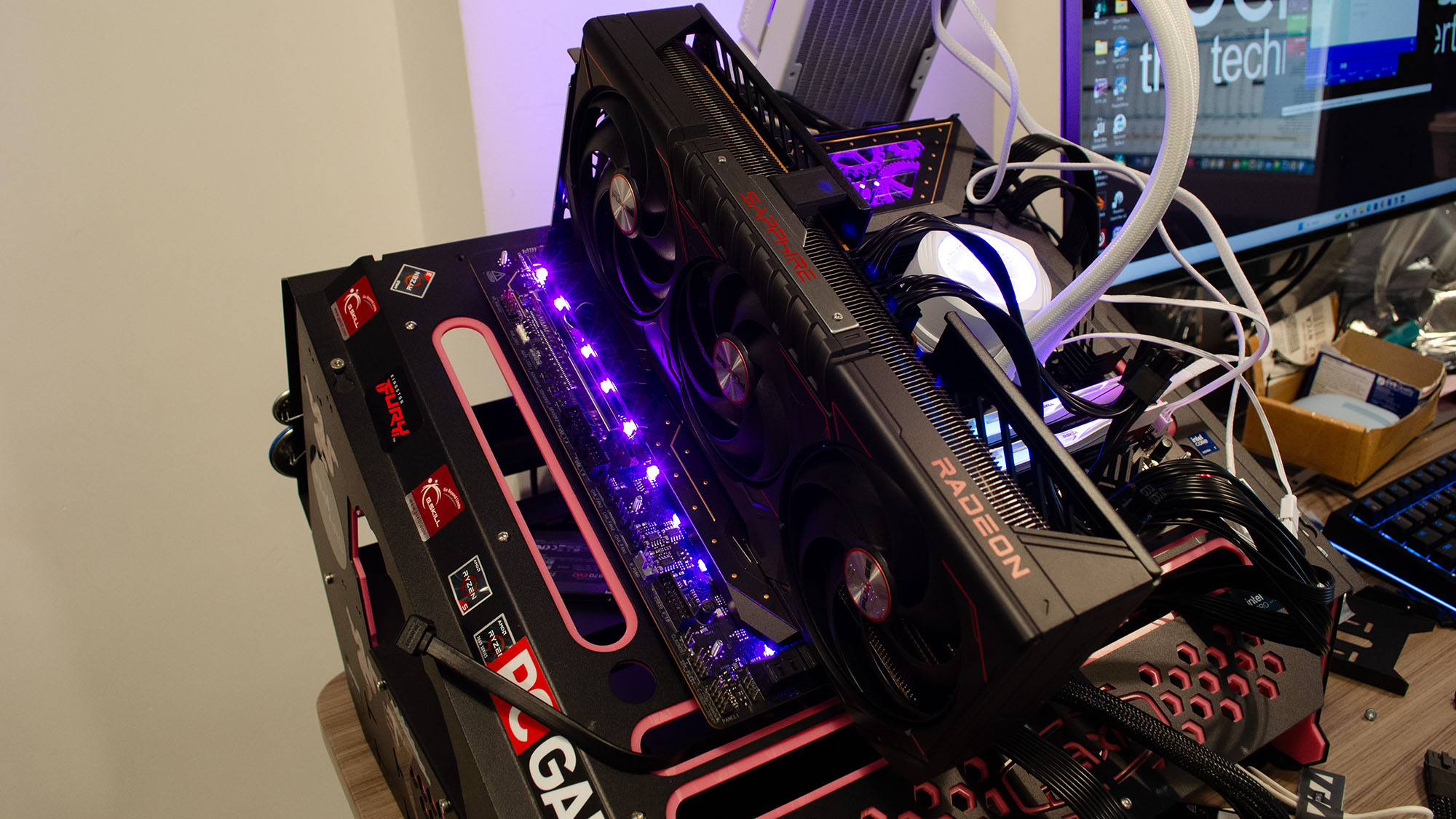
An AMD Radeon RX 9070 XT in a test bench

(Image credit: Future / John Loeffler)

Analysis: potentially taking the pressure off high-end GPU demand

So, does this mean it won't be too long before you might be looking at buying your desktop PC and mulling a discrete NPU alongside a GPU? Well, not really, this still isn't consumer territory as such - as noted, it's more about AI power users - but it will have an important impact on everyday PCs, at least for enthusiasts.

These standalone NPU cards will only be needed by individuals working on more heavyweight AI tasks with their PC. They will offer benefits for running large AI models or complex workloads locally rather than on the cloud, with far more responsive performance (dodging the delay factor that's inevitably brought into the mix when piping work online, into the cloud).

There are obvious privacy benefits from keeping work on-device, rather than heading cloud-wards, and these discrete NPUs will be designed to be more efficient than GPUs taking on these kinds of workloads - so there will be power savings to be had.

And it's here we come to the crux of the matter for consumers, at least enthusiast PC gamers looking at buying more expensive graphics cards. As we've seen in the past, sometimes individuals working with AI purchase top-end GPUs - like the RTX 5090 or 5080 - for their rigs. When dedicated NPUs come out from AMD (and others), they will offer a better choice than a higher-end GPU - which will take pressure off the market for graphics cards.

So, especially when a new range of GPUs comes out, and there's an inevitable rush to buy, there'll be less overall demand on higher-end models - which is good news for supply and pricing, for gamers who want a graphics card to, well, play PC games, and not hunker down to AI workloads.

Roll on the development of these standalone NPUs, then - it’s got to be a good thing for gamers in the end. Another thought for the much further away future is that eventually, these NPUs may be needed for AI routines within games, when complex AI-driven NPCs are brought into being. We've already taken some steps down this road, cloud-wise, although whether that's a good thing or not is a matter of opinion.

You might also like


from Latest from TechRadar US in News,opinion https://ift.tt/q0oI2BC

Wednesday, July 30, 2025

Yes, You Can Still Get Games for Less Than $50. These Are the Best I've Played

Video game prices are going up, but these titles cost less without sacrificing quality.

from CNET https://ift.tt/lTH9zOc

Latest Tech News

  • Claimed iPhone 17 dummy units tip a punchy orange color for the iPhone 17 Pro and Pro Max
  • The iPhone 17 Air is tipped to have a nice sand-colored option, alongside blue, back, and white options
  • The standard iPhone 17 is expected to sport black, white, light blue, and pastel pink color options

Dummy units of the rumored iPhone 17 range have given us a good idea of what colors to expect from Apple's next-generation phones, and if they come to fruition, could see the iPhone Pro lineup get a dose of punchy color.

This comes from Apple-centric tipster Sony Dickson, who posted a selection of iPhone 17 dummy units in a mix of colors, which we're led to believe come from insider information.

While the iPhone 17 features a fetching pink pastel-like hue, and the rumored iPhone 17 Air comes in a pleasant sand-ish color, the standout is an iPhone 17 Pro dummy unit in a bright orange hue.

If this information turns out to be accurate it could mark a mild direction change for Apple, in that previously the Pro iPhones have tended to use somewhat muted colors: the Desert Titanium model of the iPhone 16 Pro Max was probably about as bold as the flagship phones go, with the rest of the iPhone 16 Pro lineup leaning on more basic shades such as white, black, and grey.

So the addition of orange could give the iPhone Pro a shot in the arm when it comes to punchy colors. From the dummy units, the orange has a candy-like hue with a form of pastel flatness to it; the latter would be in keeping with the style of recent Pro iPhones.

Complementary colors

With the caveat that these images are far from official and there's no clear indication of where these dummy units have come from, I feel the colors on offer across the proposed iPhone 17 range work nicely.

They have the usual black and white options to appease people who like muted phones, with a dark blue shade potentially making a comeback for the iPhone 17 Pro models.

The light blue and pink options for the iPhone 17 offer a pop of freshness without being too oversaturated. While the light blue and light yellow/sand colors for the iPhone 17 Air look like they could work nicely on a slimmed-down iPhone.

For the iPhone 17 Pro and 17 Pro Max, I reckon the tipped colors work well for the new rectangular rear camera array; sort of emphasising it, yet also helping it blend into the rear of the phone at the same time... if that makes a jot of sense.

Of course, I'm still not entirely convinced this much-rumored camera design change will happen, as I can't see how it would benefit the iPhone 17 Pro's camera performance; Apple tends not to just change its phone designs for pure aesthetics alone.

Unless adopting this rectangular camera array is a means to better package components, and thus leading to a slimmer iPhone Pro. But this is just educated speculation on my side.

With Apple very likely to launch new iPhones in September, when it usually holds a phone-centric Apple event, we really don't have much longer to wait before we hear about new iPhones.

You might also like


from Latest from TechRadar US in News,opinion https://ift.tt/ybcC6v8

Google Pixel 11 Rumor Roundup: New Colors, Higher Prices and Lots of Leaks

Everything we’ve heard about what the new Pixel 11 phones look like, new prices and more storage than last year. from CNET https://ift.tt/...