Thursday, January 30, 2025

Latest Tech News


  • Following $500 billion Project Stargate launch, Meta is also dolling out the dollars
  • Meta's $65 billion is lower than Microsoft's $80 billion commitment
  • AWS is set to spend more than $75 billion while Google has yet to say how much it will spend

If you have a few hundred billion dollars burning a hole in your pocket, you’re probably considering spending it on an AI data center or two. US President Donald Trump recently announced OpenAI, SoftBank, and Oracle would launch a new AI infrastructure venture called Project Stargate, investing $500 billion over four years across the US. OpenAI noted that $100 billion would be made available “immediately.”

Elon Musk, no stranger to building AI data centers and perhaps a bit miffed about being left out, claimed that Project Stargate doesn’t actually have the money, stating, “SoftBank has well under $10 billion secured.”

While that was unfolding, Meta CEO Mark Zuckerberg made an announcement on Facebook, revealing the company is “building a 2GW+ data center so large it would cover a significant part of Manhattan,” while also outlining other AI plans.

A defining year for AI

Zuckerberg's full post reads: “This will be a defining year for AI. In 2025, I expect Meta AI will be the leading assistant, serving more than 1 billion people. Llama 4 will become the leading state-of-the-art model, and we’ll build an AI engineer that will start contributing increasing amounts of code to our R&D efforts. To power this, Meta is building a 2GW+ data center so large it would cover a significant part of Manhattan. We’ll bring online ~1GW of compute in '25 and end the year with more than 1.3 million GPUs. We’re planning to invest $60-65 billion in capex this year while also growing our AI teams significantly, and we have the capital to continue investing in the years ahead. This is a massive effort, and over the coming years, it will drive our core products and business, unlock historic innovation, and extend American technology leadership. Let’s go build!”

$65 billion on capital expenses certainly isn’t nothing, but it pales in comparison to the $80 billion Microsoft plans to invest in fiscal 2025 or the $75 billion-plus AWS intends to spend this year. We don't know how much Google will be pumping into AI infrastructure, but it's going to be a similar figure.

That said, Meta's investment is higher than most would have expected. Reuters points out: “The $60 billion to $65 billion capital spending outlined for 2025 would mark a significant jump from the company's estimated expenditure of $38 billion to $40 billion last year. It is also above analysts' estimates of $50.25 billion for 2025, according to LSEG data.”

You might also like


from Latest from TechRadar US in News,opinion https://ift.tt/0apkCl4

Wednesday, January 29, 2025

NordVPN Launches NordWhisper Protocol Designed to Bypass VPN Blocks

NordVPN’s newly launched NordWhisper VPN protocol aims to bypass VPN restrictions by mimicking traditional web traffic.

from CNET https://ift.tt/8B9yPO1

Latest Tech News


  • Wine 10 is now out with more than 6,000 updates on its release log
  • The emulator - which turns 32 this year - allows Linux/Unix users to run Windows software
  • Open source project doesn't require Windows unlike virtual machine solutions

If you want to run Windows software on a Linux OS, you'll need to install the Wine compatibility layer. Wine, a recursive acronym for "Wine Is Not an Emulator," provides a runtime environment for running Windows applications natively on Linux without virtualization. It can also be configured as the default installer for Windows software, simplifying the setup process.

First released on July 4, 1993, Wine was created by Bob Amstadt (the project’s original lead) and Eric Youngdale as an open source implementation of the Windows API for Unix-based systems. Over the past 32 years, it has evolved into a powerful tool for bridging the gap between Windows and Linux environments and after a year of development, the developers behind it have announced the stable release of Wine 10.

This new version includes over 6,000 individual changes. While many are minor fixes, there are some notable highlights, including full support for the ARM64EC architecture and hybrid ARM64X modules, allowing seamless integration of ARM64EC and plain ARM64 code.

OpenGL support

High-DPI support has been improved in this release, with automatic scaling for non-DPI aware applications. Vulkan enhancements now support child window rendering and Vulkan Video extensions.

Direct3D updates include a new HLSL-based fixed function pipeline, Vulkan shader backend improvements, and dynamic state extensions to reduce stuttering. And, in a welcome move, OpenGL is now supported within the Wayland driver, which is enabled by default. This addition will allow for better integration with Wayland-based Linux environments.

Other changes include an experimental FFmpeg-based multimedia backend, improved HID and touchscreen input handling, enhanced Unicode and locale compatibility, and solid RPC/COM support on ARM platforms.

A number of other tweaks have been made too, such as process elevation, improved serial port event handling, and support for modern vector extensions like AVX-512. Developers also benefit from updated build tools, static analysis options, and bundled library upgrades like Capstone, Vkd3d 1.14, and FFmpeg.

You might also like


from Latest from TechRadar US in News,opinion https://ift.tt/kUGA5D8

Tuesday, January 28, 2025

Best Website Builder for 2025

A website builder is a great tool for building your personal brand in 2025. These are the best ones, regardless of your experience level.

from CNET https://ift.tt/Jo2V1gC

Latest Tech News


  • AI company has released a design of a keyboard dock for smartphones
  • With a beige color scheme and a pseudo-mechanical keyboard, it has a strong 1980s feel to it
  • It is expected to cost less than $250 and will appeal to those looking for a Psion 5MX replacement

Amber.Page, an AI startup for writers, has teased a new keyboard case that transforms an iPhone into a portable, laptop-like writing device.

Shared by company founder Justin Mitchell on Threads, the renders of what he’s calling the AmberDeck show a clamshell-style design reminiscent of retro tech, like a mini Tandy TRS-80 Model 100 or the Psion 5MX. The latter had a similar design with what was widely considered one of the best keyboards ever made for a device of its size.

The device offers a minimalist setup for drafting articles, editing text, and even tackling writer’s block with the support of the startup’s AI-powered writing assistant.

Mitchell wrote, “Been cooking on some hardware for Amber over the holiday break. Always wanted a clamshell iPhone keyboard for focused writing on the go, so I made one.”

The case isn’t intended as a permanent enclosure for your phone; rather, it serves as a docking station, turning your device into a focused typing tool with a high-travel pseudo-mechanical keyboard that features a compact 60% layout. Yanko Design says when docked, you won’t be able to use your phone for usual tasks such as accessing the camera or making calls, but if you're focused on writing that will be a good thing.

A work in progress

Mitchell wrote, “Been cooking on some hardware for Amber over the holiday break. Always wanted a clamshell iPhone keyboard for focused writing on the go, so I made one.”

The case isn’t intended as a permanent enclosure for your phone; rather, it serves as a docking station, turning your device into a focused typing tool with a high-travel pseudo-mechanical keyboard that features a compact 60% layout. Yanko Design says when docked, you won’t be able to use your phone for usual tasks such as accessing the camera or making calls, but if you're focused on writing that will be a good thing.

The clamshell case includes an adjustable hinge for screen positioning and a charging port for the keyboard itself. Yanko Design notes the case doesn’t appear to support pass-through charging for the phone, and the keyboard lacks backlighting, which will limit its usability in low-light settings. That said, this is still only a prototype, so things could change.

Indeed, in another thread, Mitchell has updated the design based on feedback and suggestions from his social media followers, including changes made to improve functionality and compatibility. In the updated design, the hinge is centered and features a dual-action mechanism, allowing the case to lay completely flat thanks to an internal gap inside the top shell.

The arrow keys have been reconfigured to a standard layout, with the shift key moved to the right and enlarged for a more intuitive typing experience. A gap has been added around the faceplate, making it easy to pop off and customize or swap as needed. To accommodate a wider range of devices, including Android phones, the inset on the inside has been squared off for better versatility. Additionally, the lip of the case has been moved to the top.

Mitchell has suggested the AmberDeck could sell for under $250, and while these early renders are just a preview, the case could potentially appeal to writers, journalists, and editors looking to turn their phones into compact writing devices that can be used anywhere.

You might also like


from Latest from TechRadar US in News,opinion https://ift.tt/jOhkb3U

Monday, January 27, 2025

Tax Season 2025 Opens Today: Our Essential Cheat Sheet for Filing Your Tax Return

Taxes are no-doubt confusing, but this handy guide can help you finish your taxes and get your refund from the IRS.

from CNET https://ift.tt/NHxUGD1

Latest Tech News


  • Biodegradable battery invented by scientists in Switzerland
  • Fungi, which is the building block of mushrooms, is the core material used
  • The fungi-powered battery generates enough electricity to power sensors

Fungi have fascinated scientists for decades - centuries, probably. There are roughly 200,000 known species across the planet, they are more closely related to animals than plants, the largest organism in the world is a fungus, and some can glow in the dark. If you’ve watched or played The Last of Us, you’ll know the parasitic Cordyceps fungus infects its host by colonizing and consuming its body (admittedly, in the real world, it takes over insects and won’t be invading humans any time soon).

Through a three-year project supported by the Gebert Rüf Stiftung’s Microbials funding program, researchers at Empa (Swiss Federal Laboratories for Materials Science and Technology) have found a novel use for fungi - as they’ve developed a 3D-printed, biodegradable fuel cell that requires feeding rather than charging.

Although the fungal battery (technically it’s a microbial fuel cell rather than a battery per se) produces only modest amounts of electricity, Empa says it can sustain devices such as temperature sensors for several days.

3D printed battery

Microbial fuel cells work by harnessing the metabolism of living organisms to produce electricity. In the past, this was done with bacteria. Empa’s breakthrough combines two fungi species: a yeast fungus on the anode side, which releases electrons, and a white rot fungus on the cathode side, which produces an enzyme that captures and conducts these electrons.

"For the first time, we have combined two types of fungi to create a functioning fuel cell," Empa researcher Carolina Reyes explains.

Rather than adding fungi to a pre-assembled battery, researchers integrated fungal cells into the 3D-printed battery structure itself. Electrodes were carefully designed to provide nutrients to the fungi while remaining biodegradable and conductive.

Traditional battery disposal poses environmental challenges, as many contain toxic materials that can contaminate soil and water if not properly managed. Empa’s living batteries don't have that problem as they cleverly self-digest - by consuming the cellulose-based ink the fungal cells are embedded in - once their purpose is fulfilled.

For the main nutrient source, the researchers add simple sugars to the battery cells. "You can store the fungal batteries in a dried state and activate them on location by simply adding water and nutrients," says Reyes.

Although it’s a promising idea, the project faces challenges due to the complexity of working with living materials, blending microbiology, materials science, and electrical engineering. Empa plans to experiment with different forms of fungi going forward in the hope of finding combinations that will make the fungal battery more powerful and longer-lasting.

You might also like


from Latest from TechRadar US in News,opinion https://ift.tt/dxcthOf

Sunday, January 26, 2025

Best Antivirus Software for 2025

Keep yourself safe from phishing attacks, hackers and malware with the best antivirus software. Here are CNET's top picks for web protection, malware detection and more.

from CNET https://ift.tt/jYpER0G

Latest Tech News


  • TeamGroup T-Create Expert SDXC card is the second SD card to hit 2TB
  • Launch comes months after the firm also revealed a 2TB microSD card
  • T-Create Expert V90 can reach read/write speeds of up to 300MBps/260MBps

A few months ago, SanDisk quietly launched a new 2TB Extreme Pro SD memory card, able to store over 2,800 minutes of 4K UHD video and offering read speeds of up to 250MB/s and write speeds of up to 150MB/s.

Now, TeamGroup has announced a 2TB version of its T-Create Expert SDXC UHS-II U3 V90 card. Designed for creatives and professionals - photographers and videographers in particular - and offering features to ensure reliable performance in challenging environments, it seriously outpaces SanDisk's 2TB card.

TeamGroup says users can expect read speeds of up to 300MB/s and write speeds of up to 260MB/s.

Free data recovery

The memory card is V90 certified, so you can enjoy smooth high-resolution capture of 8K, 4K Ultra-HD, 3D, and RAW files, making it a solid choice for professional equipment, including cinema cameras, full-frame cameras, mirrorless cameras, and DSLRs.

Singling out the Canon EOS C400 cinema-grade digital camera, TeamGroup says that its card can record in the highest 6K, 59.94P format for up to two hours and eight minutes at a maximum video bit rate of 2,190Mbps.

In addition to its large capacity and high speeds, the card is durable and well-suited for use in extreme conditions. IP67-rated for dust and water resistance, TeamGroup says that the T-Create Expert SDXC UHS-II U3 V90 has been tested against shock, vibration, X-rays, and extreme temperatures.

The company includes a free data recovery service for the card during the warranty period, providing additional peace of mind for creators who can't afford to lose important content.

Although this is TeamGroup’s first 2TB SD card, the company previously launched a 2TB microSDXC model, which we reviewed in June 2024. That card offers read speeds of 170MB/s and write speeds of up to 160MB/s, and has a V30 rating.

Pricing and availability for the 2TB T-Create Expert SDXC UHS-II U3 V90 have yet to be announced, but we should know more soon. In the meantime, keep an eye on the TeamGroup site.

More from TechRadar Pro


from Latest from TechRadar US in News,opinion https://ift.tt/4ob5khz

Saturday, January 25, 2025

Best Internet Providers in Sioux Falls, South Dakota

High-speed internet is widely available in Sioux Falls, but some providers are pricier than others. CNET’s team compiled the best options for your needs.

from CNET https://ift.tt/Gef42kJ

Latest Tech News

As expected, OpenAI has released its first autonomous AI agent, called Operator this week. Operator can act independently from you on your computer using a web browser doing pretty much anything that can be done in a web browser.

So, it can perform tasks like booking a restaurant table or buying groceries. You just tell it what you want it to do, and off it goes like a faithful Internet-enabled butler that potters away until the task is complete or it needs to come back to you with a question. Say, there’s no table available at 7.00pm, would Sir or Madam mind a 7.45pm table instead?

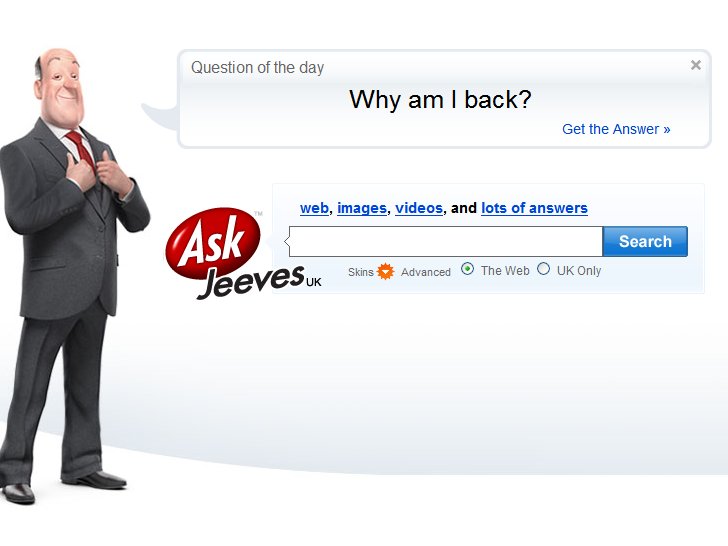
Of course, Operator doesn’t call you Sir or Madam, but it might as well. For all intents and purposes, this is the Internet butler that we were promised almost 30 years ago when Ask Jeeves was around.

Do you remember Ask Jeeves? It was a search engine from 1997 that had an image of an actual butler who stood ready and willing to find things for you online. The character was named after Jeeves, Bertie Wooster's valet in the fictional works of P. G. Wodehouse. Instead of typing in search terms, Ask Jeeves encouraged you to search for things using natural language questions, like “Find me the perfect accompaniment to a roast dinner.”

Of course, we all know that Google won the search engine war, and in 2006, Ask dropped the Jeeves persona and just became Ask.com. But somehow, we’ve come full circle with AI, and thanks to technologies like ChatGPT search and Perplexity, searching using natural language requests is back in fashion. As our Internet butlers, except now we call them AI agents...

Ask Jeeves search engine.

The Ask Jeeves search engine.

AGI is the real goal

It’s no secret that Sam Altman and OpenAI are really interested in AGI, artificial general intelligence, also often referred to as superintelligence. This is the ultimate goal for OpenAI, and why it was founded. Chatbots like ChatGPT might have taken the world by storm, but their popularity is almost like an unintended consequence (a theme I’ll return to later) of the race toward AGI.

In a video to promote the release of Operator, one of the OpenAI employees sitting next to Sam Altman comes right out and says, [Operator is] "about removing one more bottleneck in our path to AGI.”

While agents are clearly exciting, they’re not the destination for OpenAI; they’re just one more step along the path. AGI has the potential to change our world radically. Once we have created an artificial intelligence that’s smarter than we are, logically it should be able to construct even smarter versions of itself, and the level of intelligence rises rapidly.

We’ve just got to hope that it doesn’t decide to wipe us out. Not to worry you, but Geoffory Hinton, often referred to as the ‘Godfather of AI,’ recently upped his odds of technology wiping out humanity to 20%.

OpenAI's Operator on OpenTable example from live demo

OpenAI's Operator in action. (Image credit: OpenAI)

And this is where we return to the theme of unintended consequences. Many experts see AI agents as a threat. While speaking at the World Economic Forum in Davos this week, artificial intelligence pioneer Yoshua Bengio warned that AI agents could be catastrophic for humanity.

Speaking to Business Insider, he said, "All of the catastrophic scenarios with AGI or superintelligence happen if we have agents." Bengio would rather we continue towards building AGI without using agents, which allows them to do things autonomously. "All of the AI for science and medicine, all the things people care about, is not agentic," Bengio said. "And we can continue building more powerful systems that are non-agentic."

Humanity's downfall

So, could it really be that something designed to act like an Internet butler and do menial tasks like help me buy my groceries accidentally gives AI the power to take over the world?

For now, it’s hard to imagine how an automated program that slowly plods through the process of booking me a table at a restaurant using a web browser is going to end in humanity's downfall, but AI agents will live or die by one thing - if people actually use them – and I’m not entirely convinced they will.

Personally, I don’t feel ready to hand over my credit card details to a computer program that will buy things for me to save me time because I’m just not sure I’m ever going to trust it not to make a mistake. Would you?

Perhaps OpenAI needs to give its Operator a more human face if it wants me to trust it, and as it turns out, I believe that good old Jeeves might be looking for a job these days...

You might also like


from Latest from TechRadar US in News,opinion https://ift.tt/vuXCbGK

Latest Tech News


  • GeneralPurpose.8xlarge delivers 32 virtual cores and 128GB memory plus 275GB storage
  • This is far cheaper than Azure or Google Cloud, but more expensive than onprem if you plan to keep it for 6 months or more
  • You will - of course - need a separate computer to access that virtual workstation

AWS has expanded its WorkSpaces desktop-as-a-service offering with the introduction of two new workstation-grade instance types.

The company says these new instances will provide its customers with powerful cloud desktops for resource-intensive Windows workloads.

The new instance types, GeneralPurpose.4xlarge and GeneralPurpose.8xlarge, feature 16 and 32 virtual CPUs (vCPUs) with 64GB and 128GB of memory, respectively. Both include a 175GB root volume and 100GB for user file storage.

Windows-only

Amazon is positioning the two new offerings as being ideal for developers, scientists, financial analysts, and engineers who need to run demanding applications.

“Developers can handle large compilation and development tasks with tools like Visual Studio, IntelliJ, and Eclipse, while engineers and scientists can run complex simulations with MatLab, GNU Octave, R, and Stata,” the company says.

The GeneralPurpose.8xlarge instance is AWS’s first to offer 32 vCPUs but it’s not cheap. With Windows licensing, the 32 vCPU version costs $590 per month, while the 16 vCPU model is priced at $295 monthly. Hourly rates of $4.56 and $2.28 are also available for an additional $19 monthly fee.

Three’s no mention of pricing for Linux users, so it looks as if this is a Windows-only offering for now. Users with their own Windows licenses (BYOL) can save a small amount – the 32 vCPU version drops to $544 ($4.40 an hour) while the 16 vCPU model is $272 ($2.20 an hour).

Although AWS’s 32-core virtual workstation offers competitive hourly rates compared to Azure and Google Cloud, it remains pricier than on-premises options for extended use. Additionally, users will obviously still require a separate device to access these cloud desktops.

In parallel to this announcement, AWS also introduced updates to its EC2 Image Builder, allowing Microsoft Windows ISO files to be directly converted into Amazon Machine Images (AMIs), simplifying the process of using existing Windows licenses with Amazon WorkSpaces.

You might also like


from Latest from TechRadar US in News,opinion https://ift.tt/Y71ch0G

Friday, January 24, 2025

Best Fire TV Stick for 2025: Fire Stick 4K, Lite and More

Not all Fire TV Sticks are created equal. After testing numerous models, we’ve narrowed down the best. Check out our top picks to find the perfect Fire TV Stick for you.

from CNET https://ift.tt/xSEMuD4

Latest Tech News

I had a chance to see Dreame's newest robot vacuum, the Dreame X50 Ultra Complete, in action. With its cutting-edge features, this brand is the one to watch. In fact, it might even make me switch allegiance from my current favorite bot brand, Roborock.

We saw plenty of impressive robot vacuum innovations at CES 2025 in January, but the X50 Ultra Complete has the most... well, complete feature set I've seen.

The standout headline feature is that it has tiny little mechanical legs. These lift the bot and help it hoist itself over tall thresholds in the home. This 'ProLeap System' means the X50 Ultra can tackle steps up to 4.2cm tall in a single bound or up to 6cm tall in two. In action, it looks kind of like the wooing ritual of an exotic bird. It's really quite majestic.

Slightly less graceful is the bot's descent down steps. There is a "shock-absorption system" designed to soften collisions and absorb sound, as well as a little wheel in the front that means the X50 is not quite face-planting, but it still comes down with a bit more of a bump than I was expecting or am wholly comfortable with.

What's afoot?

Beyond those little feet, there's more to show off, though. It also has a navigation puck that can pop up and down (a feature appearing on one of the newest Roborock bots). That enables it to use LiDAR navigation without permanently raising the height of the bot.

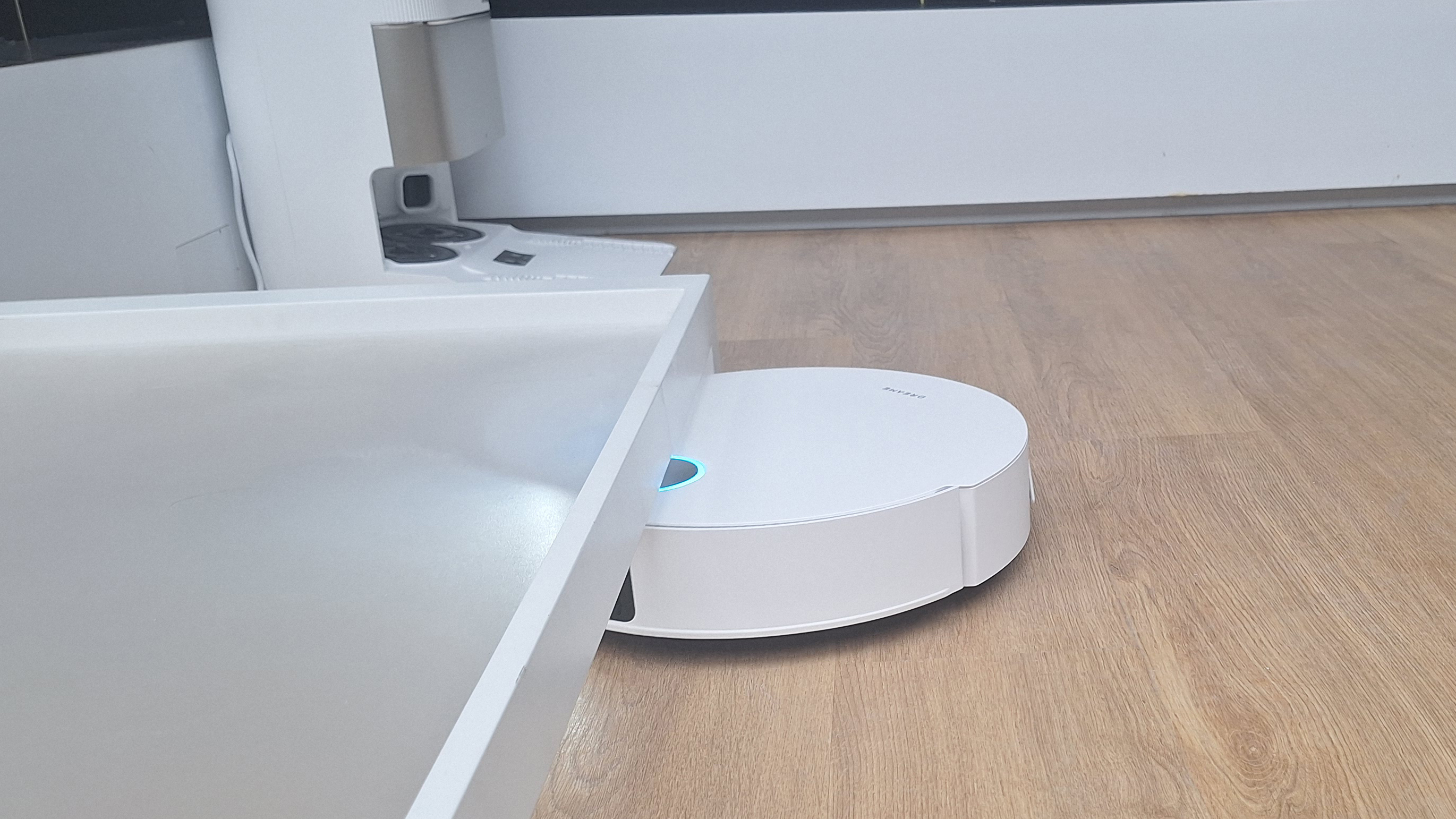
With the puck retracted, the height of the robot vacuum is just 8.9cm tall, shallow enough that it can sneak under low-sitting furniture, where dust and hair might otherwise collect. It'll then pop back up again when space allows.

Those are two 2025 innovations, but there are further features that have appeared on previous Dreames – including 2024's highly-rated Dreame L40 Ultra robot vacuum and Dreame X40 Ultra Complete robovac – and help round out what is an extremely capable setup.

For example, the spinning mop pads attach using magnets, which means the X50 Ultra Complete can drop them off in its base when they're not required and then return to pick them up again as needed, with no manual intervention required from you.

That means there's absolutely no danger of wet mop pads dragging over your carpets (the mop pads can also lift up to avoid this, but it's not such a failsafe approach if you have thick rugs, for example).

Dreame X50 Ultra Complete robot vacuum driving under a low table

(Image credit: Future)

To ensure the edges of rooms aren't missed, the Dreame X50 not only has an extending side brush to sweep debris into the robot's suction path (fairly common on premium bots), but also a mop pad that can kick out to the side.

I saw the Dreame X50 Ultra, alongside the brand's other products, at the grand opening of its first flagship store in Birmingham, UK – a "significant milestone" in the brand's expansion into the UK.

We're in the process of testing the Dreame X50 Ultra and will report back if it's as good as it looks. It will go on sale in the UK from February 7 at a list price of £1,299. It'll be available to purchase directly from Dreame (in-store and online) as well as via Amazon.

US release information and pricing has been requested, and we'll update this when we hear back.

You might also like...


from Latest from TechRadar US in News,opinion https://ift.tt/3gESAKr

Thursday, January 23, 2025

8 Best Herbal Teas to Reduce Stress and Promote Sleep

A hot cup of tea has many health benefits. If you’re feeling sick or stressed and unable to rest, these herbal teas can soothe you into a restful slumber.

from CNET https://ift.tt/Z843mny

Latest Tech News

The all-new Google Fitbit Air is now available to preorder, so you can find incredible deals on top-rated Fitb...