Friday, December 6, 2024

Latest Tech News

Update: On December 6, 2024, the European Pirate Party reported that the European Council Committee stopped the proposal (yet again) as more governments joined the list of countries against it. We made some edits to the page to reflect this.

The EU proposal to scan all your private communications to halt the spread of child sexual abuse material (CSAM) is back on regulators' agenda – but keeps being rejected.

What's been deemed by critics as Chat Control has seen many twists and turns since the European Commission presented the first version of the draft bill in May 2022. The latest development came in October 2024, when a last-minute decision by the Netherlands to abstain from the vote prompted the Hungarian Council Presidency to remove the matter from the planned discussion.

Now, about two months later, the controversial proposal has returned to the topics the EU Council discussed on December 4, 2024. On Friday, December 6, however, the European Council Committee stopped the proposal (yet again) as more governments joined the list of countries against it.

What is the EU CSAM scan bill?

As mentioned, lawmakers have implemented some changes to the EU CSAM bill amid growing criticism from the privacy, tech, and political benches.

Initially, the plan was to require messaging services and email providers to scan all your messages on the lookout for illegal material – no matter if these were encrypted, like WhatsApp or Signal chats, for example, to ensure that communications remain private between the sender and receiver.

Lawmakers suggested employing what's known as client side-scanning, a technique that experts, including some of the best VPN providers and messaging apps, have long warned against as it cannot be executed without breaking encryption protection. Even the UK halted this requirement under its Online Safety Act until "it's technically feasible to do so."

Fast-forward to June 2024, the second version of the EU proposal aims to target shared photos, videos, and URLs instead of text and audio messages upon users' permission. There's a caveat, though – you must consent to the shared material being scanned before being encrypted to keep using the functionality.

This wording made privacy experts furious, with Meredith Whittaker, President of the Signal Foundation, labeling this so-called 'upload moderation' as a "rhetorical game" instead.

In September, another version was leaked by Politico. Communications providers would be free to decide whether or not to use artificial intelligence to flag images and text chats as suspicious. These companies, however, would be required by law to scan all user chats and report when they found illegal content.

As per the European Pirate Party's data before the December 6 meeting, the greater majority of countries have already expressed their support for the new proposal. Even nations like France, who previously were among the opposed governments, have now joined the in-favor list.

At that time, only a few EU members remained either undecided (Italy, Portugal, and Finland) or against (Austria, Belgium, Czech Republic, Estonia, Germany, Luxemburg, Netherlands, Poland, and Slovenia).

A day before the voting (December 5, Patrick Breyer from the European Pirate Party reported that "unconfirmed rumors" claimed an unnamed critical government could join the countries backing up the proposal on Friday.

This, however, didn't happen as Finland voted against it during today's meeting, despite both Italy and Portugal reportedly passing from undecided to "in favor."


from TechRadar - All the latest technology news https://ift.tt/THEUyrX

Thursday, December 5, 2024

Latest Tech News

As 2025 approaches and 'New Year, new you' pressures build for those of us not keen on jogging or hitting the gym, you should know that there’s an awesome alternative to traditional fitness with Quell, one of my favorite workout apps of 2024. And today’s big announcement is that the gamified routines it offers are finally coming to Meta Quest headsets in January 2025.

For those of you that missed Quell at launch, it was originally a PC fitness platform. You’d use the controllers to punch your way through its fantasy adventure game Shardfall while wearing resistance bands that make it tougher than typical shadow boxing. The full-body HIT sessions felt intense, yet Shardfall did an excellent job of keeping me motivated by contextualizing my actions – I wasn’t just doing another rep for the sake of it, I was throwing another punch because I needed to defeat the monster in my way.

VR players can soon try this experience using a Meta Quest headset – sans the resistance bands unless they choose to buy some. That’s because Shardfall is coming to Quest as Shardfall: FitQuest VR for $19.99 / £14.99 at Meta.com, and I’m pretty darn excited about it.

Shardfall will be at home in VR

A person working out in their living room using the Quell system, they're punching a virtual enemy

Quell is great, but it'll be right at home in VR (Image credit: Quell)

The Quell hardware system costs $199 / £189 while the software subscription to access Shardfall (and future game releases) only costs $4.99 / £4.99 a month or $39.99 / £39.99 a year which I feel is a pretty good price for the kit when compared to other fitness gear or a gym membership, but it is an added expense that people might not be willing to pay for a system that can only be used with Quell games.

As a $19.99 / £14.99 add-on to your existing VR headset, Shardfall in VR is a much easier sell, and I strongly recommend everyone give it a try at launch. The combat exercises are an engaging boxing sim that does well to incorporate a full-body routine with ducks and jumps to dodge certain attacks and hazards, and it also includes jogging sections between fights that get your heart rate up.

It'll be a shame to lose the resistance bands, but again that could aid Shardfall’s accessibility as its exercises will be a little less challenging – though I expect the full-body routines will still give you a decent workout without them.

When the VR version launches I’ll certainly be there to give it a go, and if you’re looking for a more interesting way to kickstart your 2025 fitness schedule I recommend you join me.

You might also like


from TechRadar - All the latest technology news https://ift.tt/tL4Bz5c

Latest Tech News


  • Azure Integrated HSM boosts security with cryptographic key protection
  • Reduces latency and scales better than network-attached HSMs
  • Keys stay isolated, ensuring tamper-resistant, in-use protection

Microsoft has introduced a new hardware security module designed to boost cloud security by enabling cryptographic key protection directly within server environments. 

Azure Integrated HSM addresses latency and scalability challenges often associated with traditional network-attached HSMs while adhering to FIPS 140-3 Level 3 security requirements.

The new hardware module provides locally attached cryptographic services for encryption, decryption, signing, and verification. Keys remain isolated from software, including guest and host systems, ensuring strong physical and logical tamper protection. Unlike traditional HSMs, which introduce network latency or require key release to local environments, Azure Integrated HSM securely retains keys within the module for continuous in-use protection.

Coming to all new Microsoft data center servers

"As part of our systems approach in optimizing every layer in our infrastructure, security is a key priority, and we are designing our infrastructure hardware with multiple layers of defense with dedicated innovations to ensure robust protection for Microsoft and for our customers," noted Mark Russinovich, Microsoft’s CTO for Azure.

The module is designed to integrate seamlessly with both confidential and general-purpose virtual machines and containers, providing dedicated, secure partitions for each workload. These partitions are hardware-isolated, allowing workloads to access keys only through controlled oracle functions. This design boosts security and reduces latency with node-integrated connections and cryptographic hardware accelerators.

Azure Integrated HSM will be installed in all new servers across Microsoft data centers starting next year, bolstering protection across Azure’s hardware fleet. This deployment is part of the Secure Future Initiative, which also includes Adams Bridge quantum-resilient accelerator and Caliptra 2.0 silicon root of trust.

“By integrating advanced hardware security features such as the silicon root of trust and secure control modules, we are providing the foundation for the trust and security that Azure delivers to our customers,” Russinovich said. “We are committed to continuously enhancing our cloud hardware security capabilities to meet the evolving needs of our customers.”

You might also like


from TechRadar - All the latest technology news https://ift.tt/SXnFyKT

Wednesday, December 4, 2024

Ionvac SmartClean 2000 Robovac

WiFi robotic vacuum.

from CNET https://ift.tt/vUwHO6G

Latest Tech News


  • SemiQon announces first CMOS transistor for cryogenic conditions
  • Engineered for extreme cold: operates efficiently at 1 Kelvin
  • Transistor reduces heat dissipation 1,000x, consumes 0.1% usual power

Heat is widely recognized as the enemy of sensitive electronic components, but ultra-low temperatures can also pose serious performance challenges.

Now, SemiQon, a Finland-based company focused on quantum computing hardware, has announced the development of what it describes as the first CMOS transistor fully optimized for cryogenic conditions.

The transistor is engineered to function effectively at temperatures as low as 1 Kelvin (-272.15°C or -457.87°F), just 1 degree above absolute zero, where most quantum computers operate. According to the company, this innovation addresses key challenges in scaling quantum computers while also being compatible with existing CMOS manufacturing processes, requiring no new infrastructure.

Space-borne applications

SemiQon says its transistor reduces heat dissipation by 1,000 times compared to conventional room-temperature transistors and consumes only 0.1% of the power. This allows control and readout electronics to be located inside a cryostat with the processors, eliminating heat dissipation problems that could disrupt the system. SemiQon believes this solution simplifies the growing complexity of managing quantum processors as their scale increases.

“It was clear to us and others in the scientific community, that a transistor which can operate efficiently at ultra-low temperatures would offer substantial value to users in the advanced computing sector and wherever these devices are required to function in cryogenic conditions,” said Himadri Majumdar, CEO and Co-Founder of SemiQon.

“Our company is just 2 years old, and already we’ve delivered something which the world has never seen before. Our cryo-CMOS transistor will provide considerable advantages to users both in terms of CapEx and OpEx, as well as by enhancing the functionality of their hardware. This could potentially accelerate the development of quantum technologies, or even enable a new era of cryogenic electronics.”

The transistor’s potential extends beyond quantum computing to high-performance computing and space-borne applications. SemiQon also highlights its impact on energy efficiency, noting that cooling costs for data centers are projected to grow significantly in the coming years.

SemiQon says it expects to deliver its first cryo-optimized CMOS transistors to customers in 2025. A short technical paper on the new transistor can be found on the arXiv pre-print server.

More from TechRadar Pro


from TechRadar - All the latest technology news https://ift.tt/CDGNqyK

Tuesday, December 3, 2024

Snag These Last Chance Cyber Monday PS5 Deals While They're Still Available

Time is running out to snag discounts on PlayStation 5 consoles, accessories and games. Don’t miss out -- these deals won’t last much longer.

from CNET https://ift.tt/wuZTmrF

Latest Tech News


  • Geyser Data's Tape-as-a-Service reaches general availability
  • Built with Spectra Logic, integrates seamlessly with AWS S3
  • No egress fees, secure air-gapped tapes, energy-efficient solution

Back in May 2024, cloud archive provider Geyser Data and data storage and management firm Spectra Logic introduced a new Tape-as-a-Service (TaaS) cloud offering combining the durability and cost-efficiency of traditional tape storage with the flexibility of cloud services.

This TaaS solution addresses the growing demand for secure, cost-effective data storage, supporting large volumes while minimizing environmental impact.

Geyser Data claims up to 97% lower CO2 emissions, 87% less power usage, and 85% less e-waste compared to other cloud services. It offers enhanced security with dedicated tapes and full control over encryption keys, along with the freedom of immediate access.

Subscription service

Following a well-received beta phase, the TaaS offering is now generally available.

Nelson Nahum, CEO of Geyser Data, outlined some of the service's key benefits, saying, "New workloads like AI require cold data to be warmer. One of our customers' biggest challenges today is the unpredictable and skyrocketing costs tied to data retrieval and egress fees in other cloud environments. Our service provides a simple and transparent pricing model that eliminates these burdens while giving businesses the storage capacity they need without investing in new hardware."

The 'enterprise-class' tape archiving solution operates on a subscription basis. It integrates with S3 APIs, allowing businesses to manage and store large volumes of data without the variable costs typical of traditional cloud providers, the need for specialized expertise, or reliance on complex on-premises infrastructure.

“By integrating Spectra Logic's Tape Archive Platform-as-a-Service (TAPAS) with Geyser Data's robust cloud software management platform, we've developed a solution that drives significant cost savings while also addressing critical power consumption challenges faced by data-intensive technologies such as AI and machine learning," noted Mitch Seigle, Chief Marketing Officer of Spectra Logic.

"As organizations grapple with the demands of rapidly expanding data volumes, tape storage provides unmatched security, longevity, sustainability, and operational efficiency - making it a pivotal element in modern data infrastructure strategies.”

Geyser Data offers a straightforward pricing model at $28 per tape per month, with each tape capable of storing up to 18TB of uncompressed data. This equates to an effective cost of $1.56 per terabyte. There are no restrictions on the amount of data customers can archive or back up, as the Spectra Cube library is designed to scale to meet demand.

You might also like


from TechRadar - All the latest technology news https://ift.tt/Gnu7d4F

Monday, December 2, 2024

24 Meal Kit and Food Subscription Deals for Cyber Monday

Score monthly drops of wine, beer, snacks or full-on meals with these discounted subscriptions.

from CNET https://ift.tt/CUXyO6z

Latest Tech News


  • 01.ai trained an AI model for $3 million using 2000 unnamed GPUS
  • “Efficient engineering” allows 01.ai to compete globally, company claims
  • 01.ai reduced inference costs to 10 cents per million tokens

Tech companies in China face a number of challenges due to the American export ban, which restricts access to advanced hardware from US manufacturers.

This includes cutting-edge GPUs from Nvidia, critical for training large-scale AI models, forcing Chinese firms to rely on older or less efficient alternatives, making it difficult to compete globally in the rapidly evolving AI industry.

However, as we’ve seen time and again, these seemingly insurmountable challenges are increasingly being overcome through innovative solutions and Chinese ingenuity. Kai-Fu Lee, founder and CEO of 01.ai, recently revealed that his team successfully trained its high-performing model, Yi-Lightning, with a budget of just $3 million and 2,000 GPUs. In comparison, OpenAI reportedly spent $80-$100 million to train GPT-4 and is rumored to have allocated up to $1 billion for GPT-5.

Making inference fast too

“The thing that shocks my friends in the Silicon Valley is not just our performance, but that we trained the model with only $3 million," Lee said (via @tsarnick).

"We believe in scaling law, but when you do excellent detailed engineering, it is not the case you have to spend a billion dollars to train a great model. As a company in China, first, we have limited access to GPUs due to the US regulations, and secondly, Chinese companies are not valued what the American companies are. So when we have less money and difficulty to get GPUs, I truly believe that necessity is the mother of invention."

Lee explained the company’s innovations include reducing computational bottlenecks, developing multi-layer caching, and designing a specialized inference engine. These advancements, he claims, result in more efficient memory usage and optimized training processes.

“When we only have 2,000 GPUs, the team has to figure out how to use it,” Kai-Fu Lee said, without disclosing the type of GPUs used. “I, as the CEO, have to figure out how to prioritize it, and then not only do we have to make training fast, we have to make inference fast... The bottom line is our inference cost is 10 cents per million tokens.”

For context, that’s about 1/30th of the typical rate charged by comparable models, highlighting the efficiency of 01.ai's approach.

Some people may be skeptical about the claims that you can train an AI model with limited resources and "excellent engineering", but according to UC Berkeley’s LMSIS, Yi-Lightning is ranked sixth globally in performance, suggesting that however it has done it, 01.ai has indeed found a way to be competitive with a minuscule budget and limited GPU access.

You might also like


from TechRadar - All the latest technology news https://ift.tt/EYv0eVk

Sunday, December 1, 2024

We Found the 33 Best Cyber Monday Deals Under $100 Available Right Now

With Cyber Monday deals now rolling in, there's plenty of opportunity to save big.

from CNET https://ift.tt/92y1uwY

We're Not Running Out of Batteries on Christmas Morning Thanks to This Cyber Monday Deal

Right now, you can grab a 28-pack of Duracell AA batteries for just $19 at Amazon.

from CNET https://ift.tt/CybiPol

Latest Tech News


  • Micron 6550 Ion SSD comes in 30.72TB and 61.44TB capacities
  • PCIe Gen5 G8 TLC NAND improves performance and efficiency
  • Sequential read write speeds are over 12GBs and 5GBs respectively

Modern data centers require high-capacity, energy-efficient SSD storage solutions to support data-intensive applications like AI and machine learning.

Addressing these needs, Micron has introduced the 6550 Ion SSD, available in 30.72TB and 61.44TB capacities.

The 6550 Ion SSD, which Micron is positioning as the “world’s fastest, most energy-efficient 60TB data center SSD,” is available in various form factors, including E1.L and U.2, but it's the E3.S model which really shines, with its 61.44TB of TLC NAND.

Better performance than expected

Previously, in order to deliver a capacity of 61.44TB, manufacturers needed to use QLC NAND, but by making the switch to Gen5 interface G8 TLC NAND, Micron is able to offer faster write performance, endurance, and the thing that data centers are increasingly craving - energy efficiency.

StorageReview tested the new drive, and came away impressed, as reviewer Brian Beeler notes: “The Micron 6550 Ion offers massive performance and capacity benefits over the 6500 Ion, its predecessor. It adheres to PCIe Gen5 standards and incorporates future-proofing capabilities through OCP 2.5. Micron has prioritized security in the 6550 Ion, ensuring TAA and FIPS 140-3 L2 certifiability and a comprehensive security suite."

In terms of performance, Micron says the 6550 Ion delivers sequential read speeds of 12GB/s and write speeds of 5GB/s while maintaining a maximum power consumption of 20W. StorageReview's test recorded read speeds of 12.7GB/s and writes of 8.2GB/s, better than expected.

The review compared the 6550 Ion against the Solidigm P5336, the only 61.44TB SSD widely shipping today, and while acknowledging it wasn't an even match, said, "We noted many areas where the newer Gen5 interface on the Micron 6550 Ion excelled over the Gen4 interface in the P5336, which is expected. The difference between Gen4 vs. Gen5 drives relates to how much bandwidth each drive can push across the wire. The Gen4 PCIe interface with four lanes of connectivity is capable of around 7GB/s, while the newer Gen5 PCI interface doubles that with 14GB/s. Micron’s use of TLC NAND gives it another design advantage over QLC-based competitors."

Energy efficiency is another key selling point of the 6550 Ion. It uses up to 20% less power than competing SSDs and supports multiple operational power states. For example, Power State 1 (PS1) limits power usage to 20W, compared to the maximum 25W. It also consumes ≤5W when idle.

The 61.44TB capacity of the 6550 Ion is impressive, but it's set to be dwarfed when the PCIe Gen5 Phison Pascari D205V (offered in U.2 and E3.L formats) arrives in Q2 2025. As well as a 61.44TB model, there will also be one with double the capacity, 122.88TB, and it will be interesting to see how that compares in terms of performance.

You might also like


from TechRadar - All the latest technology news https://ift.tt/c69BP47

Saturday, November 30, 2024

Why You Might Want to Get a Chipolo Tracker Over an Apple AirTag Before Cyber Monday

The AirTag might not be the best Bluetooth tracker for you. Plus, the Chipolo is still on sale right now, even after Black Friday.

from CNET https://ift.tt/upkYCVG

Latest Tech News


  • Western Digital unveils new HDD storage options for businesses
  • 32TB UltraSMR and 26TB ePMR CMR are the world's highest capacity ePMR HDDs
  • Built for scalability, efficiency, and long lasting with 5 year warranty

Western Digital has unveiled new advancements in hard drive technology which it says align with the burgeoning needs of AI and data-intensive applications.

The company has recently launched the new 32TB UltraSMR HDD and 26TB ePMR CMR HDD.

These new hard drives, equipped with innovative features like OptiNAND and ArmorCache offer scalable, efficient, and cost-effective solutions for hyperscalers, cloud service providers (CSPs), and enterprises.

Cutting-edge 11-disk design for maximum efficiency

The 32TB Ultrastar DC HC690 SMR HDD is the industry’s highest-capacity HDD to date, using cutting-edge UltraSMR technology to support deep content storage at scale. On the other hand, the 26TB Ultrastar DC HC590 CMR HDD offers a drop-in replacement for enterprises looking to grow their data capacity without compromising on performance or reliability.

The 32TB UltraSMR HDD offers up to 257 MiB/s sequential performance and using just 5.5W of power while idle making it ideal for "warm" and "cold" data storage tiers, helping businesses optimize their energy consumption while scaling their storage needs. Meanwhile, the 26TB CMR HDD features a sustained transfer rate of up to 288 MiB/s and consumes just 5.6W in idle mode, making it a reliable option for mission-critical environments.

Their 11-disk design is the first of its kind to be commercially available and increases the storage capacity without increasing the physical size of the drives, making them highly efficient for modern data centers.

Western Digital integrates the new HDDs into the Ultrastar Data60 and Data102 hybrid storage platforms which can accommodate up to 102 drives, offering up to 3.26 petabytes of raw capacity. The company also uses IsoVibe and ArcticFlow to reduce vibration and optimize cooling.

The 26TB WD Gold SATA HDDs offer a decent balance for system integrators and resellers. Drawing from the Ultrastar HDD platform, these drives are tailored for small and medium businesses who require reliable, high-performance storage, and feature up to 2.5 million hours mean time between failure (MTBF) and a five-year warranty.

“Our CMR and UltraSMR technology isn't just breaking records—it’s giving customers the efficiency and TCO benefits they’ve been asking for, and we’re not done yet,” said Ravi Pendekanti, SVP of Product Management, HDD Business Unit, Western Digital.

“By delivering the industry’s highest ePMR capacities available today, we are ensuring that our customers have the storage efficiency, scalability, reliability and unmatched value they need to stay ahead."

You might also like


from TechRadar - All the latest technology news https://ift.tt/M9EFXQH

Latest Tech News

VPN usage in Pakistan has never been so high, the government is set to introduce a new policy that could potentially ban the use of "unregistered" services starting today, November 30, 2024.

People in Pakistan have been turning en masse to VPN services throughout 2024 as they look for a way to bypass growing censorship online. WhatsApp is just the latest social media platform currently blocked in the country. The block came two days after authorities restricted Bluesky amid a surge in popularity worldwide. X, Facebook, and Instagram also can't be accessed without a VPN.

I've spoken with some experts to understand what's at stake and discover everything you might need to know to retain internet freedoms in the country.

How to avoid disruption in Pakistan

  • Set up a manual VPN
  • Contact VPN support teams
  • Rotate VPN providers

If you experience some issues downloading or using your VPN app in the next days or weeks, Gytis Malinauskas, Head of Legal at Surfshark suggests setting up a manual VPN connection. You'll likely find the details on how to do this on specific devices on your provider's website such as this step-by-step guide from Surfshark. Remember, you'll still need a VPN account to do this.

If this doesn't work, contact your provider's support team for assistance. "Our team is continuously working to provide our users with privacy and security solutions even in regions with challenging internet landscapes," Malinauskas explains.

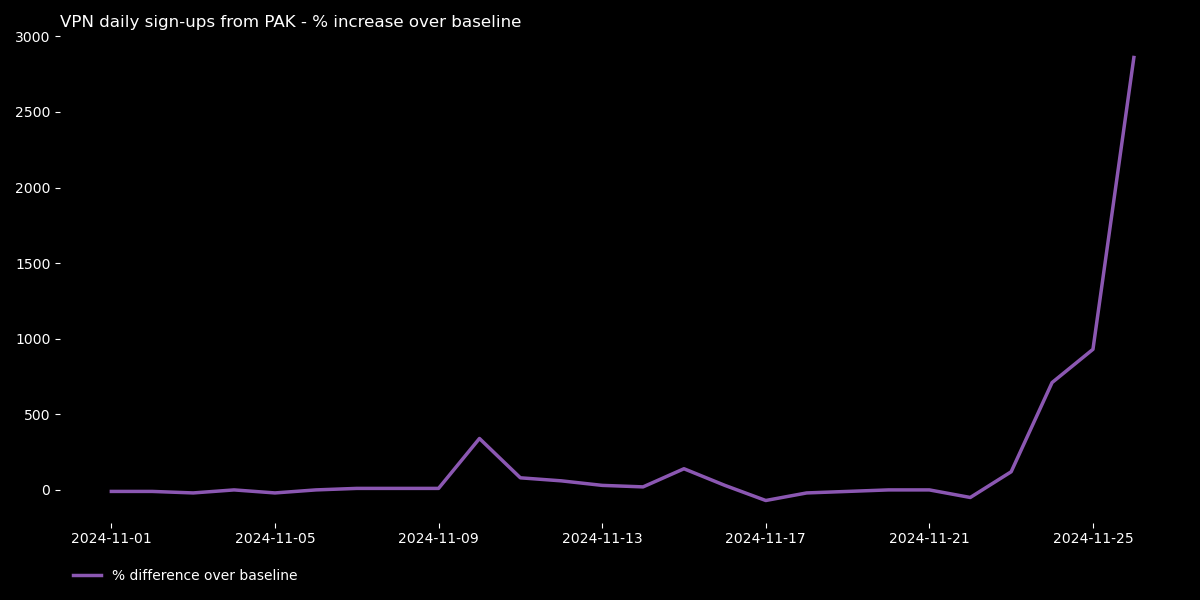
Graph showing a spike in VPN sign-ups in Pakistan starting on November 21, 2024.

Proton VPN has been recording spike in VPN sign-ups from Pakistan since the beginning of the year, with the most recent increase reaching +2860% over baseline on November 26, 2024. (Image credit: Proton)

Both Malinauskas and Simon Migliano, Head of Research at Top10VPN, also recommend rotating through multiple VPN providers.

Are free VPNs a solution?

Potentially. I suggest checking out our best free VPN page to get all the most secure freebies – PrivadoVPN and Proton VPN are today's top picks.

"It's likely to be a bit of a lottery, at least at first," Migliano told TechRadar. "Based on the recent test runs of Pakistan's new firewall, I'm expecting VPN blocks to be much more widespread from November 30. But as we've seen in countries with a much more mature internet censorship regime, such as China and Iran, it's near-impossible to block all the VPNs, all the time."

It's worth keeping in mind that the legal grounds for using a VPN to bypass restrictions in Pakistan after November 30 aren't yet clear. Commenting on this point, Migliano said: "Using an unregistered VPN in Pakistan after the deadline will be a risky proposition, depending on how strictly the authorities enforce the new rules."

Alternatives to using a VPN in Pakistan

  • Tor Browser
  • Proxy Services
  • SmartDNS service

VPNs may be the most widespread and easy-to-use circumventing tools out there, but certainly aren't the only way to bypass internet blocks, bans, and other geo-restrictions.

Tor Browser is probably the best VPN alternative you could use. Completely free to use, Tor is even considered a more secure option as it reroutes your internet connections (and data in transit) through at least three encrypted layers. This boosted encryption, however, can considerably slow down your connection speed.

It's near-impossible to block all the VPNs, all the time

Simon Migliano, Top10VPN

Proxy services are another effective method of spoofing your IP address to trick your ISP (internet service provider) into thinking you're browsing from a completely different country within a couple of clicks.

The downside here is that, unlike VPNs, proxies don't encrypt your internet connections, making them less secure overall. As Pakistan's firewall is expected to boost online surveillance, too, I recommend keeping this method as a last resort – especially now as it's not clear the risk of bypassing the government's imposed online restrictions.

You can also use a SmartDNS service to bypass geo-restriction online with ease. Again, these services do not offer the same level of protection as VPNs, meaning they don't encrypt your data. Worse still, a SmartDNS doesn't even change your IP but simply reroutes information about your location instead.

Why is Pakistan restricting VPN usage?

The government first shared plans to regulate the use of VPNs back in August to curb VPN misuse. Authorities later deemed unregistered VPNs a "security risk" for Pakistan as they can be used to access "sensitive data."

Under the new policy, using a VPN is still permitted for legitimate purposes such as banking, foreign missions, corporate enterprises, universities, IT companies, call centers, and freelance professionals.

This is why the Pakistan Telecommunication Authority (PTA) has been urging businesses and freelance workers to register their VPN services by the November 30 deadline to avoid disruption.

The debate is still ongoing, however, on whether or not commercial VPN usage should also be blocked. That said, VPNs have often been a target during the year, with residents facing temporary connectivity issues starting in February (when the ex-Twitter was first restricted).

Do you know?

VPN encrypting a flow of data

(Image credit: Shutterstock)

The best VPN apps are security software that encrypts your internet connections to prevent snooping. They also spoof your real IP address location to boost anonymity and grant access to otherwise geo-restricted content.

Not only a new stringent policy, VPN censorship is also expected to worsen as the government beefs up its filter technology.

As Al Jazeera reported, Pakistan's government has implemented a China-like firewall, which was first tested in mid-July. This system not only can allow authorities to better monitor online traffic but also control the use of popular apps more efficiently.

Most notably, the new Pakistan firewall "has the ability to block VPNs" – a Ministry of Defence official, familiar with the new deployments, told Al Jazeera.

At the time of writing, it's still early to determine the full impact all this has on people using VPNs to keep accessing the free web. Experts, however, are worried by this surge in internet censorship.

"Attempts to tighten online surveillance always raise concerns about digital privacy and freedom of expression," Gytis Malinauskas, Head of Legal at Surfshark, told TechRadar. "This could also worsen the digital divide and inequalities between those who can access unfiltered information and those who cannot."


from TechRadar - All the latest technology news https://ift.tt/1UA2pSZ

Latest Tech News

A patch was released to fix the bugs and users were forced to update their PIN codes. from Latest from TechRadar https://ift.tt/WpfjTPR