Wednesday, October 26, 2022

Latest Tech News

The latest version of the programming language Python, 3.11 has been unveiled, with its development team claiming that the new edition might just be the best yet.

In the release notes, Pablo Galindo Salgado, Python Steering Council member and the release manager for the current version, alongside fellow team members Steve Dower and Ned Deily, wrote the team has “put a lot of effort into making 3.11 the best version of Python possible”.

They also listed the keynote improvements in Python 3.11: “better tracebacks”, “faster Python”, “exception groups and except*”, in addition to offering various improvements to typing.

Python 3.11's latest improvements

The Python release team claimed in the release notes that Python 3.11 “is up to 10-60 percent faster than Python 3.10”, and reported measuring 1.22x speedups on average, courtesy of the Faster CPython Project.

Though it is worth pointing out this likely only applies to pure Python code, and Python itself has never been the fastest programming language out there, that’s still impressive.

Several Python Enhancement Proposals (PEPs) promise to offer more concrete quality of life improvements.

PEP 657, for example, will introduce more detailed error reports for tracebacks - reports detailing function calls within a python script, making debugging that much more straightforward. PEP 680, meanwhile, means that Python will be able to parse TOML files, commonly used for configuration files without the need for an external library.

However, as The Register reports, PYC files compiled by the Python interpreter are now, on average, 22% larger, and while the Python team stand by the change,  they have issued an opt-out, in the form of “PYTHONNODEBUGRANGES”, a new environmental variable.

PEP 654, on the other hand, allows for handling several exceptions at once with the introduction of exception groups and the new except* syntax.

Python 3.11 should also encourage developers to use data types more, thanks to some new features, and more subtle changes that give developers more control in the backend.

Perhaps the best illustration of this is PEP 675, which allows users to declare arbitrary string types, but there’s also PEP 673 (the Self Type), an intuitive way to annotate methods that return instances of the same class. Finally, PEP 646 (Variadic Generics), allowing generics to store several types at once for assignment to objects later.


from TechRadar - All the latest technology news https://ift.tt/GpryHSN

Alphabet Touts New Areas Like Google's YouTube Shorts After a Tough Quarter - CNET

The company plans to re-focus on profitable areas after its financial results miss analyst expectations.

from CNET https://ift.tt/TvXNfnB

Latest Tech News

Apple's new iPhone 14 Pro Dynamic Island is now just a little more dynamic. iOS 16.1, which officially dropped on millions of iPhones this week, brought with it new gesture controls to Apple's innovative notch replacement.

Available only on the iPhone 14 Pro and iPhone 14 Pro Max, the Dynamic Island not only moved the True Depth Module down from the iPhone's top edge, but it also created a fungible island of functionality. From a technical perspective, the Dynamic Island is actually two Super Retina Display XDR screen cutouts, one pill-shaped and the other wider and more cylindrical. Apple cannily uses the small bits of pixels between the two shapes to create what appears to be a lively and fully dynamic digital island.

Inside the Dynamic island are activity symbols to indicate if, for instance, your phone is locked, playing music, or delivering Map-based directions. It can appear to expand to offer more map details or conduct a Face ID scan. In other words, the Island, which also supports third-party apps, is designed to be many things to many people.

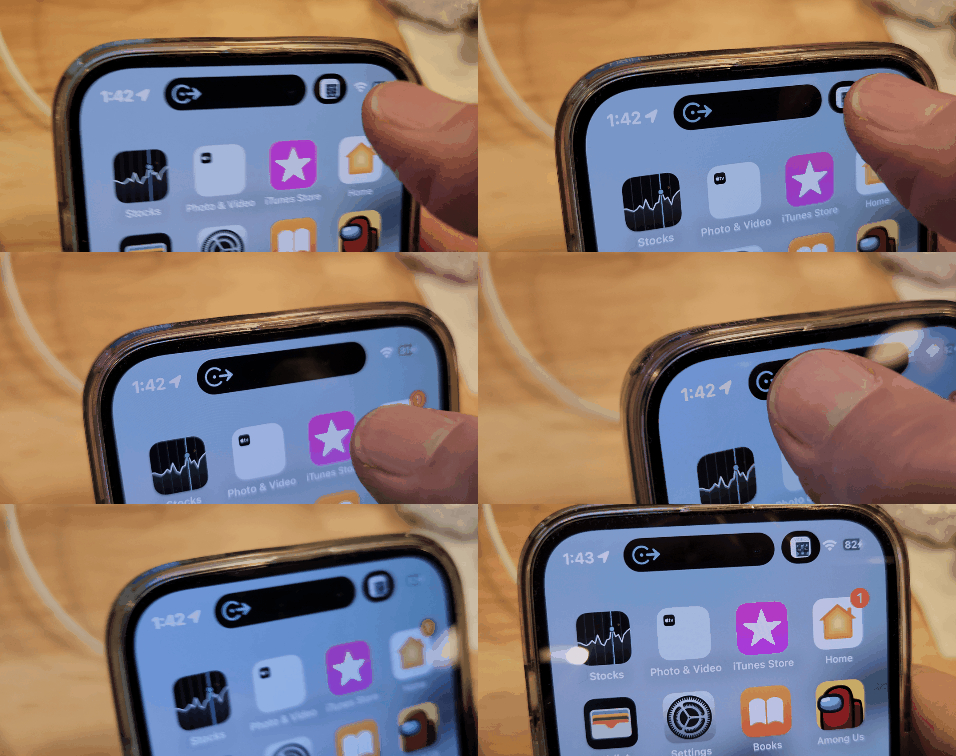
Dynamic Island swipe

(Image credit: Future)

In iOS 16.1 it gets another trick. The Dynamic Island is already capable of displaying two running apps at once, but they generally sit as two distinct islands with home screen pixels separating them. Now, with a gesture, you can easily hide one activity. Apple confirmed that this feature, which first appeared in iOS 16.1 beta is now part of the public download.

For example, we launched Apple Music and started playing a song, then switched to Maps and set the navigation for home. On the home screen, the Dynamic Island displayed these activities in two separate, for lack of a better word, islands. If we place a finger on, for instance, the smaller music island and swipe to the left the music island is hidden, and we have just one original-sized Dynamic Island running our Map directions.

Another quick left swipe on the far left side of the Dynamic Island unhides the music app, which ends up back on its own tiny island on the right.

Granted, it's a small change, but also an indication that Apple views the Dynamic Island, which already responds to taps, as a platform on which it can build a world of interaction.

We like the control and look forward to more.


from TechRadar - All the latest technology news https://ift.tt/D2861jC

Latest Gadgets News

Minister of State for Electronics and Information Technology Rajeev Chandrasekhar has said that the new data protection bill will be "very simple and modern". He said the right to privacy and data protection are fundamental rights in India and the data protection bill will be very progressive in recognising and enshrining these rights. The new personal data protection...

from Gadgets 360 https://ift.tt/XDdChsZ

Latest Gadgets News

Minister of State For Electronics and IT Rajeev Chandrasekhar on Wednesday said he has spoken to Apple on reports of stores in the national capital running out of stock of the firm's latest phone offering iPhone14 Pro. The minister also said there has been a surge in demand for iPhone 14 Pro and Apple is addressing the supply constraints.

from Gadgets 360 https://ift.tt/OkbfNTy

Tuesday, October 25, 2022

Latest Tech News

Microsoft has released its Windows Dev Kit 2023 (formerly known as Project Volterra) on general sale.

The device promises a compact all-in-one workstation for natively building, running and testing Windows apps, and faster artificial intelligence and machine learning workloads, owing to the new Neural Processing Unit (NPU).

It’s powered by Snapdragon’s 8cx Gen 3 Compute Platform in tandem with Qualcomm’s Neural Processing SDK, ensuring maximum performance and bringing Microsoft one step closer to making hybrid compute and AI workflows the norm.

Arm-native apps

The announcement follows its initial tease at Microsoft Build 2022, where the company outlined its vision for the new development kit, as well an Arm-native toolchain to keep application development local to a single device.

It’s delivered there, too. Previews of arm-native versions of Visual Studio 2022, the Windows App software development kit (SDK), and the VC++ Runtime are available now, while the .NET Framework 4.8.1 for Arm has been released with Windows 11’s 2022 update.

In addition, the .NET 7 toolchain, which claims to offer functional parity for ARM against x64 architecture, is now also available in preview, while Microsoft's Azure virtual machines (VMs) and Arm64EC are publicly available now, ensuring that development and app testing are now seamless.

Arm64EC offers a way to integrate native Arm code with x64 code as part of the same process. One potential use-case for this might be to gradually transition x64 apps to Arm architecture, rather than invest time in developing solely for one platform.

Visual Studio 2022 on Arm, which has been in monthly previews since July, now supports Desktop workloads, Windows SDK and Windows App SDK components (Win UI), and Web,  Universal Windows Platform (UWP), Node.js and game development workloads.

Coinciding with the hardware launch, Microsoft’s collaboration tools are now also available on Arm, including Microsoft Teams, Microsoft 365, the web browser Microsoft Edge, Microsoft Defender for Endpoint (MDE) and Microsoft OneDrive.

And just to make sure users never feel the need to step away from their dev kits, several creativity, video conferencing, security, and benchmarking solutions have all been ported to Arm devices. There are a lot of names here, like Adobe, Zoom, Sophos, Cisco, PassMark - and Microsoft claim even more are on the way.

The hardware itself is exciting, too. As well as what was mentioned above, the device sports 32 GB LPDDR4x RAM and a 512 GB NVMe SSD fast storage, plus three USB-A, two USB-C port, and a Mini Display port for maximum device compatibility.

We’re certainly impressed on paper, and will be looking forward to any new developments that come out on October 26’s virtual Arm Dev Summit

For now, the Windows Dev Kit 2023 is available now for purchase in the US, UK, Australia, Canada, France, Germany, Japan, and China.


from TechRadar - All the latest technology news https://ift.tt/aPXCULe

Do You Talk to Your Cat Like a Baby? (Pssst. It Knows You Do) - CNET

A new study finds kitties know when their human buddies are talking to them.

from CNET https://ift.tt/mNwt397

Latest Tech News

A major malvertising campaign has been discovered hijacking people’s internet searches, and adding affiliate links to websites. 

According to the researchers that spotted the campaign, the developers generate plenty of income through affiliate commissions and search data sales. 

Experts from Guardio Labs recently discovered as many as 30 browser extensions for both Chrome and Edge, active since at least mid-October 2020, and having been downloaded more than a million times. 

Dormant Colors

When victims visit different sites offering video downloading services, they’re first forced to download the extension, in order to continue with the download, the researchers found.

The extension offers color customization options and comes with no malicious code, it was said, allowing it to pass antivirus scans. This is also why the researchers decided to dub the campaign “Dormant Colors”. However, after installation, the extension will redirect the user to a webpage that side-loads malicious scripts that tell the extension how to hijack search results and add affiliate links. 

The extension would be instructed to return search results for queries from sites affiliated with the developers, that way generating income from ad impressions and search data sales. 

What’s more, it comes with a redirect list of roughly 10,000 websites. Should the victim try to visit any of those sites, they would be redirected to it - but through a link with an affiliate link. As a result, any purchase made on those sites would earn the developers commission. 

While the campaign might come off as a nuisance, it’s not exactly damaging to the victims and doesn’t steal money directly from their pockets. However, researchers are warning that the same methodology could be used to steal sensitive information, or login credentials, from the targets. 

By redirecting the users to a phishing site, the attackers could obtain Microsoft 365 or Google Workspace passwords, and details from banking sites, or social media platforms.

Via: BleepingComputer


from TechRadar - All the latest technology news https://ift.tt/EOiSp5w

NASA's James Webb Telescope Captures Rare View of Galaxies Merging - CNET

The next-gen instrument spots a rather extreme cosmic scene.

from CNET https://ift.tt/VIm3EbH

Latest Tech News

The new ATSC 3.0 digital TV broadcasting standard  (aka NEXTGEN TV) that’s been made available in an increasing number of US cities continues its steady growth trajectory, with stations in 50-plus markets and reaching 55 percent of households now having been upgraded from the ATSC 1.0 standard.

ATSC 3.0 tuners can be found in select sets sold in the US dating back to 2020, with some of the best 4K TVs from LG, Samsung, Sony, and Hisense all providing the feature. The benefits that ATSC 3.0 brings over the older digital high-definition TV standard include 4K resolution high dynamic range video, Dolby Atmos and DTS:X immersive audio, and Dolby dialogue enhancement and volume levelling features. Also, since it’s IP-based, two-way data-streaming is supported to bring an interactive component to TV shows and sports.

Because it’s broadcast TV with ads, those new features will come free – all you have to do is connect one of the best indoor TV antennas to your ATSC 3.0-compatible set.

But what if your current TV doesn’t have a built-in ATSC 3.0 tuner? Stations that transition to the new broadcasting standard are required to “simulcast” in ATSC 1.0 for at least five years after making the switch. Also, set-top DVRs with ATSC 3.0 tuners that that let you receive and record TV broadcasts and connect to your TV’s HDMI input are available from companies like Tablo. But at around $150, Tablo’s DVR is pricey, and not everyone wants to make TiVo-type recordings of TV broadcasts.

That’s where Pearl TV comes in. The coalition of broadcast TV companies, which counts more than 820 stations among its members, has just announced a FastTrack program to “accelerate development and retail availability of low-cost upgrade accessory receivers.”

The FastTrack initiative was announced last week at the NAB Show New York trade conference run by the National Association of Broadcasters. Noting that the ATSC 3.0 standard is not backward compatible and that 91 percent of US households currently have a TV with an HDMI input but no ATSC 3.0 tuner, Pearl TV’s release makes clear the group’s intent “to provide support to manufacturers interested in making devices that support the full NEXTGEN TV service feature set.”

The devices the group presumably has in mind will be basic set-top or stick-type external tuners that connect to an antenna and can be sold at an affordable price. Such a device would give ATSC 3.0 an opportunity to advance over the next few years as TVs with built-in next-gen tuners become more widely available. (The Pearl TV release also states that “more than 75% of all televisions sold are expected to be available with dual HDTV and NEXTGEN TV reception” by 2024.)

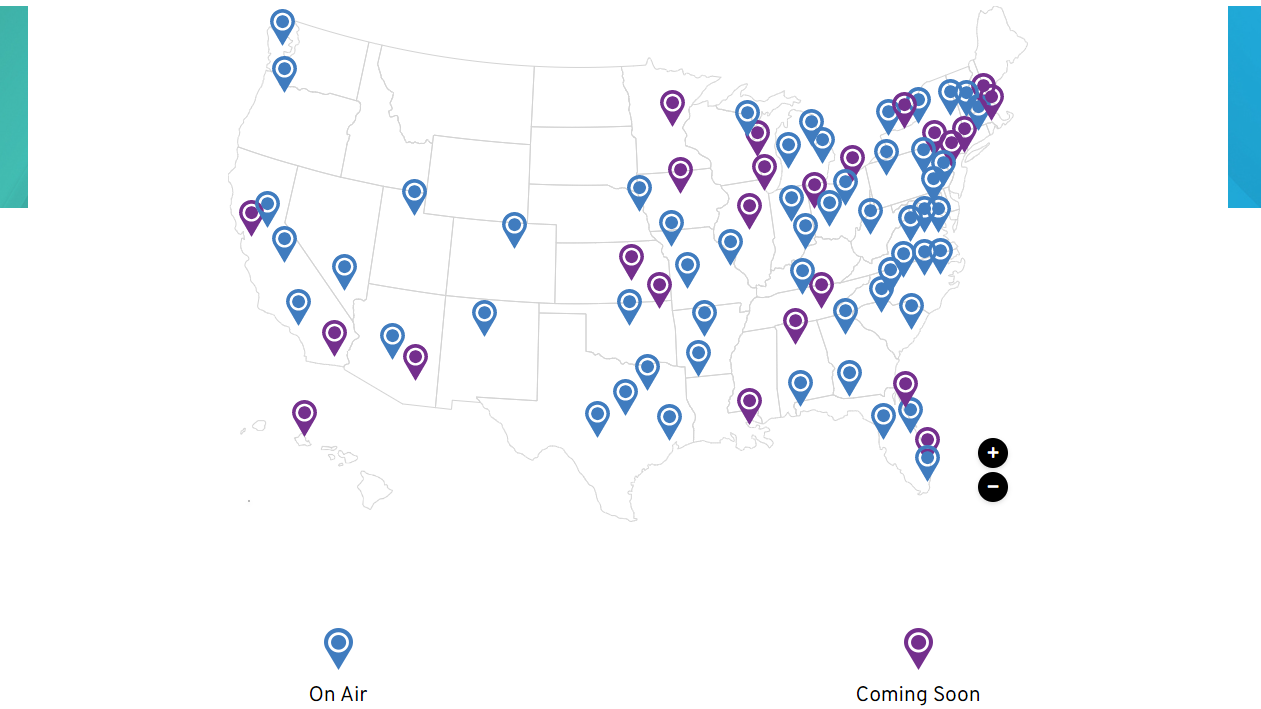
US map showing cities with current and planned ATSC 3.0 TV stations

US map showing cities with existing and planned ATSC 3.0 TV broadcast stations as of October 2022. (Image credit: Pearl TV)

Analysis: Free TV gets a much-needed upgrade with ATSC 3.0 

With most streaming services now offering shows and movies in 4K/HDR, regular broadcast TV is starting to look long in the tooth. Yes, when digital high-definition TV first arrived back in the late 1990s, it was an exciting and very welcome advancement over analog broadcasting with its low resolution and reception challenges. But 20-plus years have passed, and there have been a wide range of technical advancements in TV technology over that time.

The main ones are 4K and HDR, both of which work to greatly expand the detail level, color gamut, and visual dynamic range of video images. Both have been readily available to viewers going back to 2016, and are now seen as commonplace.

Immersive audio formats like Dolby Atmos are also available on streaming services, and owners of the best soundbars expect to experience soundtracks in the new, object-based format when watching movies and shows on their TVs.

As for the interactive component of ATSC 3.0, the benefits there are still to be explored, but services like Amazon Prime have started to make interactive features available with its Thursday Night Football streams that show extended stats and other fan-servicing extra content. Sports are a huge draw for broadcast TV, so as more streamers make interactive features available – and they most certainly will – broadcasters will start to appear well out of step.

Of course, all of these broadcast TV shortcomings can be fixed by making ATSC 3.0 widely available, as well as cheaply implemented in sets that lack a next-gen TV tuner. Pearl TV’s FastTrack program is a welcome step in that direction, and one that could greatly speed up the new standard’s success.


from TechRadar - All the latest technology news https://ift.tt/mbZcptM

Monday, October 24, 2022

Boost Your Collagen the Natural (and Cheap) Way With These Collagen-Rich Foods - CNET

Getting collagen through your diet is easier and less pricey than buying pills or powders. Here are the best collagen-rich foods to eat.

from CNET https://ift.tt/zB5Wjls

Latest Tech News

An enormous malware distribution campaign has been detected leveraging more than 200 malicious domains and impersonating more than two dozen global brands to distribute all kinds of malware for both Android and Windows operating systems. 

Cybersecurity researchers from Cyble first spotted the campaign seeking to distribute various malware among Android users. 

In the campaign, the unknown threat actors set up countless domains that seem almost identical to real domains belonging to major brands such as PayPal, SnapChat, TikTok, and others. The domains only have a single character that’s different, that’s missing, or that’s extra. 

Android and Windows users attacked

This type of fraud is usually called “typosquatting” and it’s used in all kinds of attacks, for example, on GitHub, where attackers create repositories with names almost identical to legitimate repositories, to try and distribute malware.

BleepingComputer then expanded on this research to find numerous other domains distributing malware among Windows users, as well. The exact advertisement method for these domains is unknown, but the publication suggests it’s either the victims themselves mistyping the domains on their devices, or threat actors engaging in phishing and other forms of social engineering. We shouldn’t forget SEO poisoning, though.

It was also determined that the threat actors used this big typosquatting campaign to deliver all kinds of malware. In some cases, they were distributing the Vidar Stealer, and in other - Agent Tesla. Vidar is capable of stealing banking information, stored passwords, browser history, IP addresses, details about cryptocurrency wallets and, in some cases, MFA information, as well. Agent Tesla, first discovered some eight years ago, is capable of stealing credentials from many popular apps including web browsers, VPN software and FTP and email clients.

The researchers believe the threat actors are currently experimenting with different malware variants until they see what works best. Besides malware, the researchers also found the ethersmine[.]com website which tries to steal seed phrases for people’s Ethereum wallets.

Via: BleepingComputer


from TechRadar - All the latest technology news https://ift.tt/d7TVuFZ

Medicare Premiums and Deductibles: Here Are the Prices for 2023 - CNET

Find out how much cheaper Medicare Part B premiums will be next year, and how much extra you'll pay for Medicare Part A.

from CNET https://ift.tt/jt3u4DE

Latest Tech News

This year, the cost of everything from food to fuel to travel has been skyrocketing up, up, and up. You can now add prices for your Apple Music and Apple TV+ subscriptions to that list. 

As posted on 9to5Mac, the company has quietly raised the price of an individual monthly subscription to Apple Music from $9.99 / £9.99 to $10.99 / £10.99 and Apple TV+ from $4.99 / £9.99 to $6.99 / £6.99. Apple Music Family plans will see a corresponding price increase from $14.99 / £14.99 to $16.99 / £16.99.

The price hikes also extend to the company’s Apple One plans, which bundle a number of services together. These have increased as follows:

  • Individual: $14.95 / £14.95 per month to $16.95 / £16.95
  • Family: $19.95 / £19.95 per month to $22.95 /£22.95
  • Premier: $29.95 / £29.95 per month to $32.95 /£32.95

This is the first time Apple has raised prices for these subscription services in the US and, according to the company, the hikes are mostly due to increased licensing costs for Apple Music and an expansion of the catalogue of available shows and movies on Apple TV+ since the service first launched back in 2019.

An Apple spokesperson provided the following statement to TechRadar:

"The subscription prices for Apple Music, Apple TV+, and Apple One will increase beginning today. The change to Apple Music is due to an increase in licensing costs, and in turn, artists and songwriters will earn more for the streaming of their music. We also continue to add innovative features that make Apple Music the world’s best listening experience. We introduced Apple TV+ at a very low price because we started with just a few shows and movies. Three years later, Apple TV+ is home to an extensive selection of award-winning and broadly acclaimed series, feature films, documentaries, and kids and family entertainment from the world’s most creative storytellers."

Analysis: Are Apple’s now more expensive services still worth it? 

Apple Music has ranked high among the best music streaming services for its incredible value. It has long offered both lossless and high-res music for the same $9.99 / £10.99 price, along with a large selection of albums and tracks in Spatial Audio. Compare that to market leader Spotify, which currently only streams music in a lossy, compressed format (although the company is said to finally be nearing launch of a Platinum high-res tier with a $19.99 per month price tag, or twice the cost of its current ad-free Premium plan).

Even with the price boost to $10.99 / £10.99, Apple Music still is a great value when compared to services like Tidal that also offer both lossless and high-res music streaming, but for $19.99/£19.99 per month. Following the price boost, Apple Music’s closest competitor offering lossless and high-res streaming, along with Dolby Atmos music tracks, will be Amazon Music HD ($9.99 / £9.99 per month), though that service lacks Apple Music’s elegant interface and well-organized Atmos music library.

As for Apple TV+, the same as with Apple Music and lossless/high-res, your base subscription tier gets you support for 4K and Dolby Vision HDR – there is no high-quality tier that you need to pay extra for. Compare that to Netflix, which makes you pay twice as much for those features when you upgrade from its $9.99 / £9.99 per month Basic plan (which currently doesn’t even provide HD streaming, though that will change in November when the company’s Basic with Ads plan drops).

A price hike for Apple TV+ actually seems overdue: while its offerings were extremely limited in the beginning, it now has plenty of high-quality original shows like Severance and Ted Lasso, along with a strong selection of documentaries and movies.

If you’re an Apple One subscriber, the hikes are even less painful. I currently have a Premier Apple One subscription, which gives me family access to the following Apple services: TV+, Music, Arcade, Fitness+, and News+. All of those get used on an almost daily basis, and when you consider that it also comes with 2TB of iCloud storage for photos and other files, it’s still a great bargain even if it now costs $3 per month more.

While I hate to part with more money on a monthly basis for anything, I can’t say that these Apple service price hikes are outrageous, especially for the high-value Apple One plans. It may not help the company to pile on new subscribers to Apple Music or Apple TV+, but I suspect that most current ones aren’t likely to cancel. I know I’m not.


from TechRadar - All the latest technology news https://ift.tt/BQ0RkMc

Daylight Saving Time: How to Adjust to the Time Change - CNET

Do you have trouble "falling back"? Here's how to recover from the end of Daylight Saving Time on Nov. 6.

from CNET https://ift.tt/aMIK1LS

Best Standing Desks of 2026

Give your desk setup an upgrade with the best standing desks you can buy right now. from CNET https://ift.tt/xFC3u06