Amazon appears to be planning to further expand its datacenter footprint in the US to meet growing demand for cloud computing services.
Based on a new proposal (PDF) submitted to the City of Gilroy in Santa Clara County, California, the cloud computing giant is planning to build a new site that will eventually house two datacenter buildings.
These new data centers would expand AWS availability on the West Coast and each is planned to have a capacity of up to 49MW of equipment plus a security building and backup generator facilities according to a new report from The Register.
Amazon’s new Gilroy Data Center (GDC) facility in California will be constructed in two phases if given the go-ahead by the City of Gilroy.
The company expects the first phase which will consist of a single-story datacenter building, an onsite substation, a security building and a battery energy storage system to be operational by 2023. Phase two will involve creating another single-story datacenter building that is 218,000 square feet and it is expected to be built within four to seven years following the completion of phase one depending on customer demand.
While the phase one data center will use diesel-fired backup generators, Amazon intends to use alternative backup generation technologies for its phase two data center. One of the reasons for this is due to the fact that the company’s new facility will be located on farmland just outside of Gilroy that it purchased back in 2020 for $31.3m.
Based on local media reports though, the City of Gilroy is in the process of soliciting bids from outside consultants in an effort to determine the potential environmental impact of Amazon’s Gilroy Data Center facility before granting approval for the project.
We’ll likely hear more from Amazon if and when its new Gilroy Data Center facility is approved and moves on to the construction phase.
A potentially major security flaw has been discovered on Rarible, a popular marketplace for non-fungible tokens (NFT), which could lead to users losing not just their NFTs, but also the cryptocurrencies right from their wallets.
A report from Check Point Research (CPR) identified a vulnerability that would allow a potential attacker to steal someone’s digital belongings in a single transaction. The worst part is that everything would happen on the marketplace itself, a place people would generally feel less suspicious.
According to CPRs report, the methodology is simple, and includes creating a “malicious NFT”. Should someone stumble upon it, and click on it, the malicious NFT would execute JavaScript code in an attempt to send a setApprovalForAll request to the victim.
In case the victim submits the requests, they’d grant the malicious NFT full access to their endpoint.
“In October last year, we discovered critical security flaws in OpenSea, the world's largest NFT marketplace. Now, we've identified similar vulnerabilities in Rarible,” commented Oded Vanunu, Head of Products Vulnerabilities Research at Check Point Software.
“In terms of security, there is still a huge gap between Web2 and Web3 infrastructure. Any small vulnerability opens a backdoor for cybercriminals to hijack crypto wallets behind the scenes. We are still in a state where marketplaces that combine Web3 protocols are lacking a sound security practice. The implications following a crypto hack can be extreme. We've seen millions of dollars hijacked from users of marketplaces that combine blockchain technologies.”
Last year, Rarible has had more than $273 million in trading volume, making it one of the largest NFT marketplaces on the planet.
The company notified the marketplace of its discovery, and said it “believes Rarible will have deployed a fix by the time of this publication”. We have reached out to Rarible to see if that indeed is the case, and will update the article accordingly.
However, given that it’s Easter weekend, it could be a few days before we hear back from Rarible.
“Users currently need to manage two types of wallets: one for most of their crypto and another just for specific transactions,” Vanunu continued.
“Should the wallet for specific transactions become compromised, users can still be in a position where they don’t lose everything."
Following the release of version 100 of its browser, Google has released a new update for Chrome to fix a high-severity zero-day vulnerability that is being actively exploited in the wild.
According to a new security advisory put out by the search giant, the company is aware that an exploit exists for this high-severity vulnerability tracked as CVE-2022-1364.
The bug itself is a confusion weakness in the Chrome V8 JavaScript engine and while these types of vulnerabilities usually lead to browser crashes after reading or writing memory out of buffer bounds, cybercriminals can also exploit them to execute arbitrary code on vulnerable systems.
The vulnerability was discovered by Clément Lecigne from Google’s Threat Analysis Group who immediately reported it to the Google Chrome team. Although Google has observed this zero-day actively being exploited in the wild, the company has been tight lipped regarding any attacks. In its security advisory, it said that details about the bug and links will be “kept restricted until a majority of users are updated with a fix”.
(Image credit: Google)
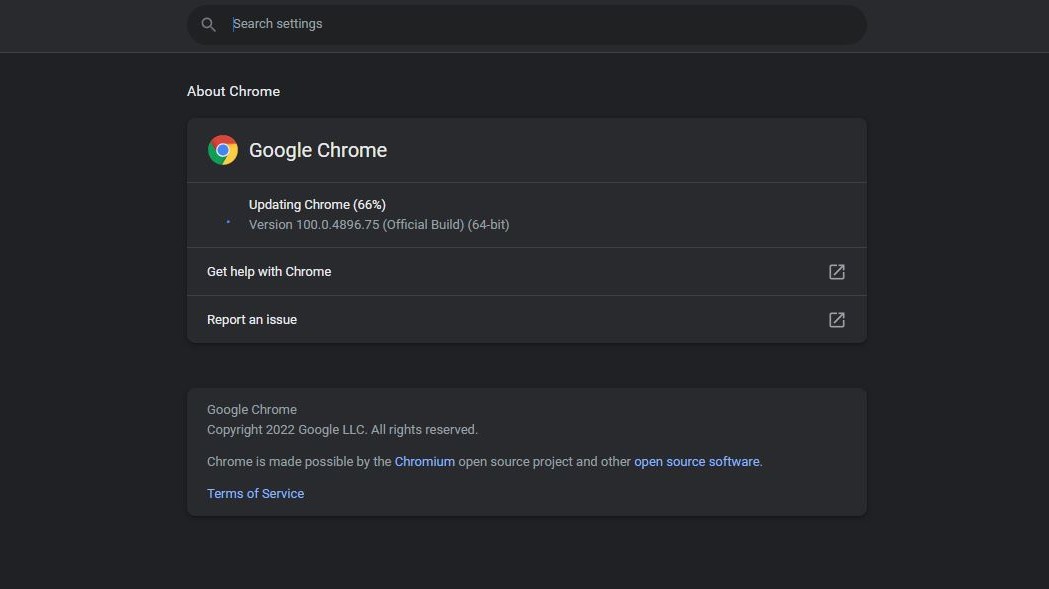
Manually updating Chrome is your bet bet
Google Chrome 100.0.4896.127 for Windows, Mac and Linux will roll out in the next few weeks as an update.
However, due to the high-severity of this vulnerability, security-conscious users can update Chrome immediately by going into the Chrome menu, heading to Help and clicking on About Google Chrome. Here, they’ll be able to manually install the update themselves as opposed to waiting for Google to roll it out.
For those that would rather wait though, Chrome will automatically check for new updates and install them the next time you close and relaunch the browser.
This is the third zero-day vulnerability that has been discovered and patched in Chrome this year.
A revamped Apple Mac Mini for 2022 is hotly anticipated, so like you, TechRadar's editors were surprised it didn't appear at Apple's Peek Performance event on March 8.
We did see something else for fans of the Apple desktop line: the Mac Studio, featuring the new M1 Ultra SoC (system-on-a-chip), designed with creative professionals in mind. But something is clearly brewing: Convincing new rumors say Apple is testing nine new Mac models ahead of WWDC with brand-spanking new M2 silicon chips -- and that includes a new Mac Mini.
The mini-PC impressed us when we reviewed it in 2020, and the M1 chip powering it showed itself to be a pretty competent performer overall. Still, a home PC is a pretty big piece of kit. Can a revamped 2022 Mac Mini win over converts beyond the device's fanbase? Here's everything we know so far.
Apple Mac Mini (2022): cut to the chase
What is it? Apple's next-generation mini-PC
When is it out? Expected late 2022 or 2023
What will it cost? Unknown, but likely similar to current pricing (starting at $699 / £699 / AU$1,099)
April 14: A firmware update for Apple’s new Studio Display references a product marked as Macmini10,1, which apparently is a model ID not used for any of the existing Mac product lines.
March 13: Bo-ring! Well-respected and (usually very well-informed) Apple analyst Ming-Chi Kuo says the upcoming Mac Mini will keep the existing form factor - and will show up in 2023. :-(
Feb. 21: Seven new Mac models will be released in 2022, says Mark Gurman, all featuring some version of the Apple silicon processors. Including a new Mac Mini.
March 04: With an Apple event right around the corner, there's a lot of attention being paid to rumors of new MacBooks, iPads, and iPhones. But a new M2-powered Mac Mini could be the star in the show, writes TechRadar's John Loeffler.
Aug. 23, 2021: Bloomberg’s Mark Gurman suggests that the M1X Mac mini could launch “in the next few months.” Could that mean Apple will have a massive announcement event planned for September?
Release date and price
(Image credit: Future)
The Apple Mac Mini (2022) hasn't even been announced yet, so there's no official release date that we can confirm. The last Mac Mini (M1) was released in late 2020, so going off Apple's typical 18 to 24 product release cadence, we expected it to be announced at the March 2022 event, but sadly this wasn't the case. It's still likely we could see it announced before the end of the year though if Apple does have plans to release an M2 SoC.
The 2020 models of both products were announced at the same time, and both feature the M1 chip. There are also a lot of rumors that the 13-inch MacBook Pro won't see a major redesign, which might be reserved for a new MacBook Air reveal later this year.
If that is true, then it may make sense for the Mac Mini with M2 to be announced alongside the 13-inch MacBook Pro since there's much less excitement around a Mac Mini redesign than there is for a MacBook.
After all, announcing two new M2-powered devices that don't feature major redesigns is better than announcing just the one, and if the Mini were to only get internal improvements, swapping out the M1 for the M2 would make mass production significantly simpler.
More recent rumors from well-placed sources suggest that Apple might have decided to push back the Mac Mini 2022 to 2023 – and if that turns out to be the case, we're going to have to stop referring to it as the Mac Mini 2022.
Design
(Image credit: Future)
One of the major advantages to the Mac Mini is its size, which is perfect for those who need a home PC but don't want a large PC case or an all-in-one computer like the latest iMac. But will that change?
There has been a lot of talk about the potential redesign of Apple's MacBook Air (2022) as well as the lack of redesign for the 13-inch MacBook Pro. Which side of things do we expect the Mac Mini to come down on?
It's a hard question to answer, unfortunately: since there is less interest in seeing a Mac Mini redesign, there's less incentive for Apple to redesign the Mac Mini. However, one of the reasons why the lack of a redesign for the 13-inch MacBook Pro makes a lot of sense is that the 13-inch MacBook Pro might be discontinued after this year in favor of the 14-inch MacBook Pro (2021).
If you're going to continue to release a product, and we don't expect the Mac Mini to be discontinued any time soon, then it's almost certain that it will have to get a redesign (albeit, nothing major) to fit in with other Mac products that do, namely the iMac, and presumably the MacBook Air and MacBook Pro 14-inch and MacBook Pro 16-inch.
The rumor mill has gone both ways on this, but earlier leaks hinting that a change in form factor was on the cards have since been shot down by other sources. We'll have to wait and see what the Mac Mini 2022 looks like.
Specs and performance
There's not much we can say specifically about the Mac Mini's specs without knowing the Apple chip that runs it, but we do expect that it will have the same 8GB/16GB Unified Memory configuration options, with anywhere from a 256GB SSD up to a 2TB SSD.
We also expect the number and types of ports to stay more or less the same, but we're hoping for an upgrade to USB-C Thunderbolt 4 from the existing Thunderbolt 3. Same goes for upgrades in the way of HDMI 2.1 and a DisplayPort 1.4 output, but with Thunderbolt 4, those ports might not be necessary anyway, so they might get the axe with a new Mac Mini.
That might shift around our list of best monitors for the Mac Mini, but something tells us this isn't much of a concern for Apple.
As for the chips powering the new device, that's where things can get interesting.
There is some buzz that we won't just see an M2-powered Mac Mini, but we might also see an M1 Pro and even an outside chance of an M1 Max-powered Mac Mini.
These latter two might be more for professionals rather than home PCs, but the possibility could give the Mac Mini much broader appeal, especially since it might allow consumers of all stripes to access the performance of an M1 Pro and M1 Max at a more accessible price point than you'd get with a MacBook Pro.
Cerebras Systems, makers of the world’s largest chip, has announced that its CS-2 system now supports PyTorch and TensorFlow which will make it possible for researchers to quickly and easily train models with billions of parameters.
The company’s CS-2 is the world’s fastest AI system and is powered by its Wafer-Scale Engine 2 (WSE-2) CPU. With the release of version 1.2 of the Cerebras Software Platform (CSoft), the CS-2 now supports additional machine learning frameworks which will give developers even more choice when it comes to the types of models they want to run.
Senior director of AI framework at Cerebras Systems, Emad Barsoum provided further insight in a press release on how CSoft now enables developers to express models written in either TensorFlow or PyTorch, saying:
“From the start, our goal was to seamlessly support whichever machine learning framework our customers wanted to write in. Our customers write in TensorFlow and in PyTorch, and our software stack, CSoft, makes it quick and easy to express your models in the framework of your choice. By doing so, our customers gain access to the 850,000 AI optimized cores and 40 Gigabytes of on-chip memory in the Cerebras CS-2.”
Scaling large language models
CSoft version 1.2 now enables developers to write their models in the open source frameworks of PyTorch or TensorFlow and run them on the Cerebras CS-2 without any modification whatsoever. At the same time, an AI model written for a GPU or CPU can run in CSoft on the CS-2 without any changes.
With the combined power of CS-2 and CSoft, developers can seamlessly scale up from small models such as BERT to the largest models in existence like GPT-3.
Training large models using a GPU is challenging and time-consuming while training from scratch on new datasets often takes weeks and 10s of megawatts of power on large clusters of legacy equipment. Additionally, as the size of the cluster grows, power, cost and complexity grow exponentially.
Cerebras Systems built the CS-2 to address these challenges and its AI system can set up even the largest models in only a few minutes. Since developers spend less time setting up, configuring and training their models with the CS-2, they are able to explore more ideas in even less time.
While Cyberpunk 2077 didn't have the smoothest launch, it's been getting regular fixes and adjustments over the last year, and now an expansion is not only confirmed, but we know it'll be arriving next year. That's quite the wait, and with a few more years it would actually be 2077 (we kid), for the ultimate headset-free VR experience.
On Thursday's financial call, CD Projekt Red revealed that the expansion will be arriving sometime in 2023. There are no details now on what the new content will be like, but it did also confirm that there would be more details later this year.
CD Projekt Red also reaffirmed continuing support for the game, which comes as no surprise after the massive 1.5 patch in February. It was welcome, if slow to arrive, and introduced PS5 and Xbox Series versions and a huge list of refinements, fixes, and changes.
As it was mentioned in @CDPROJEKTRED_IR financial call moments ago, Cyberpunk 2077's upcoming expansion will arrive in 2023. Please stay tuned for more details coming later this year 🦾 https://t.co/rq1w6RDTDLApril 14, 2022
See more
There's a huge shopping list most players can make for Cyberpunk 2077 fixes. From extensions to the customization of V and their vehicles, increased depth and complexity of the NPCs and AI behavior, to agency and depth in the backstory system for V, but all seem unlikely with an expansion this far out from the main release. Instead, what's most likely is a suite of content additions, bringing new vehicles, new weapons and cyberware, and new quests and areas to drift through on your stolen cyberbike and shoot up in duels with gangers.
A welcome change that's possible would be some additional depth to the hacking systems for netrunners, and also the options available for the lackluster crafting system. It would be cool to see more quests able to be resolved, lore discovered, or missions deconstructed through the use of Intelligence-focused builds, and likewise, to bring some customization and flair to being a Technical character. The Crafting skill is a particularly boring one, with lots of perks exclusively unlocking higher rarities of crafting.
But maybe I'm just biased in wanting grappling hook launchers in my arms, or to make smart guns that cook me some eggs first thing in the morning.
If waiting for Cyberpunk 2077's expansion has you needing to fill hours, we had some high opinions in our Dying Light 2 review.
from TechRadar - All the latest technology news https://ift.tt/at0lB62
Wikipedia's community of editors has voted to stop accepting cryptocurrency donations after an intense, months-long debate.
The vote – 232 for, 94 against – means that the proposal now goes to the Wikimedia Foundation for consideration, which isn't bound to accept it.
The discussion was started by Wikipedia user Molly White, known as GorillaWarfare, who runs the excellent Web3 is going just great blog, highlighting frequent oddities in the crypto space.
Extremely risky
"Cryptocurrencies are extremely risky investments that have only been gaining popularity among retail investors," White wrote back in January 2022. "I do not think we should be endorsing their use in this way."
One of the core reasons was that Bitcoin and ether, the two most popular currencies, use a proof-of-work model that requires huge amounts of computation power.
One of the main debates within the Web3 space right now is over proof-of-work versus proof-of-stake, a newer and less energy-intensive model that – if all goes to plan – Ethereum will eventually switch to.
In an email to Ars Technica, the Wikimedia Foundation said: "We are aware of the community's request that the Foundation consider ending our acceptance of donations in cryptocurrency. Our Fundraising team is reviewing the request and related discussions and we will provide additional information once they complete that process."
Hungry hippos
One popular estimate – which, it's worth noting, is dispute – shows that Bitcoin uses around 200 TWh of energy per year, or as much as 70 million people in Thailand.
As the climate crisis worsens, that much energy being consumed by an asset that is fairly useless outside of speculation is a very questionable thing to be happening.
Proponents of accepting cryptocurrencies at Wikipedia argued that the energy use comes from mining, not using the currency.
Similar debates have been raging at Mozilla, another independent web darling, which received a lot of criticism after a tweet referenced accepting donations in crypto.
The browser maker has since retreated and said it won't accept such donations in the future.
You’ve probably heard a lot about cloud gaming. The game library isn’t big. You’ve got to re-buy games you already own. It’s inferior to PC gaming. The lag makes most games unplayable. Depending on the cloud gaming platform, some of these things may be true. But NVIDIA is setting the record straight with GeForce NOW. The technology has come a long way, and the performance and features on offer can provide parity with PC gaming in ways you likely didn’t realize.
The graphics aren’t that good?
If you’ve tried to stream content over a poor internet connection, you might run into bad visuals. But with a strong internet connection, you’ll realize just how much power is under the hood in GeForce NOW to provide exceptional visuals. NVIDIA offers an RTX 3080 membership for GeForce NOW that provides an experience the vast majority of gamers aren’t getting out of their gaming PCs or consoles. There’s enough muscle there to deliver 1440p at 120fps or 4K HDR. Nvidia’s RTX real-time ray tracing is also available to provide life-like reflections and lighting, a rendering technique that takes serious power and will make a lot of computers sweat.
And all of that power is running behind the scenes, in the cloud, so you can enjoy it on your phone, MacBook, streaming device, or even a modest Chromebook. Just about whatever you can connect to the internet with and connect a controller or keyboard and mouse too. Running that heavy processing in the cloud also means the electric bill and heat in your room aren’t going up like they would from a local PC.
The lag makes games unplayable?
If your internet is having a lag spike, your online games are going to be unplayable whether you’re using the cloud or a local system. But with fast internet, you’ll find GeForce NOW more than up to the task of offering a responsive gaming experience. NVIDIA’s servers offer stable performance that can help provide consistent frame rendering times, helping minimize that component of lag. With the RTX 3080 Membership, you’ll get a boost from even faster frame rendering and more efficient encoding. On a modest internet connection, your inputs will likely feel as responsive as gaming on a console. NVIDIA also has plenty of tips on optimizing your latency. As NVIDIA has expanded its service, you’ll have an easier time finding servers that may be closer to you (and therefore reduce ping).
(Image credit: NVIDIA)
There aren’t enough games?
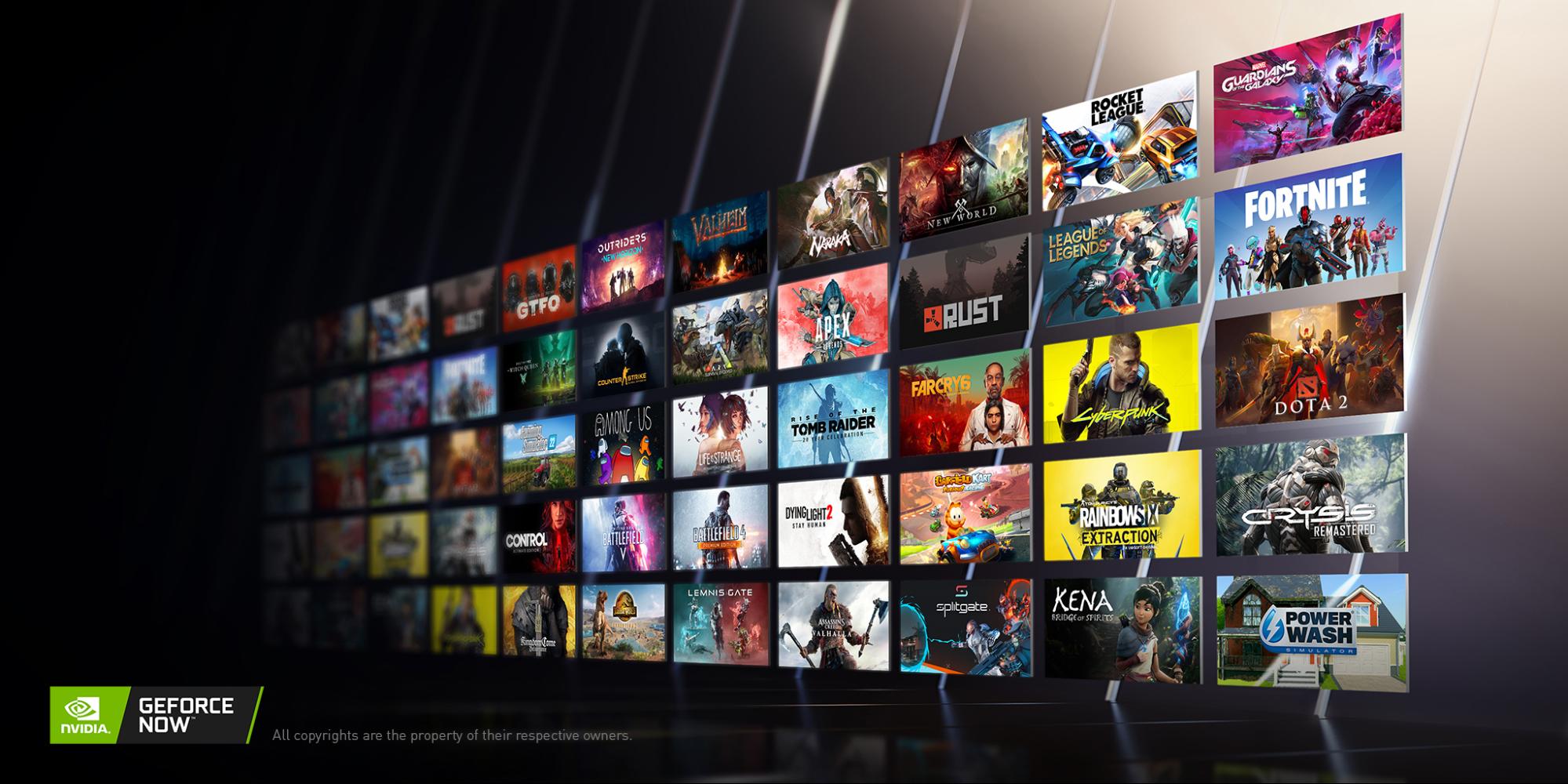
If you’re looking at the wrong gaming service, it might feel like there aren’t enough games to play. If you look at the huge list of titles supported on GeForce NOW, you might change your mind. GeForce NOW has a library of more than 1,000 games, including AAA titles from the most popular publishers like EA Ubisoft, Epic, and more as well as critically acclaimed indie hits. Its library includes graphically stunning games like Cyberpunk 2077 and Far Cry 6 with RTX On and DLSS for superb visuals and exceptional performance. The service also offers almost 100 free-to-play titles, including industry titans like Fortnite, Apex Legends, and Destiny 2.
You’ve got to pay for games you already bought?
Depending on the cloud gaming service, you might have to buy a game again even though you already have it in your PC gaming library. Fortunately, NVIDIA GeForce NOW isn’t one of those services. This subscription is for the PC gaming rig in the cloud, not for the games. In fact, you can log into Steam, Uplay, Epic Games Store, and GOG.com to access your libraries and play supported games through GeForce NOW. Not only do you not need to re-purchase them, you also don’t need to wait to download them or update them. That’s especially handy if you like to game on a lot of different devices. You won’t be downloading the game a half dozen times, and you won’t even have to find storage space for your games. The amount you’d need to spend on storage to keep a thousand games available on all your devices at a moment's notice makes the $10-$20 subscription cost of GeForce NOW look like even more of a bargain than it already is.
You can’t play with your friends?
You have to be on a console to game with your console friends, and you have to be on a PC to game with your PC friends, right? That’s just it — when you use GeForce NOW, you are using a gaming PC. That gaming PC is in the cloud, but it’s still a gaming PC. You can link up with your friends just the same as if you were on your own local PC. For games that support cross-play, you won’t miss out on that functionality either.
If you’re still skeptical about cloud gaming, why not let NVIDIA GeForce NOW prove it’s the real deal. You can sign up for a subscription here to reap all the benefits of the service, from 4K HDR or 1440p/120fps to near-instant game downloads and PC gaming across a huge range of devices. You can even try the service for free to get a taste. And if you think it’s good now, you should know it just keeps getting better. To stay up to speed on all the new games and developments on the service, you can tune in weekly for the GFN Thursdays blog or follow GeForce NOW on Facebook and Twitter.
from TechRadar - All the latest technology news https://ift.tt/VS3dHEz
Building on its VPN and secure email service, Proton has launched an encrypted calendar app for Android as part of its mission to create a better internet where privacy is the default.
Proton Calendar first launched on desktop back in 2020 and last year, the company released a beta version of its encrypted mobile calendar app.
While securing your calendar may not be the first thing that comes to mind in regard to protecting your privacy, it actually contains loads of personal data including who you meet and where you meet. As this information deserves the same level of protection as your email and files, Proton has stepped up to create the most secure calendar around.
Unlike other calendar apps, all of the event details including event names, participants, locations, notes and descriptions in Proton Calendar are fully encrypted to prevent others from gaining access to your schedule.
Proton Calendar for Android
Proton Calendar for Android includes a full set of advanced features and functionalities so it can easily replace Google Calendar or any other calendar app you may currently be using.
With Proton Calendar installed on your Android smartphone, you can easily switch between day, schedule and month view to see your calendar as you like and Proton has also created a widget which you can add to your home screen for a bird’s eye view of your upcoming events.
Proton has even included both a light and dark mode with the option to easily switch between the two as well as the ability to set multiple reminders on your phone and by email to ensure you’re always on time.
For those interested in switching to Proton Calendar, there are two ways to do so. First off, you can import your existing calendar by using Easy Switch from the settings menu of your ProtonMail account. However, you can also import a local calendar file with the .ics file extension directly into Proton Calendar.
Once your events arrive in Proton Calendar, they are automatically encrypted to help keep your data, plans and whereabouts private.
After falling victim to a data breach last year, the US telecom T-Mobile hired a third-party which tried to buy back the company’s stolen data before it could be widely distributed online.
As reported by Motherboard, the plan was ultimately unsuccessful as the cybercriminals responsible continued to sell the company’s data on an online hacking forum despite being paid a total of $200k to delete their copy.
The news outlet only recently learned that a third-party hired by T-Mobile tried to buy back the telecom’s stolen customer data following the Department of Justice unsealing an indictment against Diogo Santos Coelho who is allegedly the administrator of the notorious hacking site RaidForums.
While Coelho was arrested in the UK back in March of this year, an affidavit regarding his extradition to the US contained new information on the T-Mobile data breach though the company was not named outright.
Purchasing stolen data from cybercriminals
According to the affidavit, a RaidForums’ user going by the handle “SubVirt” made the original post on the site offering to sell a stolen database containing the social security numbers, dates of birth, driver’s licenses and other sensitive information of 124m T-Mobile customers.
An employee of the third-party hired by T-Mobile responded to the post and bought a sample of the data in the database for $50k in Bitcoin. After reviewing the sample, they then went on to purchase the entire database for around $150k on the condition that SubVirt would delete their copy of the data. This would limit T-Mobile’s customer data from ending up in the hands of other cybercriminals that could use it to commit fraud, identity theft, phishing attacks and other cybercrimes.
After being paid $200k for the database, SubVirt and the other hackers behind the breach continued to try and sell the company’s stolen customer data on RaidForums. While the court documents don’t name the third-party hired by T-Mobile, in a statement back in August, the company’s CEO Mike Sievert explained that its investigation into the breach had been “supported by world-class security experts Mandiant from the very beginning”.
Paying cybercriminals is not out of the ordinary and it routinely occurs when organizations fall victim to ransomware attacks. Just like in this case though, cybercriminals may not keep up their end of the bargain which is why the FBI and other law enforcement agencies say to never pay a ransom.