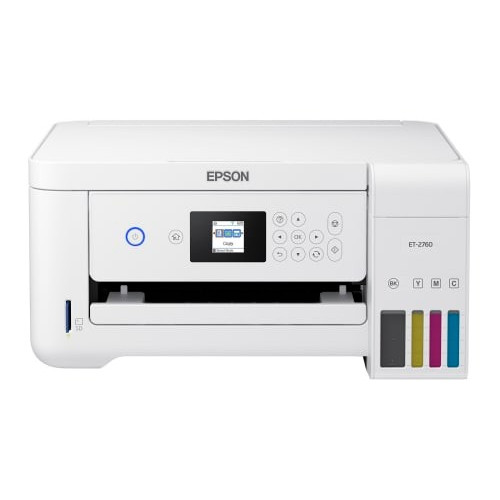
Epson EcoTank ET-2760 printer -$299.99 at OfficeDepot
(roughly £230) If swapping out cartridges is the last thing on earth you want to do, this Epson EcoTank might just be the printer for you. This cartridge-free all-in-one is also seriously economical in the long term, with an extremely low print cost per color page.View Deal
The EcoTank ET-2760 (C11CG22203) is neither the cheapest nor the most capable of Epson’s popular all-in-one, cartridge-free printer range. It is, however, the model that delivers the most value, available at just under $300.
Its main feature is the fact you don’t need cartridges; instead, you can simply refill the four built-in ink reservoirs (cyan, magenta, blue and black) with the bundled ink set. There’s enough, Epson says, to fill up to 80 individual cartridges (worth around $600) or print 7,500 black/6,000 color pages.
That means much less waste, a lower carbon footprint and less time swapping cartridges around. Add in an extremely low cost per color page (as little as 1c per color ISO sheet) and Epson has a winner on its hands.
The rest of the specification is equally enticing: voice activated printing, duplex double-sided printing, a color display for easy setup and navigation, two year limited warranty and a memory card slot.
As for the caveats, there’s no ADF (automatic document feeder) and the paper tray is not as voluminous as some of its competitors. The EcoTank ET-2760 is also not as fast as it could be, lacks wired Ethernet connectivity and there’s no front USB port to plug in a storage device.
This Epson device is ideally suited for those that prioritize simplicity above all else, because it won't need filling up any time soon.
How often does it happen that you’re scrolling through Instagram, come across something really cool which was apparently shot on a phone, but when you try it, it just doesn’t match? Even if your phone might be capable to do it?
Some of us might hate to admit this, but it is probably because the photographer was better with the camera he/she was using, or they probably knew how to edit in the right way. Basically, the person knew how to make the most of whatever resources were at disposal, which is very likely the same as yours. In even simpler words, the same hardware was used to create better results because of better knowledge of the software and manual settings.
What if our phones would just know how to get the shot based on what we ask it to do?
Cameras on smartphones have come a long way in the last few years. Along with an increase in quality and quantity, they’ve become easier to use. Getting the shot you wanted is usually not that difficult, especially with high-end phones. They work well for most scenarios, but can be confusing when trying to shoot something out of the ordinary.
To understand what a phone camera could possibly do one day, we need to understand what it can’t do today. All modern digital cameras work in the same way in principle — Light waves reflect off objects, enter the camera passing through a series of lenses and hits the sensor, which then processes and converts them into signals which can be interpreted as an image. The differences between any two images is basically a fluctuation of any of these parameters. Some of these can be controlled while others are what you have to make do with.
For instance, the biggest reason why images from a DSLR look so nice over a smartphone image is the significantly bigger sensor. Image sensors have the biggest impact on the look of the image, where bigger is almost always better. In technical terms, it allows for better details, a shallower depth of field and potentially brighter images. While the sensors in smartphone cameras have definitely gotten bigger, there’s also nearing the upper limit of how much space they can occupy within a phone.
AI to the rescue!
(Image credit: Future)
The solution? Bridging the hardware inadequacy via smart software (software being a very wide term here). The individual adjacent pixels are combined to have significantly larger resultant pixels and improve light sensitivity. The depth of field is increased via implementations such as portrait mode which understands what the subject is and defocuses from everything else. Since the aperture can’t be changed and pulling the shutter speed will bring shake to the equation, phones use superior processing to make images brighter even when there may not be enough light.
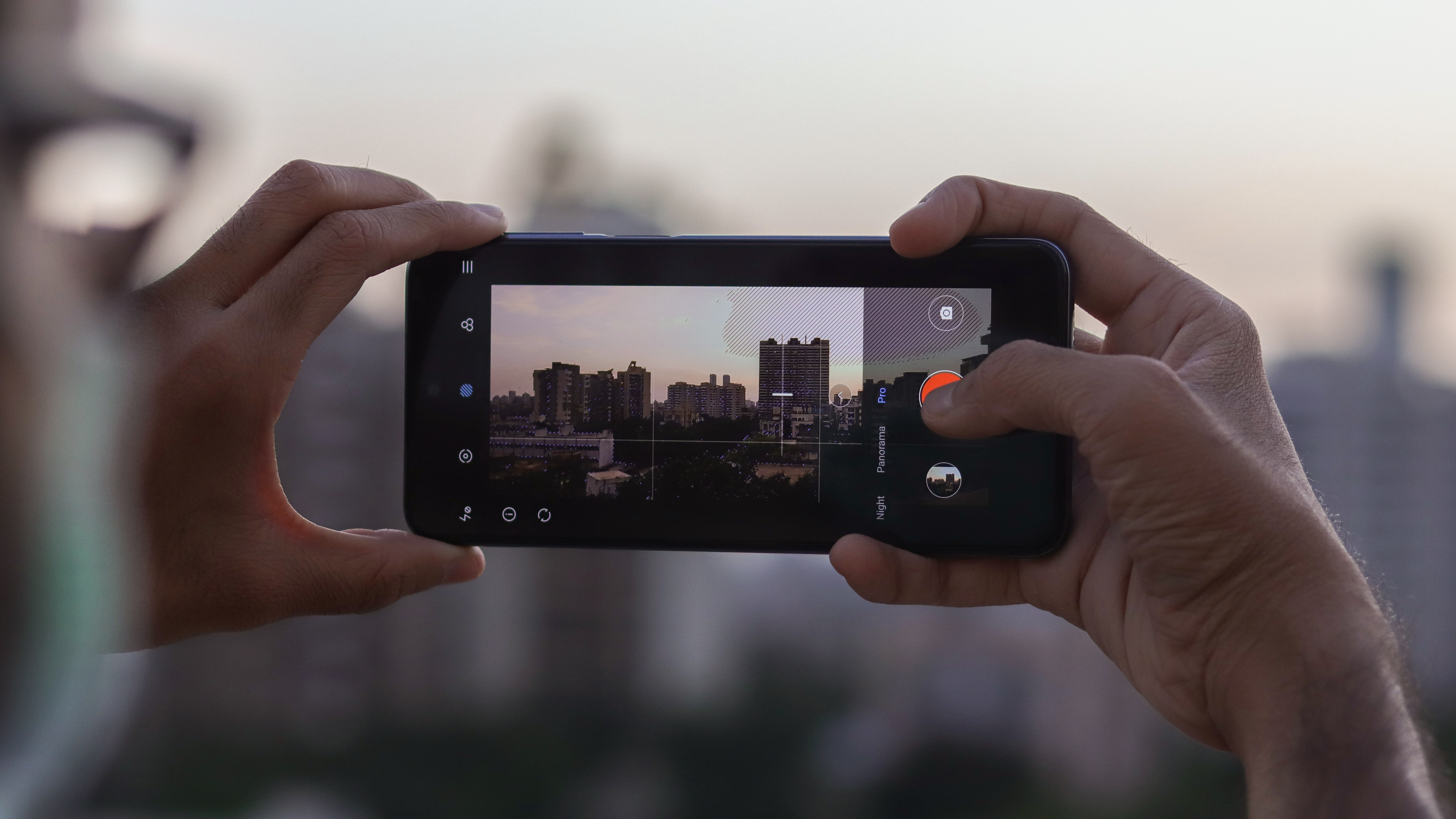
The last bit is going to get increasingly more important as more phones look to adopt varying degrees of computational photography. Here’s a very basic test you can do to understand how effective it can be. Try clicking a picture of something in less than ideal lighting conditions, such as a dimly-lit room, in the auto. Now check its EXIF data (usually found under the ‘details’ section of an image) and note down the settings. Switch to the Pro mode, move to the same settings and then click an image. The result will invariably be worse. The sole reason for this is that while shooting with manual controls, the phone holds back how much it processes an image. Any real camera (aka non-smartphone) will not natively support such optimiazations and will be dependent on the exposure triangle. On modern phones, the exposure triangle is getting more irrelevant each day. Features such as Night mode widen the gap further.
The ability of a smartphone to change how it behaves when given a specific set of instructions which override the shooting settings is what will put them ahead of dedicated cameras.
We’re not saying that DSLRs are endangered, but there are definitely a lot of things a smart phone would be able to do better than a dumb camera. For this particular example of shooting in Night mode, the phone understands that the shutter speed needs to be pulled but not too much, multiple images are clicked and stacked to increase illumination throughout the, highlights are suppressed and shadows are raised, any shake is compensated for, the noise is reduced, align with a bunch of smaller tweaks to yield a brighter image. But this is just the beginning…
Overtaking a 'real' camera
Astrophotography, a style reserved for extremely high-end shooters is now possible on affordable smartphones that take the night shooting optimizations to the next level. Bring able to shoot constellations with just a phone and tripod, without any knowledge of how to focus or expose an image, or a mount that tracks and compensates for Earth’s rotation is beyond exciting.
On the same lines, some phones offer a long exposure or a light painting mode. This is not only a technically difficult option, but also one that can be tricky even if you know your way around with a camera. If that wasn’t enough, the phone will also give you an edited image ready for sharing. Low-light photography is just one of the areas where phones are better. They also win in areas such as dynamic range, focusing, stabilization, audio capture, weather-proofing, burst photography and many more.
It’s no secret that we’re almost at the point where the hardware on smartphones can no longer improve with the current state of technology. Sensors will probably get a little bigger, manufacturers will toy with the idea of faster apertures, and OIS could get more robust, but we’re looking at marginal improvements now. Moreover, the changes that come with these upgrades can also have detrimental effects. A big sensor combined with a wide aperture is the recipe for creamy bokeh, but take it too far and you have a camera that will struggle to focus on any macro subject. This is due to the plane of focus getting so slim so anything that is a few millimetres on either side starts going out of focus.
The solution can once again come from a combination of smart software that makes the camera function in a particular way - focus stacking. As the name suggests, it involved clicking multiple pictures at the same settings but with slight changes in where the camera focuses. Once the stack is ready, the images are combined at their sharpest points to yield an image that has a subject entirely in focus.
Even better than offering manual controls?
(Image credit: TechRadar)
Manufacturers often face the challenge of whether they should prioritize giving more features to users or give an easier user experience. Companies such as LG, Samsung and Huawei lean towards the former while Apple and Google lean toward the latter. Neither is particularly wrong, as it is a conscious choice to not give an option that users may not know how to use and end up getting bad results. Here’s where AI and computational photography can solve things and bring features that were hitherto inaccessible.
People like to click cool pictures and smartphone makers want to assist in their aspirations when possible.
Once you understand how every image is practically just a function and combination of the settings, the opportunities to break these rules increase exponentially. It might even compel smartphone makers to move to ideas that don’t imitate real cameras but find smarter workarounds for problems.
The move to multiple lenses on smartphones is a classic example of how you can achieve versatility when your camera’s capabilities are limited; by letting another camera take care of it. Multiple focal lengths is the most popular example of this, but there are some other unusual creations too. Monochrome sensors can help improve tonality and dynamic range as black and white images are inherently better at that. Some phones opt for the exact same cameras just to be able to gather more information within an image and enable more editing legroom. In simpler terms, smartphones continue to adapt and overcome conventional camera challenges via sophisticated hardware and software combinations. We’re just at the beginning of this revolution.
By taking the route less travelled, some companies have also experimented with ideas such as built-in ND filters via electrochromic glass that can control the physical amount of light entering the camera by changing its opacity. As gimmicky as it may seem, it opens up opportunities such as truly cinematic video shooting where the shutter speed doesn’t keep bouncing as the ambient light, or something way trickier such as day-time long exposures or silky water.
Perhaps, we could finally see iPhones and Pixels offer added versatility in this manner instead of manual controls.
In a time when physical attributes of a camera are about to hit a wall, hardware will be a decreasingly smaller part of the equation in the future. And the best part? Since these will be software-driven features, your phone’s skills could theoretically keep on growing as more models get trained and shared.
The point of this piece is to show consumers what could be cooking in a few years from now as manufacturers find ways to add these features in a way that more people can use it. In an ideal world, you just tell your phone what you’re looking for and it takes care of the rest with minimal assistance. A future where smartphones truly democratize all forms of photography might not be that far.
Redmi Note 9 was launched in India last month and will go on sale today via Amazon and Mi.com starting 12pm (noon). It has gone on sale multiple times in the past.
The crypto-mining malware used by the cybercrime group TeamTNT has been updated with new functionality that allows it to steal AWS credentials from infected servers.
The group has been operating since at least April of this year according to a report from Trend Micro, whose researchers discovered its cyptocurrency miner along with a DDoS bot used to target Docker systems while investigating an open directory containing malicious files first discovered by MalwareHunterTeam.
TeamTNT scans the internet searching for misconfigured Docker APIs that have been left exposed online without a password. When the group finds a vulnerable Docker system, it deploys servers inside the installation to launch DDoS attacks and run crypto-mining malware.
However, TeamTNT is just one of many cybercrime gangs that employs similar tactics in order to take advantage of organizations whose systems are not properly secured online.
First cryptocurrency, now credentials
According to a new report from the UK-based security firm Cado Security, TeamTNT has expanded the scope of its malware to target Kubernetes installations while also adding a new feature that scans infected servers for any AWS credentials.
If an infected Docker or Kubernetes system runs on top of AWS infrastructure, the group scans for AWS credentials and configuration files, copies them and then uploads them to its command-and-control server. To make matters worse, both the ~/.aws/credentials and ~/.aws/config files stolen by TeamTNT are unencrypted and contain plaintext credentials and configuration details for a target's AWS account and infrastructure.
Thankfully though, the group has not yet used any of the stolen credentials according to researchers at Cabo Security who sent a collection of canary credentials to its C&C server which have yet to have been used.
Team TNT and its crypto-mining malware pose a serious threat to organizations as the group will likely be able to boost its profits significantly by either selling the stolen credentials or using them to mine additional cryptocurrency.
Also check out our complete list of the best antivirus software
Realme’s mid-range series is all set to get a new refresher soon. The company has now confirmed the launch of the Realme 7 series in China.
The Realme 7 series will be unveiled on September 1 in China as per the official posting on the micro-blogging platform, Weibo. The device will be unveiled at 2 PM in China which is 11:30 AM in India on September 1.
At the launch event, Realme is expected to unveil the successor to the Realme 6 and 6 Pro which is Realme 7 and 7 Pro. Along with the Realme 7 series mid-range devices. The company is also expected to announce a couple of budget devices, the Realme 7i and the Realme C17.
All the aforementioned devices have cleared NBTC certification recently, according to tipster Mukul Sharma. The Realme 7i comes with “RMX201” model number, the Realme 7 Pro has “RMX2170” model number linked to it, and lastly, the “RMX2103” model number is linked with the Realme 7i. Further, he also confirmed that the Realme 7 Pro will be coming with support for 65W fast charging and will have a dual-cell battery inside.
Furthermore, the teaser on the Weibo also reveals a couple of features. The Realme 7 Pro(X7 Pro in China) is said to come with a 120Hz refresh rate and sport an AMOLED screen which is a huge upgrade from 90HZ LCD panel on the Realme 6 Pro. Also, the Realme 7 Pro’s is a big jump from 30W fast charging to 65W fast charging.
The device is also confirmed to support 5G. So, we can expect the device to pack in a Snapdragon 765G or the Snapdragon 690, which are 5G capable SoCs from Qualcomm. Although we don’t have confirmed information on the chipset, we won’t be surprised if the devices will be powered by MediaTek’s dimensity 5G family.
A decade after it was first announced and the NBN rollout is almost complete, so there’s a very good chance that wherever you are in Australia, you’ll have access to the nation’s high-speed network.
While different areas will have access to different connection types, some of the trickiest choices you’ll need to make are deciding which internet service provider to go with, which speed tier you’ll need and how much data you’ll use.
Here, we’ll drill down on the best NBN plans currently on offer, whether it be the most affordable option, the highest speeds or the best overall value. Along with our handpicked plans, you’ll also find a live tracker featuring the best NBN plans as, and when, they’re put on offer.
The price for NBN50 plans is steadily creeping up but this one from Tangerine is the best value right now. Starting at a little under AU$60 a month for the first half-year, you'll get unlimited data and no lock-in contract. You'll need your own modem though, or alternatively you can pay AU$119.90 upfront to get the same plan but with an included modem.
Tangerine had long held our number one pick for best NBN100 plan, but it’s now been dethroned by this killer deal from Mate. For AU$79 a month, you’ll get unlimited data and typical evening speeds of 83Mbps – excellent value for a premium plan. There’s no setup fee, and you’ll have the option of using your own modem, or you can pick up a preconfigured one from Mate for AU$165.
Before rushing to sign up to a high-speed NBN1000 plan, there are a couple of caveats you should be aware of. This tier is only available on two types of NBN connection – fibre-to-the-premises (FTTP) and hybrid fibre coaxial (HFC). And while all FTTP connections can sign up for 1000Mbps, that speed will only work with a select subset of HFC installations – estimated to be roughly 7% of the total.
Aussie Broadband was the first in the market to offer NBN1000 to residential addresses, but that didn’t stop the telco from offering an incredibly competitive plan. For download speeds of up to 1Gbps and upload speeds approaching 50Mbps, you’ll pay just AU$149 a month. Aussie has rightly cautioned potential customers that it’s yet to determine definitive numbers on peak evening speeds, though it’s put forward 215Mbps as its baseline, so you’ll at the very least get that.
If you’re happy to sign up to an NBN1000 plan with a 3000GB data limit, you can opt for this limited time deal with Superloop, where you can save AU$10 each month over your first year – that’s AU$139 each month. That discount is available with the code Whistleout10FOR12 until September 30.
We won’t beat around the bush, Australia’s top telco doesn’t have the cheapest NBN options around. But what Telstra offers in exchange is high quality, reliability and extras such as a three-month free trial of Binge. With this NBN50 plan, you can expect unlimited data with typical evening speeds of 44Mbps. And if you have a landline, you’ll get unlimited calls to Australian mobiles and standard lines at no extra cost. New Telstra customers will have their connection fee waived, and if you stick with them for 24 months, you won’t have to pay for the Telstra Smart Modem either (usually AU$216).
If you’re looking to go with a trusted telco, but are hoping for a competitive price, then this NBN50 plan from Optus offers value for money. For AU$75 a month, you’ll get unlimited data and typical speeds of 44Mbps during the busy evening period. Optus Sport is also included as standard, and the telco’s modem comes with 4G backup. It’s worth noting that there’s an additional AU$99 upfront fee to get started, and if you stick with Optus over 36 months, you won’t have to pay for the modem (usually AU$252).
TPG is a favourite for delivering solid, reliable speeds at a bargain price. The ISP typically ranks well in the Australian Competition and Consumer Commission’s (ACCC) quarterly report, delivering typical evening speeds of 46Mbps. If you sign up for 18 months, TPG will waive the usual AU$99 setup fee. However, note that a AU$10 delivery fee applies, as well as a AU$20 home phone deposit. While this plan is much cheaper than what’s on offer from the big telcos, be mindful that you could face a contract payout fee of up to AU$350 if you decide to leave early.
Total minimum cost over 18 months is AU$1,289.82View Deal
Live-updated NBN deals: today's best-value plans
Want to see other broadband options? You can use our broadband plan finder to compare a huge range of Australian NBN, broadband and cable plans!
NBN connection types: what you need to know
Australia’s NBN was first proposed as a high-speed network of fibre-optic cable that would reach every home in the country. Following a change in government, that’s not what we've ended up with, with the final rollout combining a mix of old and new technologies.
While the NBN is made up of a multi-technology mix, it’s important to know that you don’t have a choice in what technology is available to you. Different connection types have been built in different areas, so it’s entirely dependent on where you live. Below, we lay out the connection types across the network, and what they mean.
Fibre-to-the-premises (FTTP)
FTTP is a fibre-optic line that runs directly to your home, and therefore is the best type of connection you can have. It requires a device to be installed in your home, and is what was originally intended for every household in Australia when the NBN was first announced.
Fibre-to-the-building (FTTB)
An FTTB connection is most commonly used for connecting apartment blocks and similar buildings to the NBN. In this instance, a fibre-optic line runs to the building’s communications room, and existing technology such as copper wiring is used to connect each apartment from there.
Hybrid fibre coaxial (HFC)
An HFC connection uses existing pay TV (Foxtel) or cable network as the final connection to households. The HFC line will run from your home to the nearest available fibre node.
Fibre-to-the-curb (FTTC)
FTTC is when the fibre-optic cable extends a little closer to your home by connecting to a distribution unit located outside on the street. From there, it uses the copper phone line to run the last leg into your home.
Fibre-to-the-node (FTTN)
The majority of Australian households – around 4.7 million – are using FTTN technology. This connection type uses existing copper phone wire to make the final connection to the home from a central node in your neighbourhood. The distance of your home to the node will affect the average speeds you can reach, so if your home is more than 700m from the node, it’s not advisable to choose an NBN100 plan.
Fixed Wireless
Fixed Wireless connections are used to reach regional and remote areas. Homes in these areas will access the NBN from a transmission tower through an antenna installed on their roof.
Sky Muster satellite
The NBN’s Sky Muster satellite technology is also used to reach regional and remote communities. It requires a satellite dish to be installed on the premises, to which the NBN is received through satellite.
Other factors to consider
It’s important to note these recommendations do not take into consideration other factors which could make certain deals a better option for you. For instance, do you already have a Telstra or Optus mobile plan and home phone line? If so, sometimes combining them with their respective NBN plans could save you some money.
When applying for a new NBN deal, make sure you’re not already signed up to a contract you can’t get out of – most contracts are on 12 or 18 month terms, so it’s important to contact your current provider before committing to anything else.
Another thing worth noting is some services may not be available in your area. If a particular deal seems good to you, head over to the provider’s website to find out if it’s available at your address.
from TechRadar - All the latest technology news https://ift.tt/2CFEz4b
Update(August 19): The Realme C11 will go on sale in India today.
The Realme C11 will go on sale for the first time in India today. It is Realme’s latest affordable phone which was unveiled in India last week along with 30W Dart charge power bank.
The Realme C11 will be available in Flipkart starting 12 noon today on Flipkart. It is priced at Rs 7,499 and will be available in two colour options: Rich Green and Rich Grey.
The handset comes in only one configuration - 2GB of RAM with 32GB internal storage along with a dedicated microSD card slot(up to 256GB). On to the optics, the Realme C11 comes with 13MP f/2.2 primary shooter with 2MP f/2.4 portrait lens and over at the front, you get a 5MP selfie camera with f/2.4 aperture. The camera functionalities include HDR, Chroma Boost modes, and super nightscape mode. The Realme C11 misses out on the fingerprint scanner and instead gets only the face unlock.
It is backed by a big 5,000mAh battery with 10W charging support via micro USB slot. It is running on Realme UI based on Android 10. Connectivity options include Wi-Fi 802.11 b/g/n, Bluetooth 5.0, and Dual SIM slot. On the sensors front, you get Magnetic induction sensor, light sensor, proximity sensor, and acceleration sensor. The device weighs around 196 grams and is thick at 9.1mm. The device is also splash resistant.
Realme will be announcing yet another smartphone in India this week dubbed Realme 6i. It is said to be a rebranded version of Realme 6s which was launched in Europe recently. It is very similar to Realme 6 the only major difference is the rear camera. The Realme 6i is expected to come with a 48MP setup instead of a 64MP quad-camera array. The device will be launched in India on July 24.