Whether that will happen remains to be seen, but Google is ending the era of free access to its Gemini API, signaling a new financial strategy within its AI development.
Developers previously enjoyed free access to lure them towards Google’s AI products and away from OpenAI’s, but that is set to change. OpenAI was first to market and has already monetized its APIs and LLM access. Now Google is planning to emulate this through its cloud and AI Studio services, and it seems the days of unfettered free access are numbered.
RIP PaLM API
In an email to developers, Google said it was shutting down access to its PaLM API (the pre-Gemini model which was used to build custom chatbots) to developers via AI Studio on August 15. This API was deprecated back in February.
The tech giant is hoping to convert free users into paying customers by promoting the stable Gemini 1.0 Pro. “We encourage testing prompts, tuning, inference, and other features with stable Gemini 1.0 Pro to avoid interruptions," The email reads. “You can use the same API key you used for the PaLM API to access Gemini models through Google AI SDKs.”
Pricing for the paid plan begins at $7 for one million input tokens and rises to $21 for the same number of output tokens.
There is one exception to Google’s plans - PaLM and Gemini will remain accessible to customers paying for Vertex AI in Google Cloud. However, as HPCWire points out, “Regular developers on cheaper budgets typically use AI Studio as they cannot afford Vertex.”
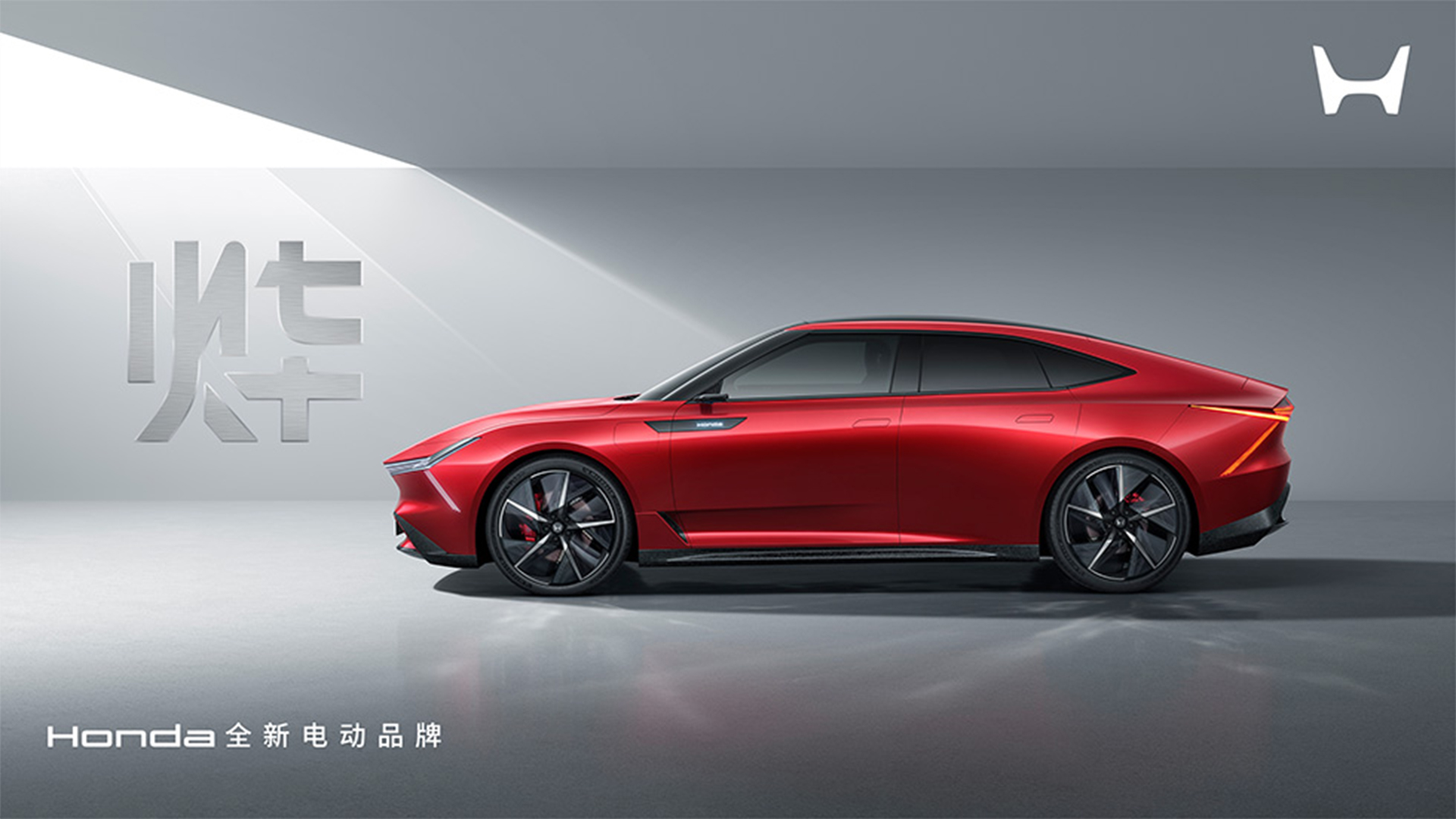
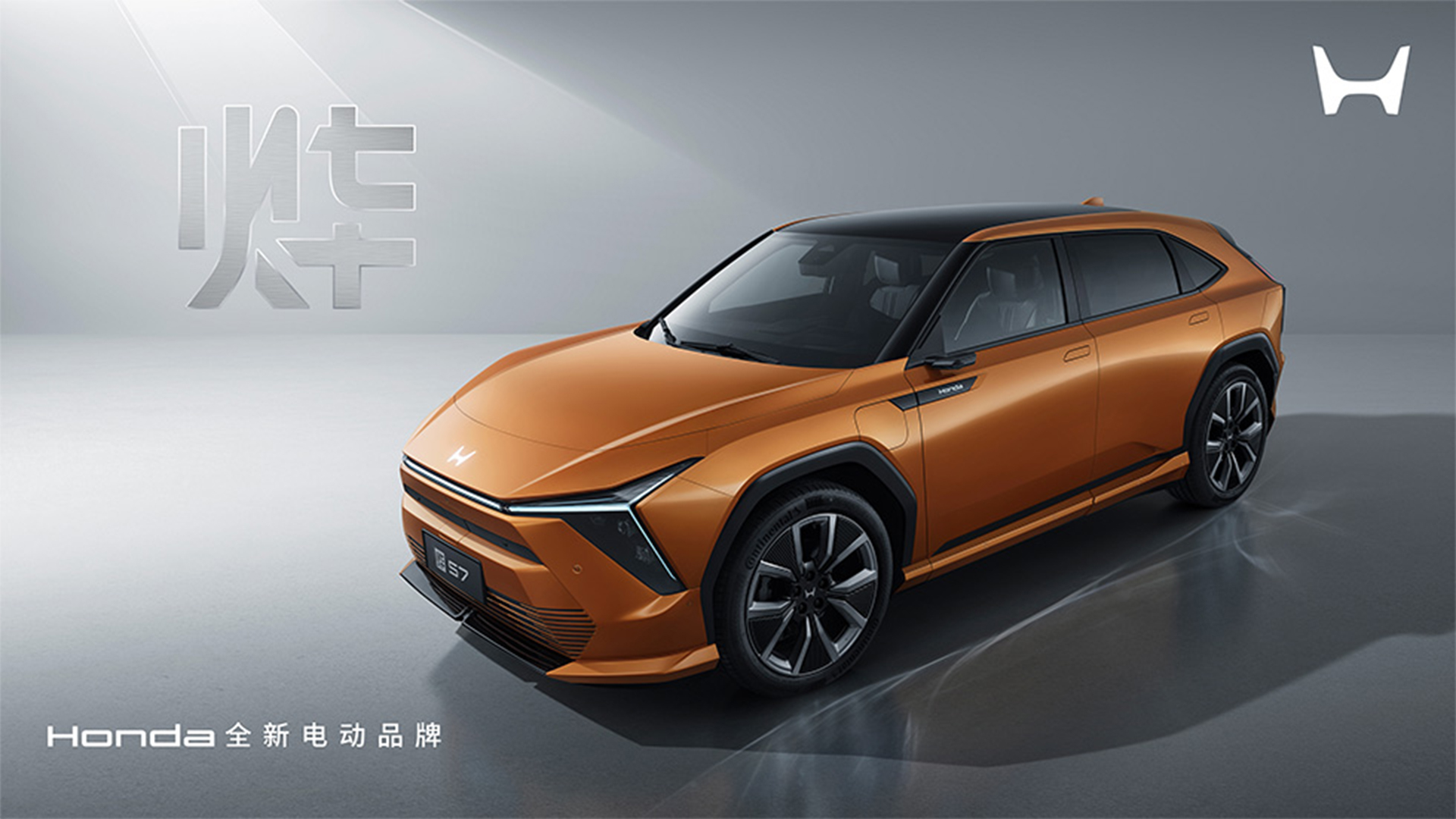
Honda has revealed a new line-up of slick, sporty and decidedly future-thinking electric vehicles that comprises of two SUVs and a low-slung four-door GT that packs a racing-inspired cabin… but there’s a catch.
The Ye Series, which will be joined by a further three concepts in the very near future, is only destined for China and will be fully unveiled in the flesh at the Beijing motor show next week.
Honda says the models are a joint venture between itself and Dongfeng Honda and GAC Honda, two companies that operate in the Chinese domestic market. Despite looking like concept vehicles, the P7 and S7 SUVs are due on sale towards the end of the year.
The pair of sharply-styled crossovers ride on a newly developed dedicated platform and are designed in pursuit of the "joy of driving," according to the slightly clunky press release that a companied the announcement.
(Image credit: Honda)
They will be offered in either a one-motor rear-wheel-drive or dual-motor four-wheel-drive option, and have been specifically engineered to serve up "sporty and crisp handling", although the company doesn’t mention anything about battery capacity, range and charging times.
Compared to the e:Ny1 and the Prologue, which is due to arrive in the US later this year, they are altogether more futuristic, with cameras replacing conventional wing mirrors and longer, wider and lower stances on the road.
To rub further salt into the wounds of Western customers, Honda has also said it plans to offer a production version of the low-slung and rather attractive GT Concept, which the Japanese company claims has a “race driver” seating position and "dynamic performance".
There’s no word on the interiors of all three models (we will have to wait for the Beijing motor show for those), but Honda has said that these China-bound EVs will feature AI-powered assistants, oodles of space inside and funky LED lights that can be personalized with specific lighting patterns.
Analysis: Is this proof that hybrids still rule in Europe and the US?
(Image credit: Honda)
Honda's decision to offer arguably its most exciting models since the innovative and stylish E exclusively to Chinese customers could be a good indication that it believes that hybrids and - dare we say it - combustion engines are still the powertrain of choice for the majority of customers everywhere else.
China is already leagues ahead of the rest of the world in terms of EV uptake, with a staggering 7.7 million units sold in 2023 alone. The country accounts for nearly 60 per cent of EV sales worldwide and more than half of the electric cars on the road today are found there.
So, it appears that if we want to see the results of Honda’s exciting and experimental new design language, we need to start buying more battery electric vehicles. Otherwise we're stuck with the distinctly safe e:Ny1, Prologue and a handful of plug-in hybrids.
For a month now, hackers have been mounting a large-scale credential stuffing attack against multiple Virtual Private Network (VPN) instances around the world. At the moment, it’s hard to say who is behind the attack, or what the motives are, but researchers have some clues.
As reported by Ars Technica, Cisco’s Talos security team recently warned of an ongoing campaign in which attackers keep trying more than 2,000 usernames and some 100 passwords against different VPNs. Some of the products in the attackers’ crosshairs include Cisco Secure Firewall VPN, Checkpoint VPN, Fortinet VPN, SonicWall VPN, RD Web Services, Mikrotik, Draytek, and Ubiquiti, however others could be targeted, as well.
The victims are scattered all over the world, and operate in various verticals, prompting the researchers to conclude that the attackers don’t have a preferred target, but are rather casting as wide of a net as possible.
Growing in strength
“Depending on the target environment, successful attacks of this type may lead to unauthorized network access, account lockouts, or denial-of-service conditions,” the researchers said in their report. “The traffic related to these attacks has increased with time and is likely to continue to rise.”
While the evidence is inconclusive, the researchers believe this could be the work of the same threat actor that targeted Cisco a few weeks back. They are basing this assumption on the facts that there are “technical overlaps” in how the attacks were conducted, and that in both instances, the same infrastructure was used. In the Cisco campaign, the goal was reconnaissance, so the speculation is that it’s the same this time around.
The IP addresses found from the previous attack were already added to Cisco’s block list for its VPN, and organizations worried about these attacks are advised to do the same, for any third-party VPN they have deployed.
A super-powerful all-in-one PC has been unveiled by Alafia AI, a startup specializing in advanced imaging appliances.
The Alafia Aivas SuperWorkstation is a medical imaging behemoth powered by an Ampere Altra Max 128 ARM v8.2+ 64-bit CPU running at 3.0GHz, and Nvidia GPUs.
The SuperWorkstation sports a 27-inch 4K touch-sensitive rotating display and comes with 2TB DDR4 memory and an 8TB SSD expandable up to 72TB.
Won't run Windows
Alafia AI claims the GPUs have up to 28,416 cores, but we’re not entirely sure of the setup. Tom’s Hardware says the device has Nvidia RTX 4000 and RTX A3000 GPUs but the latest specs revealed at Embedded World 2024 say only that it’s powered by a single Nvidia RTX card, with AI acceleration provided by the "three Nvidia Tesla Ada Architecture Tensor Core GPUs". Nvidia retired the Tesla brand in May 2020. We've asked Alafia AI for clarification.
The SuperWorkstation doesn’t run Windows, instead it has a custom OS (ALAFIA OS 24.04 LTS) for AI inference and medical healthcare. The workstation reportedly features a custom cooling solution to manage its 700w power consumption efficiently.
The machine has two Intel X550 RJ45 (10GbE) one Intel i210 (1GbE) RJ45 ports and can drive three additional screens via HDMI, DP and miniDP ports, at up to 8K. There are also USB-C 3.2 and USB-A 3.2 ports, and connectivity is provided in the form of Wi-Fi 7 802.11be and Bluetooth 5.4.
The company plans a Q2 2024 hardware release, and as you might expect there’s no actual published pricing – potential buyers will need to contact the company directly for that.
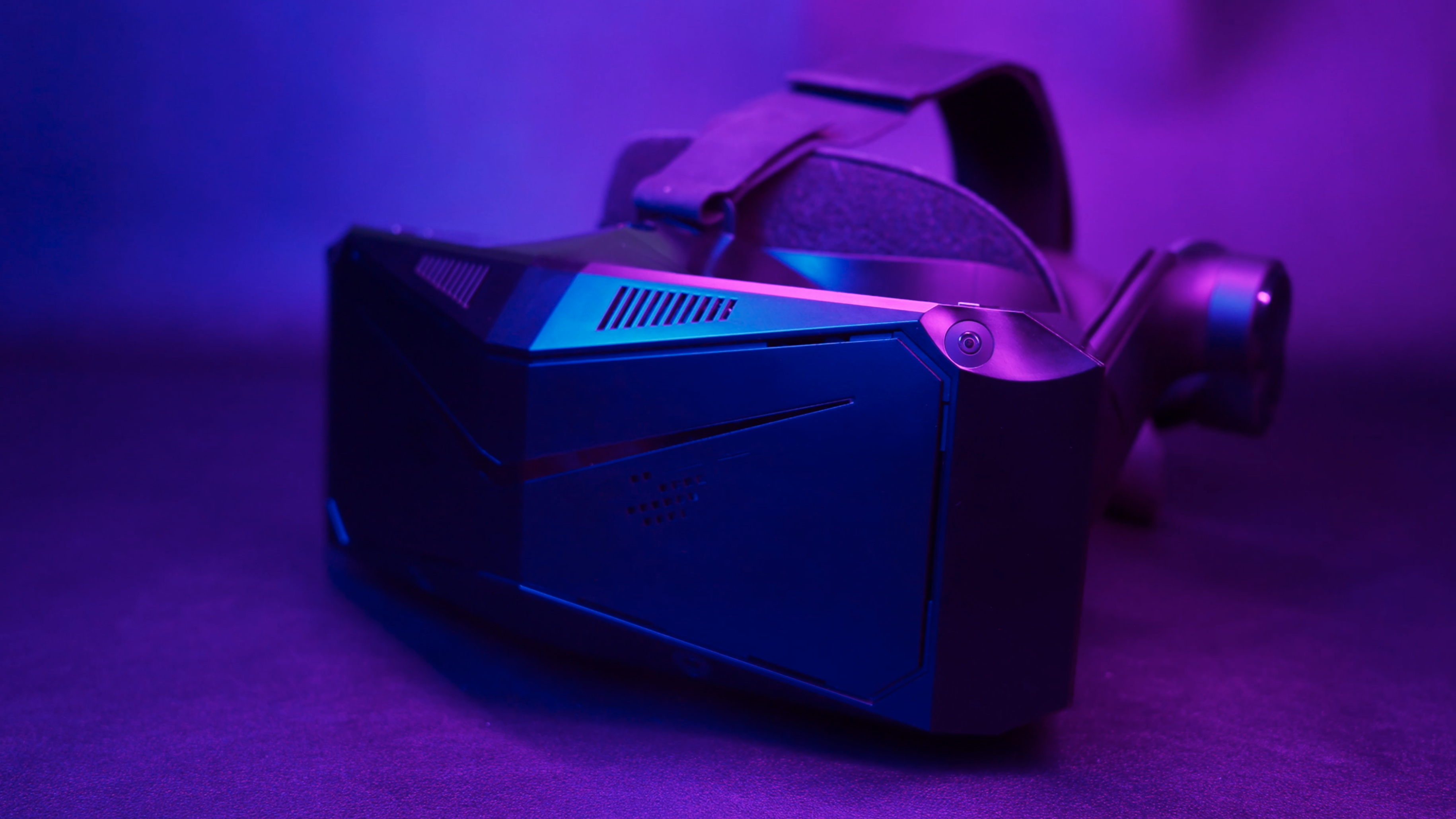
Pimax has unveiled two new VR headsets with the top of the line Pimax Crystal Super seemingly set to put the best VR headsets to shame – even the Apple Vision Pro – with some phenomenal specs. It also has one of most unique display features we’ve ever seen: you can swap between an OLED and QLED display engine to get the most out of your virtual experience.
Are you playing a frightening horror adventure that has you exploring dark spaces filled with monsters? Then an OLED screen’s excellent dark contrast will be just what you need. If you’re instead kicking back with a vibrant VR social app then you could swap in the QLED screen to be dazzled by the colors it can produce.
No matter which screen type you choose, the Pimax Crystal Super will deliver 29.5 million pixels across its dual, 3,840 x 3,840 pixels per eye displays, each with 200 nits of brightness. The QLED display system has a max refresh rate of 120Hz and uses glass aspheric lenses, while the OLED one has a 90Hz max refresh rate and uses less bulky pancake lenses.
You’ll also find neat features like eye-tracking, dynamic foveated rendering, and inside-out tracking – so there’s no need for lighthouses.
As you'd expect, this swappable display design doesn’t come cheap. If you want a Pimax Crystal Super with both the OLED and QLED display engines you’ll be paying $2,399 (around £1,925 / AU$3,700) for the headset. Alternatively if you’d rather get just one type of display the QLED model will set you back $1,799 (around £1,450 / AU$2,800 ) while the OLED version costs $1,999 (around £1,600 / AU$3,100).
No precise release date has been given yet but Pimax estimates the Crystal super will launch in Q4 2024 (so October, November or December).
The Pimax Crystal Light(Image credit: Pimax)
If this is all still too much to pay for a VR headset – especially one that requires you to have a similarly high-end PC gaming rig so you can get the most out of your headset’s capabilities – or you want a headset that’ll arrive sooner, you could instead opt for the Crystal Light.
The crystal light boasts less sharp displays – boasting just 2,880 x 2,880 pixels per eye – though its QLED screen can get up to 120Hz. However, it uses aspheric lenses so will be bulkier than headsets using pancake lenses, and it lacks eye-tracking, and dynamic foveated rendering capabilities.
The upshot is it’s a heck of a lot cheaper starting at just $699 (around £550 / AU$1,100) and it should launch in May according to Pimax.
As impressive as these news Pimax headsets sound, I'm disappointed that they’re locked into the PCVR ecosystem, and aren’t at least adopting Pimax’s own wireless tech.
Analysis: Several steps forward, several steps back
A big issue with PCVR headsets are the cables that tether you to a PC – or a console in the case of PSVR 2 – that limit your movement, and that you can catch yourself on as your flail about in virtual reality.
However, as we’ve seen from the displays in Pimax’s headset, the advantage of PCVR is you can enjoy a super high level of graphics and performance that outshines standalone devices – like the Meta Quest 3 and even Apple Vision Pro (provided you have a great PC, that is).
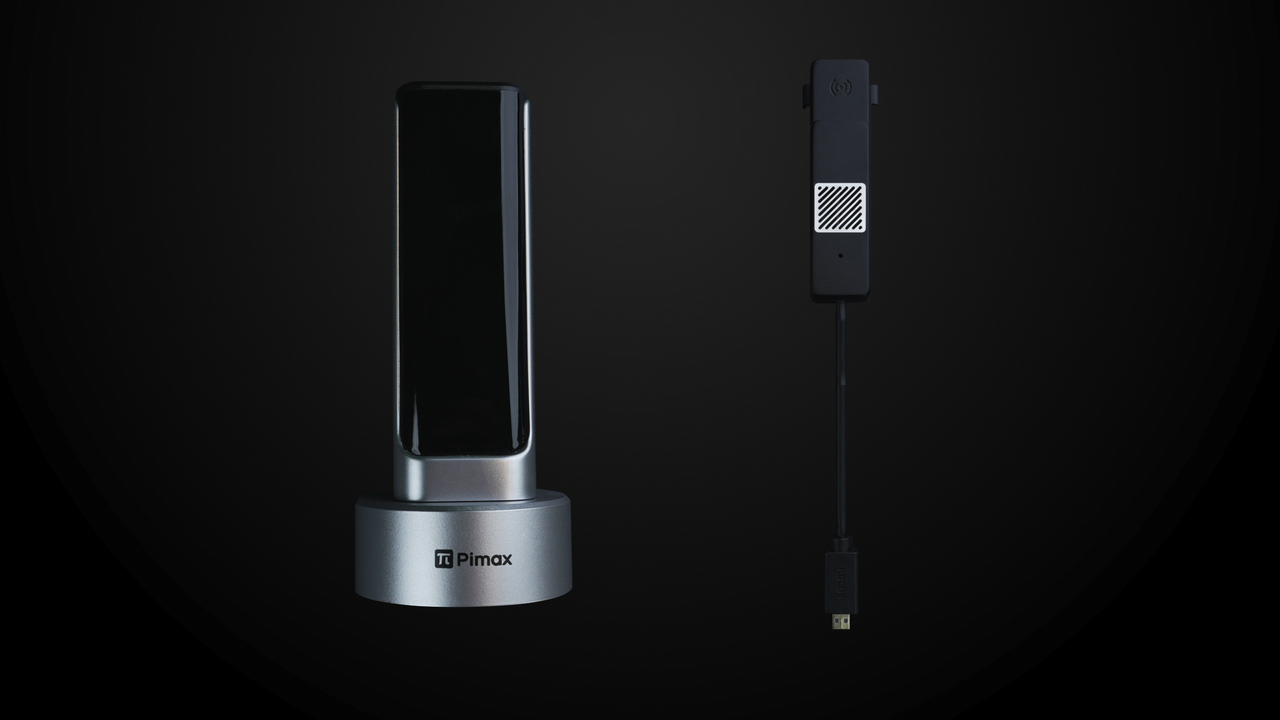
This is where a wireless module can come in like the Pimax Crystal 60G Airlink device as they allow you to enjoy PCVR without being tethered. We’ve known that this device has been coming for a while – it was demoed at CES 2024 already – but we finally know exactly what the Crystal 60G can do with official specs straight from Pimax.
Specifically it boasts wireless PCVR with a 2,880 x 2,880 pixel resolution per eye, 90Hz max refresh rate, and “ultra low latency” – though exactly what this means hasn’t been revealed.
The Pimax Crystal 60G Airlink module(Image credit: Pimax)
Unfortunately, neither of Pimax’s new headsets – the Crystal Super or Crystal Light – will support the 60G Airlink module.
What’s more, they strip out the batteries and Qualcomm Snapdragon XR2 chipset that the base Pimax Crystal headset included, which allowed it to support both wireless PCVR and a standalone VR experience.
To this end, you might find the base Crystal model is the better option for you – or a non-Pimax model like a Quest 3 or Apple Vision Pro – thanks to the versatility offered by a standalone headset. Not only are you freer to use the headset wherever you want but also, with the exception of the Vision Pro, you can very easily use these headsets for wireless VR and for wired PCVR – giving you the best of both worlds.
This versatility is one of the reasons why Quest headsets have been topping the Steam VR usage charts for years.
Considering how impressive Pimax’s machines are I’d love for it to have kept pushing into the world of standalone VR. Improving its software catalogue or partnering with a company with a great VR OS to jumpstart its app store – ideally the amazing Quest ecosystem, though are others out there from the likes of HTC – would also have been great.
I’ll have to try the latest Pimax headset out for myself before giving my final verdict, but as it stands I don’t think these are VR gadgets I can see most people using – nor do I think most people should use them. Which is a real shame because otherwise I feel Pimax’s machines could be a slam dunk on pricey competitors like the Vision Pro – for now, though, I feel relative newcomer Apple has Pimax’s Crystal Super beat, on paper.
Two years after the debut of its Arc Alchemist GPUs, Intel is launching six new Arc products, but these are designed for edge/embedded systems.
These edge systems, which process data near the source to reduce latency and bandwidth use, are becoming increasingly essential in areas such as IoT, autonomous vehicles, and AI applications.
As Intel says, “AI at the edge is exploding with new use cases and workloads being developed daily. These AI workloads often require a high degree of parallel processing and memory bandwidth for peak performance, dedicated hardware, optimized architecture for compute efficiency, and reduced latency with faster results for real-time processing. A discrete GPU may be the ideal solution for edge AI use cases requiring high performance and complex model support.”
Six SKUs
The new Arc on edge GPUs are built on Intel's highly scalable Intel Xe-core architecture and support AI acceleration, visual computing and media processing. Using the OpenVINO toolkit developers can deploy AI models across Intel hardware.
The Arc on edge offerings have a number of benefits, including reduced latency, improved bandwidth efficiency and better privacy and security.
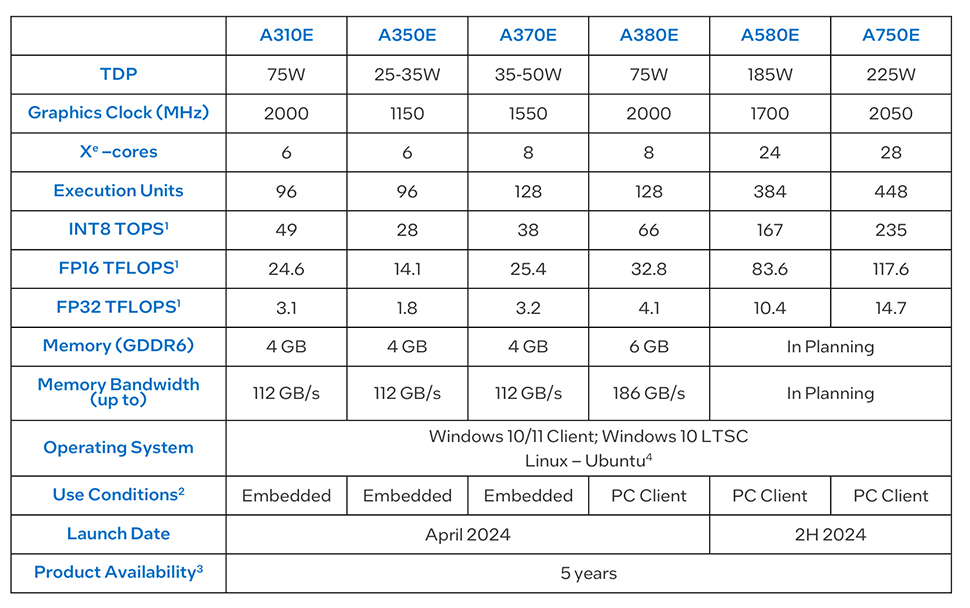
For high performance and to handle heavy AI workloads and expansive use cases such as facial recognition and generative conversational speech, there’s the 7XXE. For immersive visual experiences and enhanced AI inferencing capabilities, there’s the 5XXE, and for low power and small form factor requirements, Intel has the 3XXE.
There are six SKUs available – the A310E and A3503 with 6 Xe-cores, the A370E and A380E with 8 cores, and the A580E and A750E with 28 cores. The A310E, A3503 and A370E have 4GB of GDDDR6 memory with 112GB/s memory bandwidth. The A380E has 6GB with 186GB/s bandwidth, while the A580E and A750E’s memory and memory bandwidth are unknown for now. Intel says only that it is “in planning”. There’s also no launch date for those two either, just TBD. The other four SKUs will be available this month.
Intel Arc GPUs are built to be paired with Intel Core processors, from 10th Gen upwards and Intel Xeon W-3400 and W-2400. A number of products featuring the new Arc GPUs are set to be released in the coming months from Intel partners including from ADLINK, Advantech, Asus, Matrox and Sparkle.
I’m going to tell you that my Roomba S9 Plus is haunted, but don’t dwell on the haunting. The buttons are stuck, which may or may not be related. I have been living with the haunted Roomba and its broken buttons since last year, when it was still under warranty, but it only recently started waking me up in the middle of the night. When I finally contacted iRobot for support, they told me that my Roomba was dead (undead?!), and it would be impossible for them to fix it.
I need to live with the haunted Roomba or destroy it.
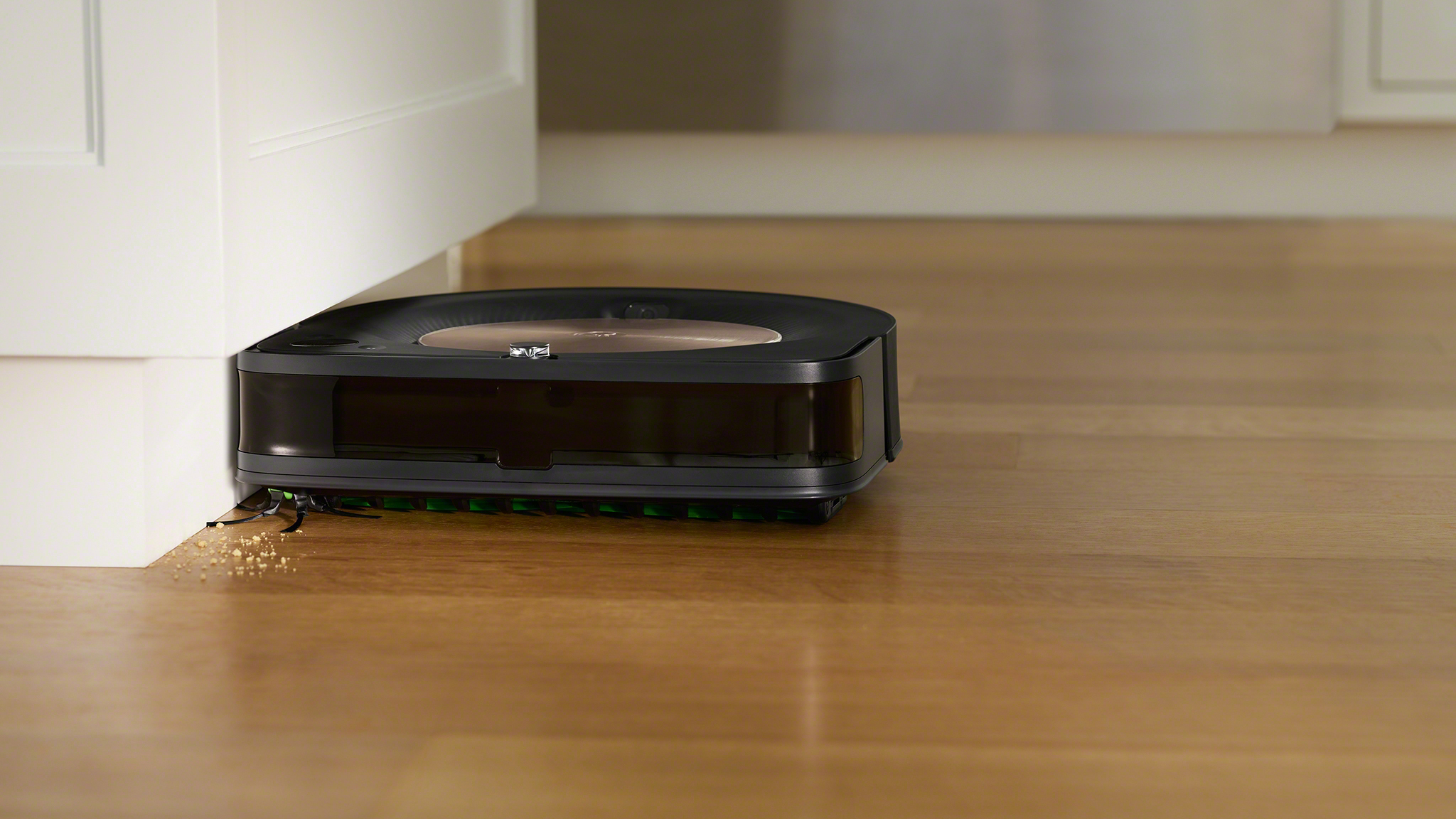
A Roomba S9 like mine, but not as haunted(Image credit: iRobot)
Again, let’s not dwell on the haunting part. There are many things you can replace on a Roomba. Of course, you can replace the filters. You can replace all of the cleaning elements, like the brushes and sweepers.
You can replace the battery, though you’ll need a screwdriver and some patience. The buttons, however, are sacrosanct. If the buttons get stuck, iRobot support tells me they cannot be replaced. There is no way to fix my Roomba S9 with broken buttons, and there is no workaround that will clear the robot of its ghosts.
A broken Roomba behaves like it's haunted
Okay, now for the haunting. One day I was sitting in my living room and the Roomba started to vacuum. On its own. No schedule, nothing. I sent it home again. It kept happening, once a week at first, but it happened at inconvenient times.
My robot would start cleaning at 3 AM, on its own. I had a hunch and engaged the child lock. Now, instead of cleaning on its own, it would loudly yell “The buttons have been disabled. Please use your iRobot home app to clean.”
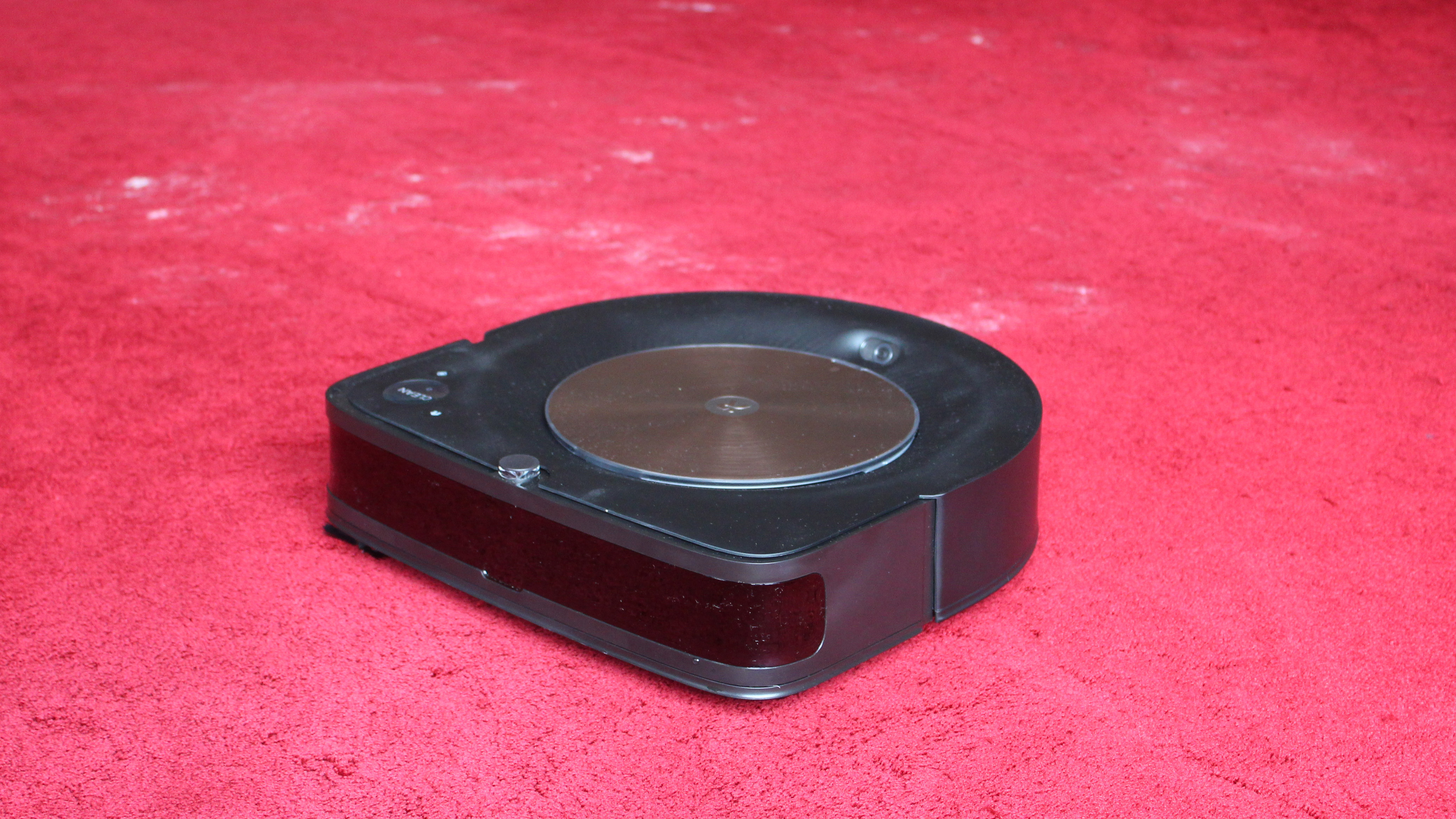
The Roomba on a blood red carpet(Image credit: TechRadar)
Something was pressing the buttons. I’m not saying it was a specific ghost, but it’s been a hard and tragic few years for many of us. I know people who have passed away who would want my floors clean. I know others who might want to pester me at night for fun. Once you believe there is a ghost in your robot vacuum, unsatisfied with unswept floors, that idea sticks.
Eventually, the unprovoked yelling started happening daily. I cleaned the Roomba thoroughly and replaced all of its cleaning parts. I plugged it into a surge protector after reading on Reddit that power surges can cause the vacuum to start a cleaning session. I vacuumed the vacuum itself to clear any dust or debris. Nothing helped.
My haunted vacuum becomes a poltergeist
One night the haunted Roomba went too far. It started screaming over and over again “The buttons have been disabled. Please use your iRobot home app to clean.” Over and over. There is no mute setting for the Roomba. A reboot didn’t help. My Roomba tormented me.
I shut it down by holding down the power button. It fell silent. I went to bed. Then I heard the beeping chime of the Roomba starting up. The robot refused to die.
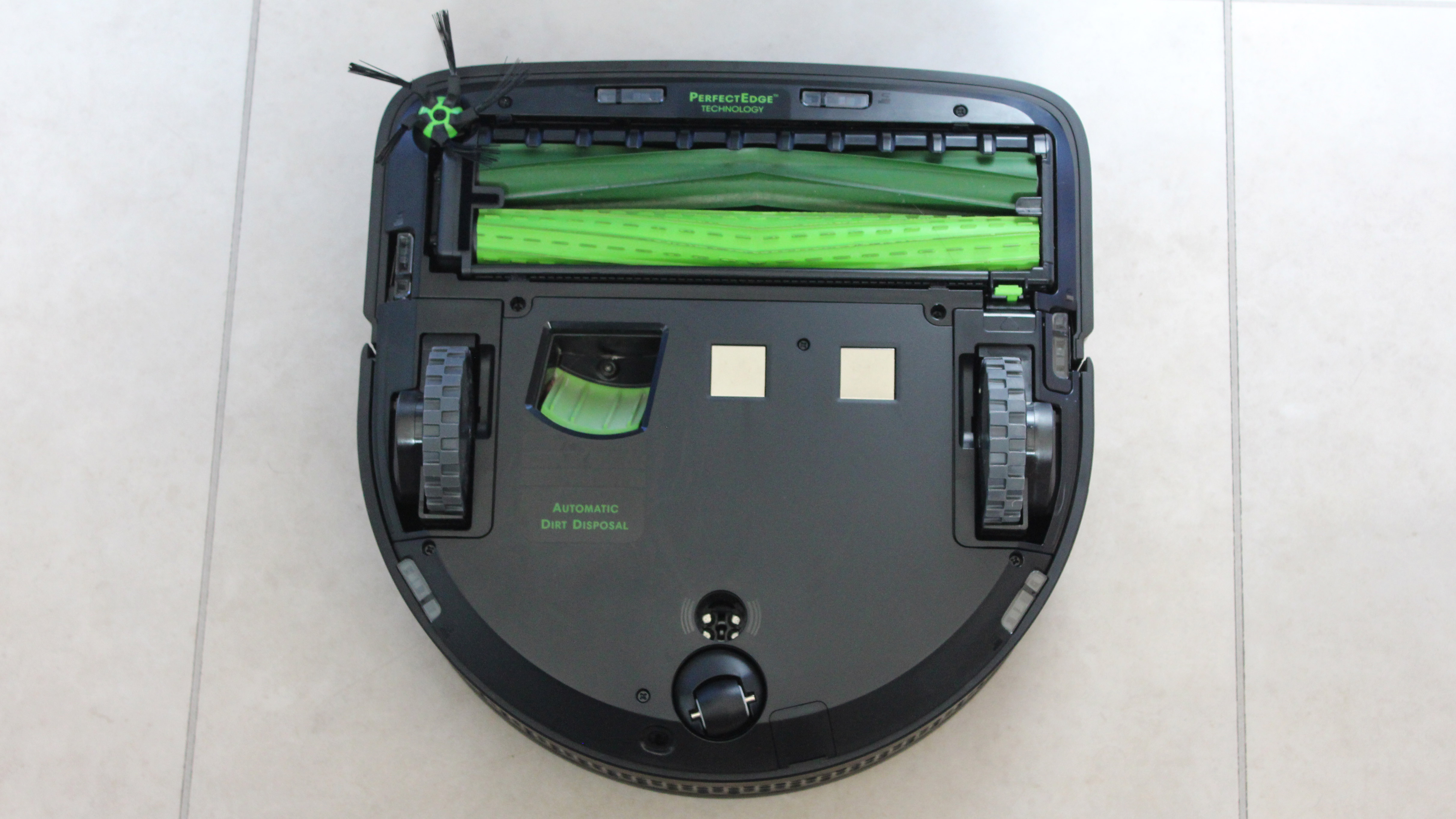
The underbelly of the beast(Image credit: TechRadar)
I covered the Roomba with thick blankets to mute the sound, and eventually it ran out of battery power. I contacted Roomba, and they showed me how to remove the battery completely, to perform a hard reset. The hard reset failed. The screaming continued.
They suggested I set up a Do Not Disturb period for the entire day and night. That actually worked! For a few days, at least. My robot was silent. Then, in the middle of the night (always!), it started to chime as it powered down. Then it chimed again, powering up. Down. Up. Down. Up. It kept going. I unscrewed the battery, and now it sits like an autopsy patient on my table.
There is no fix for a haunted Roomba, or stuck buttons
This was my first robot vacuum, and I won’t be replacing it
Support from iRobot says “The issue you are describing means that the buttons of the robot are stuck, and unfortunately this issue is non-repairable.” They can’t fix it. My 18-month-old Roomba S9 Plus, which I got on sale for around $800 in November, 2022, is kaput.
That’s totally unacceptable. There must be some path to rectify this problem, and not just for me, for all owners. There can’t be a malfunction that causes the robot to die, with no hope of repair. iRobot must have some way to fix this issue, or it needs to offer Roomba S9 owners some way to trade our robots for a robot that actually works, and that is eligible for repairs when it breaks.
This was my first robot vacuum, and I won’t be replacing it quickly because it’s a huge expense that I cannot afford right now. Perhaps in the future, I’ll consider iRobot again, if I hear that reliability and service have improved. Until then, I’ll need another option. Maybe I’ll get a dustbuster, or maybe I’ll call the Ghostbusters.
HP has launched a new ultra-portable laptop in Japan, and the sleek and powerful EliteBook 635 Aero G11 is already being hailed as a potential competitor to Dell's XPS 13, thanks to impressive specs and a lightweight design.
The Windows 11 Pro laptop is powered by either an AMD Ryzen 5 8640U or Ryzen 7 8840U processor and comes with 16GB of onboard LPDDR5 memory and a 512GB M.2 SSD. It features a 13.3-inch WUXGA (1920 x 1200) LCD display with a maximum brightness of 400 cd/m².
The EliteBook 635 Aero G11 includes a 5MP webcam (with a sliding privacy cover), an IR camera compatible with Windows Hello, Poly Studio audio, and a backlit keyboard. With a magnesium casing the laptop is impressively lightweight at just 1kg, making it perfect for users on the go.
Japan only
Aimed at business users, the EliteBook 635 Aero G11 has a variety of ports including USB Type-A 3.2 Gen 1, a combo stereo headphone/mic jack, two USB Type-C 3.2 Gen 2 ports with USB Power Delivery and DisplayPort 1.4 capabilities, HDMI 2.1, and another USB Type-A 3.2 Gen 1 port. Connectivity is provided in the form of Wi-Fi 6E and Bluetooth 5.3.
It looks great, but there is a huge catch – the EliteBook 635 Aero G11 is currently only available in Japan, with no plans for a global launch. It’s possible that HP may be testing the waters with a limited release there first and will bring it to other territories in due course, but for now we’ll just have to wait and see.
In Japan, the EliteBook 635 Aero G11 will be released on April 26, priced from 274,780 yen ($1796.79).