Wednesday, July 27, 2022

Best Bitcoin and Crypto Wallets for August 2022 - CNET

Your crypto wallet holds the keys to your coins and tokens, and it's how you'll buy and sell crypto. Find our top picks for cold and hot crypto wallets.

from CNET https://ift.tt/91R75QC

Latest Tech News

Data breaches are costlier and more impactful than ever before, a wide-ranging study by IBM has found.

Surveying 550 organizations from all over the world, the company claims that the global average cost of a data breach has now hit $4.35 million - an all-time high, and  up 13% compared to the same period two years ago.

However, it’s not just the affected businesses that feel the sting of a data breach - everyone else does, too, albeit passively. IBM says that there is a chance that the rising costs of goods and services could be tied back to these incidents, as well. The company bases these conclusions on the fact that almost two-thirds (60%) of the respondents claimed to have raised the prices of their products or services, due to a data breach. 

Paying ransomware doesn't pay

What’s more, if a company suffers one data breach, it’s bound to suffer another. More than four in five (83%) have experienced more than just one breach in their lifetime, the report found. Then, there are also the after-effects of breaches: almost half (50% of breach costs are incurred more than a year after the initial incident).

The report also states that businesses that suffer a ransomware attack and decide to pay up for their data, don’t usually end up with lower breach costs, compared to those that don’t. Ransomware victims that decided to pay saw only $610,000 less in average breach costs, and that’s not including the cost of the ransom. 

For IBM, having an antivirus solution will not suffice, anymore.

“Businesses need to put their security defenses on the offense and beat attackers to the punch. It’s time to stop the adversary from achieving their objectives and start to minimize the impact of attacks. The more businesses try to perfect their perimeter instead of investing in detection and response, the more breaches can fuel cost of living increases.” said Charles Henderson, Global Head of IBM Security X-Force. “This report shows that the right strategies coupled with the right technologies can help make all the difference when businesses are attacked.”

IBM’s report suggests that Zero Trust is the way to go. However, 80% of critical infrastructure organizations said they did not adopt the practice across their endpoints just yet, despite the fact that they’re paying an average of $1.17 million more for data breaches, compared to those with Zero Trust. 


from TechRadar - All the latest technology news https://ift.tt/N4jZIW3

Tuesday, July 26, 2022

Best Torque Wrench for 2022 - CNET

If you plan on doing any automotive maintenance or repairs, you should own a torque wrench, whether it's a beam-style, a clicker or even digital.

from CNET https://ift.tt/CgAIq1Q

Latest Tech News

Google Workspace has unveiled a much-needed upgrade to some of its most popular software tools aimed at making them easier to use and experience on larger-screen mobile devices.

The updates will cover Google Drive, Docs, Sheets, Slides, and Keep on Android, and look to address several key pain points seen by users with larger-screen Android smartphones or business tablets.

With more of us now working flexibly and across multiple devices, Google hopes that the updates will bring improved usability and less frustration for workers everywhere.

Google Workspace on tablets

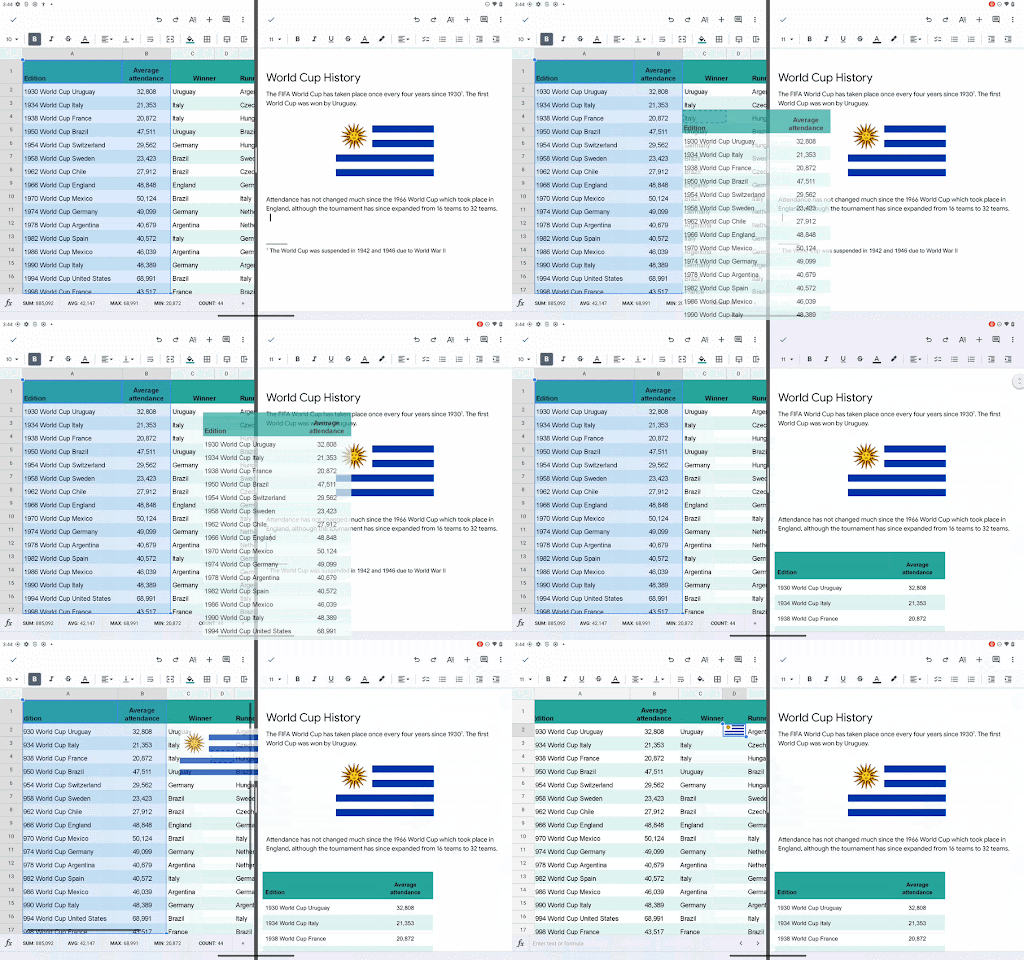
The new features include the ability to drag and drop files from one Google Workspace app to another to improve the links between different services.

For example, users can now drag a table from a Google Sheets form directly into a Google Docs document on the same display, ending fiddly copy-and-paste functions, or drag a Google Drive file into a new Keep note.

Google Workspace drag and drop from Sheets to Docs

(Image credit: Google Workspace)

Mobile and tablet devices will also see much-improved keyboard support for Drive, Docs and Sheets, making it much easier to use your device when on the move. Google says all your favorite shortcuts will be available, making it a lot smoother to use a keyboard when on a train or bus, for example.

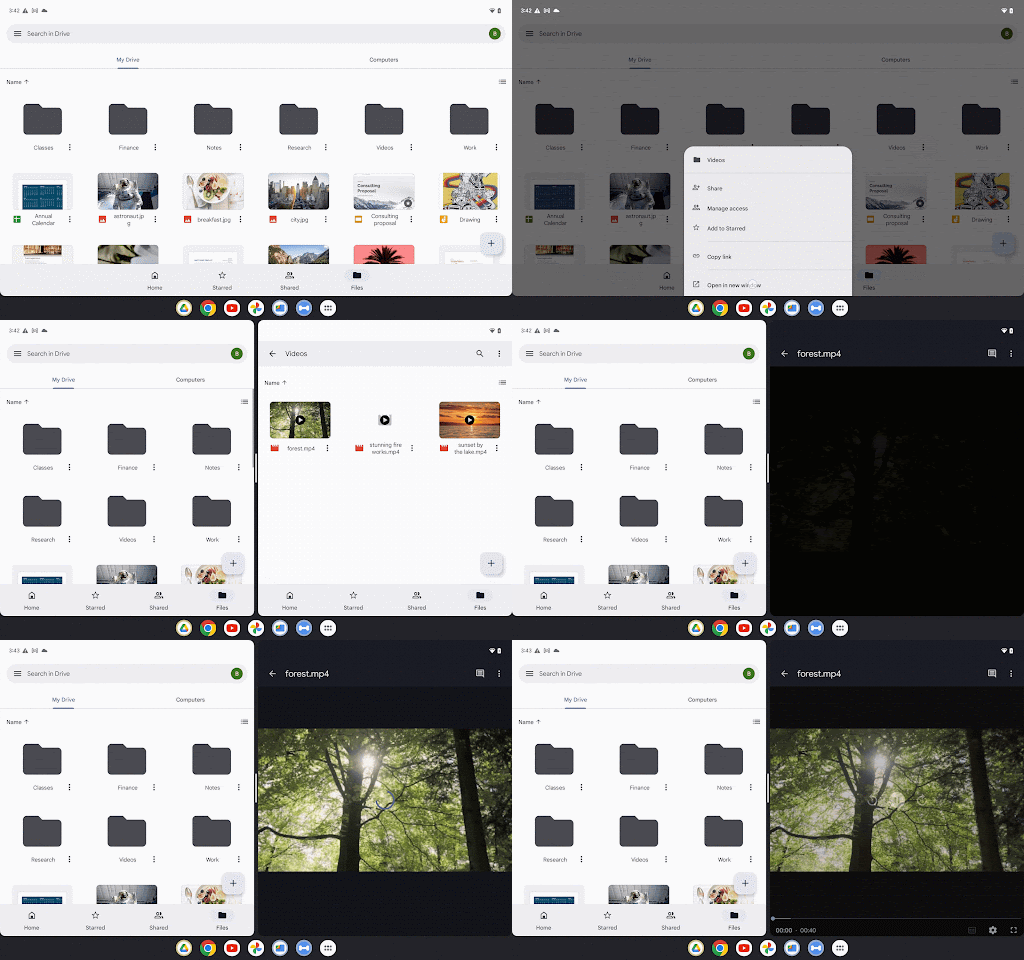
Google Drive multi-instance windows open

(Image credit: Google Workspace)

Finally, Google Drive users can get a clearer view of their files by having two windows open side-by-side at the same time, allowing them the chance to view video or photos without having to juggle multiple overlapping windows.

"As part of our mission to provide a top-class user experience on large screen devices, we’re adding several new features and functionality," the official Google Workspace Updates blog post noted.

"We hope these updates enhance flexibility by giving you more ways to work with, display and organize your content across Google Workspace."

The new features are rolling out now to users across the world, and will be available to all Google Workspace customers, as well as legacy G Suite Basic and Business customers, along with users who have personal Google Accounts.


from TechRadar - All the latest technology news https://ift.tt/7b3u2ch

Viasat Home Internet Review: Availability From Coast to Coast, But It Comes at a Price - CNET

Despite expensive plans, varying speeds (depending on your location) and data caps, this satellite provider is a top rural internet option.

from CNET https://ift.tt/69RkK3b

Latest Tech News

James Cameron’s 2009 sci-fi epic Avatar is being remastered in high frame rate (HFR), along with his 1997 film, Titanic. That announcement comes from Pixelworks, the developers of the TrueCut Motion technology being used to transform the director’s signature blockbusters for a return to theaters.

“We’re bringing Avatar and Titanic back to the big screen, looking better in every way,” said James Cameron in a Pixelworks press release. “We will be presenting both films in 4K with high dynamic range visuals and have been working with Pixelworks’ TrueCut Motion platform to remaster the films in high frame rate, while keeping the cinematic look of the original.”

What is HFR?

To explain HFR, we first need to discuss frame rates, and how they differ between film and video formats. Motion pictures shot using both film and digital cinema cameras are captured at a 24 frames per second (fps) rate, while TV shows like news, sports, and sitcoms are shot on video at either 50 or 60 fps depending on the country.

The main benefit to displaying images at a higher refresh rate like 50 or 60 Hz is that programs like sports with plenty of fast action look more clear and detailed. That same action captured and displayed at a 24 fps rate will have much lower motion resolution, with the end result being that images look comparatively blurry, and the action less smooth. 

To address this situation for movies, filmmakers like Peter Jackson in The Hobbit, for example, boosted the camera’s frame rate to 48 fps HFR. And while the HFR version of The Hobbit got a mixed reception at the cinema (including from this writer), the motion resolution improvement it brought to that movie’s many action sequences was undeniable.

Enter TrueCut Motion technology 

TrueCut Motion technology, according to the Pixelworks release “allows filmmakers to dial in the motion, with any source frame rate, shot by shot, in post-production.” The release adds that the platform “ensures that these creative choices are delivered consistently across every screen, whether in the theater or the home.”

I caught a demo of TrueCut Motion technology put on by Pixelworks and TV-maker TCL at the CES tradeshow in early 2022. The demo gave me the chance to once again see HFR footage from The Hobbit, except this time processed using TrueCut Motion. 

The remastered HFR version The Hobbit displayed on the TCL TV looked much better than what I remembered from my theatrical experience: images retained detail in fast-action sequences, but more standard shots didn’t have the same sped-up “soap opera” effect that could look unnatural at best, and sick-making at worst.

To expand a bit on the Pixelworks press release, the tech as explained to me by the company’s reps at CES is a “motion grading” process that allows for image motion to be varied within a 48 Hz high-frame-rate (HFR) container on a scene-by-scene basis. That, in effect, makes it similar to Dolby Vision HDR grading, where the range between the deepest shadows and brightest highlights in images can be adjusted on a similar scene-by-scene basis during post-production.

watch titanic online

(Image credit: Paramount/20th Century Fox)

TrueCut Motion on TVs?

While higher-motion resolution versions of Avatar and Titanic are clearly in the works for theaters courtesy of Pixelworks, that doesn’t necessarily mean we’ll get to see the same at home. 

The reason why is that TrueCut Motion technology is an end-to-end process – all components in the production and presentation chain need to support it. Even the digital cinema cameras used for movie production can be equipped with the variable motion capture tech. 

And that means your TV will also need to support TrueCut Motion. You can think of it as the movie equivalent of Variable Refresh Rate (VRR), an HDMI 2.1 feature included in newer TVs that eliminates screen “tearing” and permits smoother motion during gaming – something it does by syncing the TV’s refresh rate with the variable output of games played on next-gen Xbox and PlayStation consoles.

The set used for the demo I caught at CES 2022 was outfitted with TrueCut Motion, so it’s obviously something that can be easily licensed and incorporated into TVs – which TCL plans to do. At the time, I thought Peter Jackson agreeing to allow The Hobbit footage to be used by Pixelworks was a good sign for the motion grading tech’s future. Now, with James Cameron fully on board, its chances of making it into the best 4K TVs is looking even better.


from TechRadar - All the latest technology news https://ift.tt/dhL0qN6

Latest Tech News

Nvidia has unveiled its Enterprise version 2.1, an update to the company's end-to-end artificial intelligence and machine learning workloads software.

The updates affect the Nvidia TAO Toolkit and Nvidia Rapids, with further support being added for Red Hat OpenShift running in the public cloud.

The company says this should “[make] enterprise AI even more accessible across hybrid or multi-cloud environments,” with Microsoft Azure NVads A10 v5 series virtual machines also gaining certification.

Nvidia AI Enterprise 2.1 updates

REST APIs integration, pre-trained weights import, TensorBoard integration, and new pre-trained models are some of the highlights coming to the latest iteration of Nvidia TAO Toolkit, version 22.05, which itself is a low code solution of Nvidia TAO. The tool is designed to make building computer vision and speech recognition models easier.

New models, techniques, and data processing capabilities added to Nvidia RAPIDS 22.04 will provide “more support for data workflows,” which will be available across all of the data science libraries.

Furthermore, enterprise Kubernetes platform Red Hat OpenShift gained certification to work with the updated version of AI Enterprise, along with deployments over bare metal and VMware vSphere, which is intended to standardize AI workflow.

Companies running A10 Tensor Core GPU-powered Azure NVads A10 v5 series virtual machines will now be able to use AI Enterprise 2.1 “to deliver optimized performance for deep learning inference."

For companies who prefer to run something tried and tested, Nvidia says that “support will continue for those relying on earlier versions of Nvidia AI frameworks.” 

Users can use Nvidia LaunchPad to get short-term access to the update in a private, accelerated environment with hands-on labs hosted on Nvidia’s own infrastructure, which are set to run over an eight-hour period with two weeks’ availability.

An on-premise evaluation is also available on Nvidia’s website, with a free evaluation license to try EI Enterprise 2.1 on compatible devices. 


from TechRadar - All the latest technology news https://ift.tt/gUBkHdT

Latest Tech News

Apple has finally removed the last traces of Intel silicon from its Macs.

The tech giant's decision to sever the key relationship with the manufacturer was announced during CEO Tim Cook's Worldwide Developers Conference (WWDC) keynote address in June 2020, and it's been gradually rolling out the necessary changes every since. 

Apple has been using Intel silicon in its processers since 2006 when it moved from PowerPC processors, built by the 1991 Apple–IBM–Motorola alliance,  to Intel x86 processors.

What was the final piece?

Intel's JHL8040R Retimer chips, used for USB4 timer functions,  were the final remnant according to the Twitter user and semiconductor aficionado SkyJuice, who apparently had been carefully looking through a teardown of an M2 MacBook Air posted by hardware website iFixit.

The new chips carry the codename ‘U09PY3’, and it's unknown who makes them, though it could well be Apple themselves.

Apple has yet to make a comment on the move, and neither has intel, so we're somewhat in dark about the motivations behind some of these changes.

Unfortunately for Intel shareholders, it's not just Apple that is cutting down reliance on Intel hardware.

AMD has also apparently opted not to use any Intel hardware for its line of Rembrandt laptops, instead opting for retimers such as the KB8001 ‘Matterhorn’ from Swiss start-up Kandou.


from TechRadar - All the latest technology news https://ift.tt/07A2hOb

Monday, July 25, 2022

US Energy Department to Loan $2.5B for GM Battery Factories, Report Says - CNET

Manufacturing will focus on lithium-ion batteries, which are used in electric and hybrid cars.

from CNET https://ift.tt/NIcW8Q3

Discover Credit Cards for 2022 - CNET

Discover offers compelling cash-back incentives across a broad portfolio of cards.

from CNET https://ift.tt/lZFi9IC

Latest Tech News

Microsoft has released a number of interactive guides and experiences in an attempt to help reassure users about moving to Windows 11.

It's no surprise that the tech giant is hitting the gas pedal when it comes to encouraging customers to make the switch, Windows 11 adoption is currently still pretty low compared to past iterations of the operating system.

The lack of adoption could simply come down to the relatively high specifications that Windows 11 demands from users, which are simply too great for many business PCs and laptops.

How do the simulations work?

The company has launched four "guided simulations" in total to help explain how different Windows 11 features work.

Featuring imaginary IT workers Megan and Allan at the firm Contoso, the first simulation provides a brief introduction to new Windows 11 features, including the updated search function and collaboration features.

The second simulation covers how to deploy a cloud printer using Universal Print.

The process of upgrading from Windows 10 to Windows 11 is covered in the third simulation, with imaginary worker Allan updating his business's network using cloud management tools such as Windows Update for Business deployment service and Microsoft Endpoint Manager.

The final simulation walks users through deploying a new device with Windows 11 using Autopilot, which allows admins to configure devices from a cloud console and have their supplier ship Windows devices directly to employees.

All the simulations are currently available, and you can read more about what's on offer by heading here.

  • Need better specs to run Windows 11? Check out our guide to the best workstations around 


from TechRadar - All the latest technology news https://ift.tt/4EBTHsx

Don't Bother Leaving Home. Enjoy a Drink (Responsibly) and Get Alcohol Delivered - CNET

Order in or stock up with the best on-demand booze delivery services for 2022.

from CNET https://ift.tt/bIvEylU

Latest Tech News

US operator T-Mobile has promised to pay out $350 million to fund claims, legal fees, and administration costs following 2021's gargantuan data breach.

The company also said in an SEC filing that it would fork out $150 million on “data security and related technology” over the next two years.

However, T-Mobile maintained that the settlement "contains no admission of liability, wrongdoing, or responsibility by any of the defendants".

What actually happened?

T-Mobile claims that the breach impacted 76.6 million people and involved the data loss of customers’ first and last names, Social Security numbers, and driver’s license information.

The incident was blamed on a "sophisticated cyberattack" and T-Mobile customer data later appeared for sale on the dark web, according to reporting by Motherboard, which said a hacker obtained the information by breaching the telecom company's servers.

The settlement still needs court approval, which is expected as early as December 2022.

Though the settlement amount for T-Mobile, which reported $58.4 billion in full-year 2021 earnings, is fairly eye-popping, it's still somewhat mid-table in the list of the largest data breach payouts; Equifax paid out $575 million following its widely publicized 2017 incident, while Home Depot paid out $200 million following its 2014 breach.

Recent research from Splunk found that nearly half (49%) of companies suffered a data breach in the last two years.

  • Want to avoid your company making a massive payout? Check out our guide to the best ID theft protection.

Via The Verge


from TechRadar - All the latest technology news https://ift.tt/ZR5c40B

Sunday, July 24, 2022

Some iOS 16 Features Are Just Annoying. Here's How to Disable Them - CNET

Improve your iOS 16 experience by ditching these four unlovable features.

from CNET https://ift.tt/TIQr8BU

Before the Air Force: From Biplanes to Jet Prototypes - CNET

The US Army was flying airplanes for four decades before it gave birth to the Air Force in 1947. We take a look back at those early years.

from CNET https://ift.tt/w8ZrEli

Latest Tech News

DDR5 memory sticks with a triple-fan cooler on top are going to leave your wallet quaking in fear. from Latest from TechRadar https://ift....