In our list of the best streaming services we crowned Paramount+ as the best platform for classic movies, and it still is – however, it's broadening its library of 21st century features in its list of new titles for June 2025.
With over 80 new movies landing on June 1, among the list of new Paramount+ movies lies modern titles that over time have earned modern classic status, starting with No Country for Old Men (2007) – a western thriller from the Coen brothers starring Javier Bardem and Josh Brolin.
But that's not all and, if anything, the drama never ends. Joining the Coens' thriller is Steve McQueen's Best Picture winner 12 Years a Slave (2013), Tarantino's Pulp Fiction (1994), and four movies from the Indiana Jones franchise. The thrills are endless.
Everything new on Paramount+ in June 2025
Arriving on June 1
3:10 to Yuma (movie)
12 Years a Slave (movie)
Bad News Bears (movie)
BlacKkKlansman (movie)
Boogie Nights (movie)
But I'm a Cheerleader (movie)
Call Me By Your Name (movie)
Carol (movie)
Carriers (movie)
Center Stage (movie)
Changing Lanes (movie)
Chasing Amy (movie) Cloverfield (movie)
Crawlspace (movie)
Daddy Day Camp (movie)
Dance Flick (movie)
Dog Day Afternoon (movie)
Double Jeopardy (movie)
Eagle Eye (movie)
Elf (movie)
Enemy at the Gates (movie)
EuroTrip (movie)
Everybody's Fine (movie)
Extract (movie)
First Blood (movie)
Heatwave (movie)
How She Move (movie)
How to Lose a Guy in 10 Days (movie)
Imagine That (movie)
In & Out (movie)
Indiana Jones and the Kingdom of the Crystal Skull (movie)
Indiana Jones and the Last Crusade (movie)
Indiana Jones and the Raiders of the Lost Ark (movie)
Indiana Jones and the Temple of Doom (movie)
Jawbreaker (movie)
Kinky Boots (movie)
Law of Desire (movie)
Layer Cake (movie)
Light of My Life (movie)
Like a Boss (movie)
Marathon Man (movie)
Masterminds (movie)
Military Wives (movie)
Naked Gun 33 1/3: The Final Insult (movie)
No Country for Old Men (movie)
Orange County (movie)
Overdrive (movie)
Pretty In Pink (movie)
Pulp Fiction (movie)
Racing with the Moon (movie)
Rambo III (movie)
Rambo: First Blood Part II (movie)
RED (movie)
Reservoir Dogs (movie)
Risky Business (movie)
Road Trip (movie)
Run & Gun (movie)
Saturday Night Fever (movie)
Save the Last Dance (movie)
School Ties (movie)
Scouts Guide to the Zombie Apocalypse (movie)
She's All That (movie)
Sky Captain and the World of Tomorrow (movie)
Stand By Me (movie)
Teen Titans GO! To the Movies (movie)
The Autopsy of Jane Doe (movie)
The Crossing Guard (movie)
The Dictator (movie)
The Fighting Temptations (movie)
The Gambler (movie)
The General's Daughter (movie)
The Girl Next Door (movie)
The Godfather (movie)
The Godfather Part II (movie)
The Godfather Coda: The Death of Michael Corleone (movie)
The Hunt for Red October (movie)
The Ides Of March (movie)
The Kings of Summer (movie)
The Last Samurai (movie)
The Lovely Bones (movie)
The Naked Gun 2 1/2: The Smell of Fear (movie)
The Naked Gun: From the Files of Police Squad! (movie)
The Nice Guys (movie)
The Other Woman (movie)
The People vs. Larry Flynt (movie)
The Running Man (movie)
The Shootist (movie)
The Space Between Us (movie)
The Untouchables (movie)
Tigerland (movie)
Tommy Boy (movie)
Tootsie (movie)
Total Recall (movie)
True Grit (movie)
Whiplash (movie)
Without a Paddle (movie)
xXx (movie)
Zola (movie)
Arriving on June 4
SpongeBob SquarePants season 14 (TV show)
Arriving on June 5
Lions for Lambs (movie)
Arriving on June 8
The 78th Annual Tony Awards (TV show)
Arriving on June 11
The Really Loud House season 2 (TV show)
Arriving on June 15
In Bloom: Everybody’s Fight (TV show)
Arriving on June 22
Nickelodeon Kids’ Choice Awards (TV show)
Arriving on June 25
The Patrick Star Show season 3 (TV show) Ice Airport Alaska season 5 (TV show) The Last Cowboy season 5 (TV show)
Google confirms that Instagram for Android is draining excessive battery power compared to similar apps
The issue apparently lies with the standard Instagram app
Google’s advisory urges users to fix the issue by updating their app
Think your Android smartphone’s battery life has been dropping faster than normal recently? The culprit may have been identified.
Noticing excessive battery drain in recent weeks, Android users on Reddit have been speculating that the Instagram app is responsible. In battery drain comparisons with other apps, Meta’s social media app appeared to be consuming far more of their capacity than it should for the amount of usage.
One Redditor, using a Samsung Galaxy A53, noticed that 54 minutes of Instagram screen time used 12.4% of their battery capacity, while 49 minutes of WhatsApp screen time used only 2.4%.
Google has now stepped in to apparently confirm what many suspected. In an advisory post entitled “Battery drain on Android devices”, posted on the Android support site, a Google community manager identified Instagram as the cause of said drain, and urged Android users to immediately update their Instagram app.
How to fix the Instagram battery issue
(Image credit: Shutterstock)
The latest build of the app at the time of writing (build 382.0.0.49.84) appears to resolve the issue, so if you’ve been noticing your smartphone losing battery power faster than expected, it’s well worth ensuring that you’ve downloaded this update.
Of course, there are lots of other ways to extend your battery life. These range from putting unused apps to sleep (go to Settings > Battery > Background Usage Limits) to turning on Power Saving or using Dark Mode.
So if you’re still having power problems after the update (or if you don’t even use Instagram) check out our guides below to keep things ticking along on your Android phone for as long as possible.
A new leak claims the DJI Osmo 360 will be launched in July 2025
The "DJI Osmo Nano" has mentioned in a recent FCC filing
Tariff uncertainty could mean US launches are postponed
DJI’s long-rumored 360 camera may be only weeks away from release – and it might not be the only action camera the brand has in store for us this summer.
In a report published today, Chinese website IT Home claims that the DJI Osmo 360, DJI’s first consumer 360 camera, will be launched in July 2025. Aside from that rather vague and tantalizing rumor, the news piece is light on new info – but given that some commentators have speculated that this camera would never see the light of day at all, it’s something.
And then, earlier this month, dozens of images apparently showing the camera design were leaked alongside snaps of its instruction manual, which revealed details such as a 1,950mAh battery, on-board touchscreen and compatibility with the DJI Mimo mobile app.
👉To break your boredom, here are some photos of the DJI Osmo 360 prototype💁♂️#dji #djiosmo360 pic.twitter.com/Ywi3cChOeDMay 4, 2025
If this rumor of a July launch turns out to be true, we’d certainly welcome another challenger to take on the superb Insta360 X5.
With a full-blooded GoPro Max 2 apparently suffering repeatedly delays, and GoPro’s refreshed Max offering only modest updates over the 2020 original, Insta360 currently dominates our guide to the best 360 cameras. Some stiffer competition is sorely needed, and that's hopefully en route according to these fresh rumors.
And what of the DJI Osmo Nano?
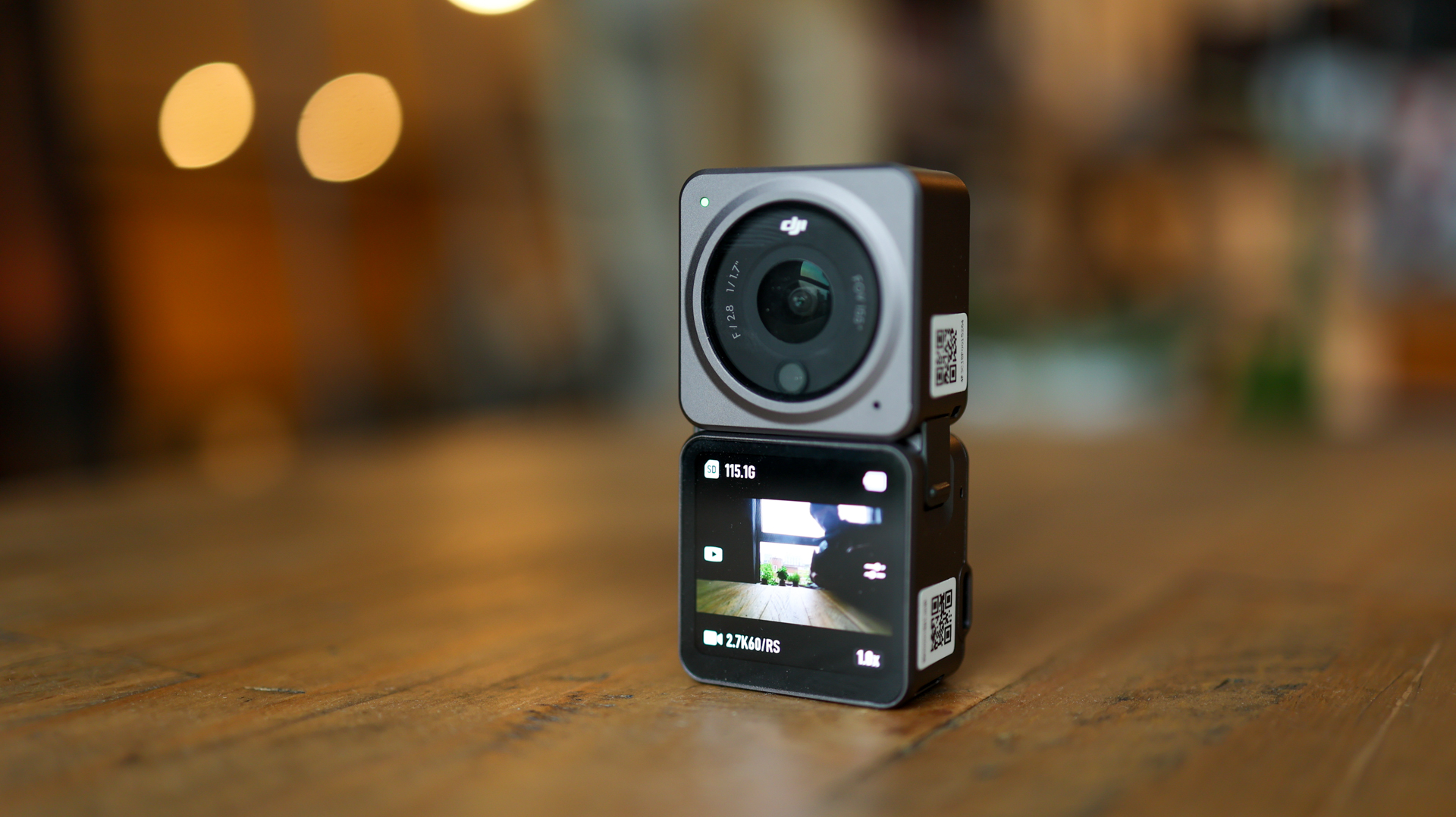
The modular DJI Action 2: could the Osmo Nano be bringing back this approach?(Image credit: Future)
The Osmo 360 may not be DJI’s only upcoming camera launch of the summer, either. The online rumor mill is also speculating about an ultra-compact action camera called the DJI Osmo Nano, following its appearance in two listings with the FCC.
The Osmo Nano appears to be a return to the modular design of the DJI Action 2, which allowed tiny separate components to be magnetically attached to each other.
While the small size and clever design did impress, DJI subsequently abandoned the modular approach, opting for a GoPro Hero-style design with its more recent Osmo Action cameras. The Nano could be a return to that approach.
We’ve also heard that a DJI Osmo Action 6 will be released this year, replacing the superb Osmo Action 5 as the brand’s leading ‘standard’ action camera. So, it seems that DJI has a busy few months ahead of it.
One thing we do wonder about, however, is whether all (or any) of these cameras will make it to the US or not. Citing uncertainty over the tariff situation, DJI has postponed launching its new Mavic 4 Pro flagship camera drone in the States – could these action camera in line for a similar fate until some stability returns? It seems we won't have to wait long to find out.
Over 1.6 million files have been discovered online by researchers
These seem to belong to Etsy, Poshmark, and TikTok Shop customers
Personally Identifiable Information is included
Two apparently unsecured Azure Blob Storage containers holding a combined 1.6 million files have been discovered by CyberNews researchers, allegedly belonging to online shopping platforms Etsy, Poshmark, and TikTok Shop.
The researchers say these files contained personally identifiable information, such as full names, home addresses, email addresses, and shipping order details.
Anyone who uses these services should keep a close eye on their accounts and take a look at the best identity theft monitoring tools if they are concerned.
TechRadar editors praise Aura's upfront pricing and simplicity. Aura also includes a password manager, VPN, and antivirus to make its security solution an even more compelling deal.
Both of the exposed instances “contained shipping email confirmations in HTML format,” researchers confirmed, and the vast majority of users exposed are in the United States, with some from Canada and Australia.
The exact origin or ownership of the datasets is not yet known, but the nature of the information suggests that these belonged to one particular storefront (across multiple shopping platforms), in particular a Vietnamese-based embroidery service.
It’s also not known whether cybercriminals have accessed these datasets, but only an internal forensic audit would reveal this information.
Researchers outlined the risk this brings to those exposed, such as convincing social engineering attacks from cybercriminals posing as Etsy or TikTok shop - urging customers to give their details, resulting in potential financial loss.
“With access to personal information like full names and addresses, attackers could impersonate trusted shipping providers or Etsy itself, making fraudulent communications seem more credible and urging victims to take actions such as confirming personal details, making payment, or clicking malicious links,” the researchers said.
Data leaks are unfortunately all too common for internet users today.
We recommend regularly checking whether your details have been exposed, using services like Have I Been Pwned - and monitoring your accounts, statements, and transactions - and immediately reporting any suspicious or unexpected activity with your bank or credit card provider.
No need for conventional speakers and no increase in thickness
Could be used for in-car displays, smartphones and headsets
For years now the TV industry has been thinking about pixels: how to make them brighter, how to make them smaller, how to put them together in the best possible way. And now there's a new push: how to make them sound.
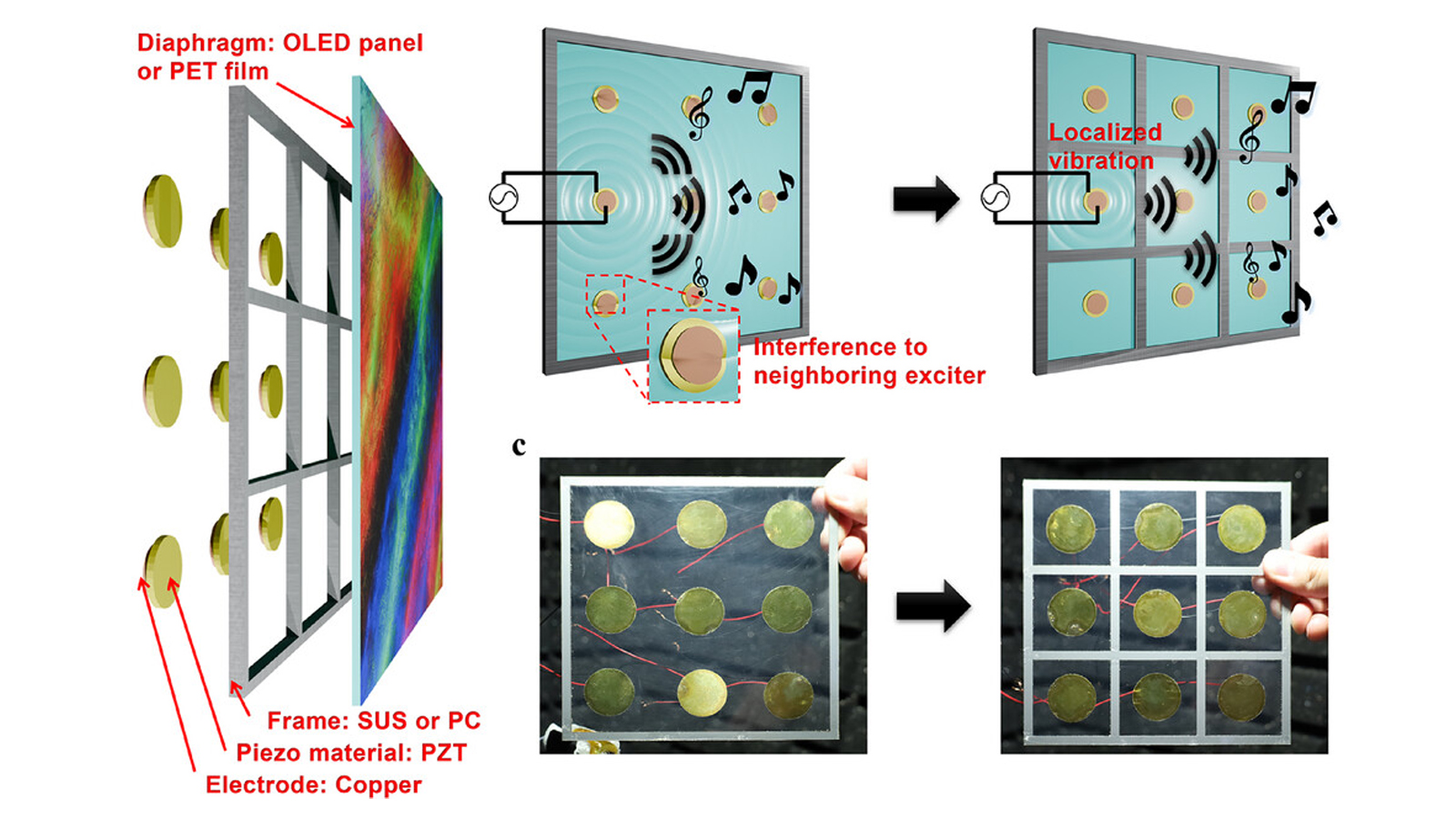
As spotted by Science Daily, researchers at Pohang University of Science and Technology (POSTECH for short) have created a 13-inch OLED panel where every pixel makes sound as well as light.
And that tech could one day deliver multi-channel sound with incredible precision – without requiring speaker drivers.
Pixels should be heard as well as seen
(Image credit: Wiley / POSTECH )
As Science Daily reports (hat tip to Notebookcheck), the team have called their invention 'Pixel-Based Local Sound OLED technology'. And as they explain, the problem with TV audio is that it's really hard to get accurate positional sound with conventional speakers.
"The core issue is that traditional exciters – devices that vibrate to produce sound – are large and heavy, making it difficult to deploy multiple units without interference or compromising the OLED's thin design," the researchers say. "Additionally, sound crosstalk between multiple speakers leads to a lack of precise control over localized audio."
Their solution was to embed piezo-electric exciters within the OLED display frame. "These piezo exciters, arranged similarly to pixels, convert electrical signals into sound vibrations without occupying external space. Crucially, they are fully compatible with the thin form factor of OLED panels."
That enables each pixel to become an independent sound source, and the team says that they were able to completely eliminate crosstalk – so that sounds coming from different parts of the display didn't interfere with one another.
The applications of the technology go beyond TVs. One suggestion is that in-car displays could send different audio to different people, for example by giving vocal directions to the driver while the passenger listens to music. And in phones or headsets the audio could change as the head, hand or device moves.
According to Professor Su Seok Choi, "This technology has the potential to become a core feature of next-generation devices, enabling sleek, lightweight designs in smartphones, laptops, and automotive displays – while delivering immersive, high-fidelity audio."
The "has the potential" bit is key, however: this is a proof of concept, not a product – and there's a big difference between producing audio and producing excellent audio. And of course what works in a 13-inch prototype may prove much more difficult to achieve in panels of larger sizes.
There's also the question of cost – so while the announcement is definitely exciting I think the best soundbars can breathe easy for a good few years yet.
Apple may be developing a dedicated gaming app for iOS, macOS and more
The app will contain things like achievements, leaderboards and messages
It could be announced at WWDC in June
For years, Apple has been trying to convince the world that it’s taking gaming seriously, and with the popularity of IOS gaming and the appearance of AAA titles like Cyberpunk 2077 on macOS, there’s some truth to the company’s assertion.
Just in case you needed more convincing, there’s a new rumor from Bloomberg reporter Mark Gurman that Apple will soon launch a dedicated gaming app in iOS 19 to woo players to its platforms. As a Mac-owning gamer, I'm cautiously optimistic about the rumors – even if we still need more affordable hardware and games before it gets anywhere close to being a Windows competitor.
If you missed the news, the app will apparently “serve as a launcher for titles and centralize in-game achievements, leaderboards, communications and other activity,” Gurman said, adding that it will also feature “editorial content from Apple about new titles, offer access to the App Store’s game section and promote [Apple] Arcade.” It’s expected to be revealed on iOS, macOS, iPadOS and tvOS as soon as Apple’s WWDC 2025 event on June 9.
The move makes sense – after all, the iPhone is a phenomenally popular gaming platform, and announcing a move like this at WWDC could help to cement the popularity of iOS 19 before it’s even out the door. Apple might also be hoping that it will tempt more gamers to switch from Windows to the Cupertino firm’s platforms – but on this point, I’m not entirely convinced.
Destination of choice for gamers
(Image credit: Apple)
This app might work well in iOS 19, where gaming tends to be a little more casual than on desktop computers. But things might look very different on macOS.
As a gamer who also owns a Mac, I’ve been encouraged over the last few years by Apple’s strides in the gaming world. It’s nowhere near parity with Windows yet, but the situation today is much better than it was just a few years ago.
For a long time, the problem was the chicken-and-egg nature of Mac gaming. Gamers didn’t want to switch to macOS due to the lack of games, and developers didn’t want to bring games to the Mac due to the lack of players. That’s slowly starting to change, with big-name titles like Cyberpunk 2077, Assassin’s Creed Shadows, and Baldur’s Gate 3 helping to dispel the idea that the Mac is a gaming wasteland.
However, the impact of a dedicated gaming app will likely be limited. Beyond my contention that gamers care more about hardware and game availability than launcher apps, Gurman is also skeptical, saying that “testers of the software say it probably won’t change the perception among players and makers of high-end titles.”
Any advance for gaming on Apple’s platforms is welcome in my eyes, and this app could help by making gaming more prominent among users of iOS and macOS. But what’s really needed – on the Mac at least – is a greater number of attention-grabbing titles and more affordable access to components that offer exceptional gaming performance.
Until that happens, Windows will always be the destination of choice for gamers.
At first, I wasn’t sold on the idea of titanium being used in phone chassis, dismissing it as a bit of a marketing gimmick rather than a truly useful feature. But then I spent time with the iPhone 15 Pro Max, Samsung Galaxy S24 Ultra, and then their successors, the iPhone 16 Pro Max and Galaxy S25 Ultra, made me a titanium convert
My 180-degree turn in opinion about titanium stems from my habit of not using cases for flagship phones, as part of my appreciation for slick industrial design. This doesn't mix with an inherent clumsiness and bad luck that often sees these expensive phones take a plunge towards hard floors and surfaces in one way or another.
Those with a stainless steel chassis would tend to chip, dent, and scratch, but the aforementioned titanium-sporting phones benefit hugely from the toughness of the metal and basically shrug off the accidental battering I give them.
So it’s my hope that more phones, including the likely upcoming Samsung Galaxy Z Fold 7 make use of titanium.
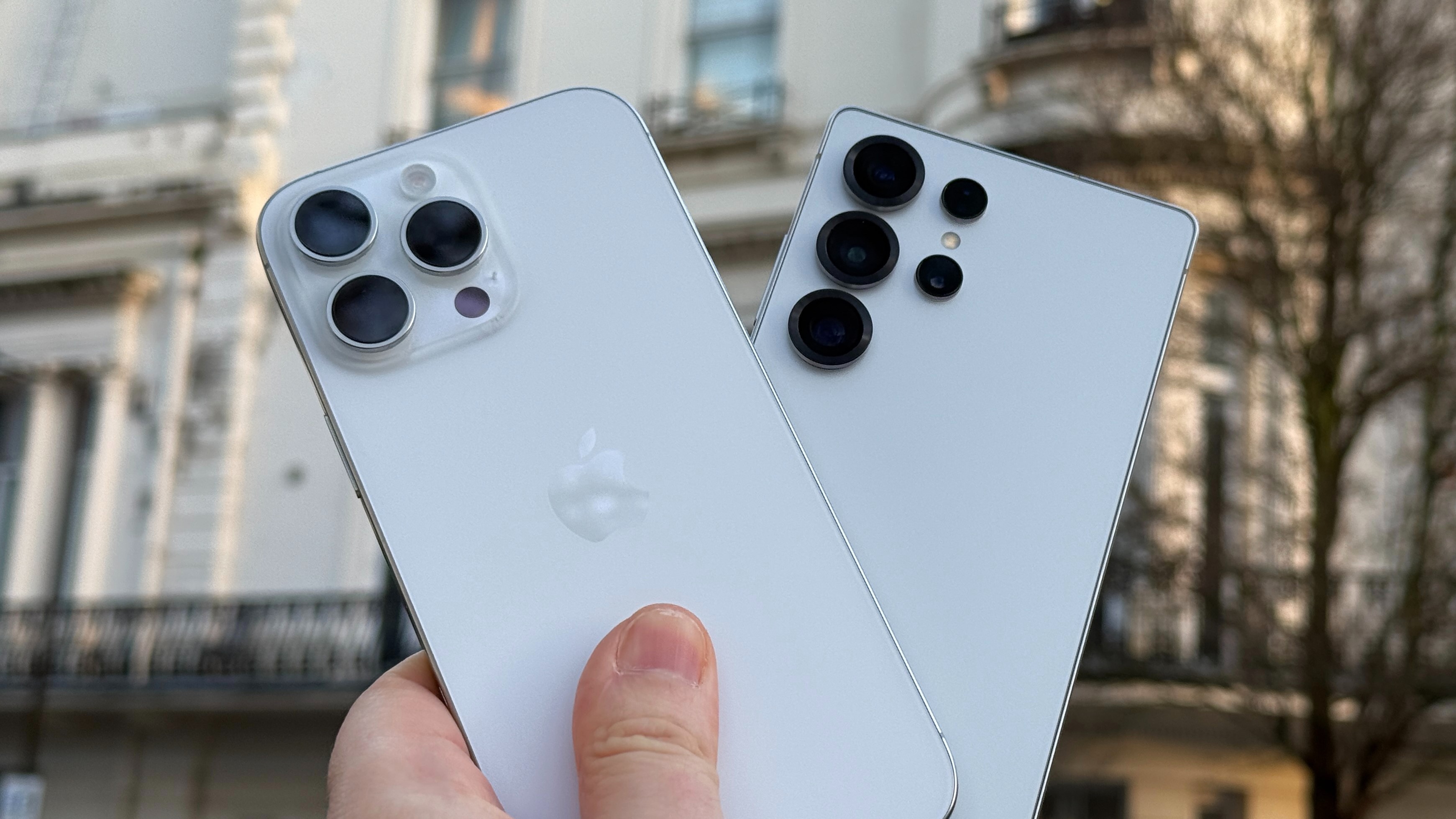
However, despite its toughness and relative lightness, the rumored iPhone 17 Air will eschew titanium for an aluminium frame, all with the idea of maximising thinness and lightness. We’ve heard this rumor a few times, with the latest tip coming from the Korean-language yeux112‘s blog.
The blog, which supposedly has insider or supply chain information, claims aluminum will be used for the frame of the iPhone 17 Air, as toughness takes a back seat in favour of lightness.
Leaving me alumi-numb
(Image credit: Future)
Having recently been at a wedding, I’m all for thinner and lighter phones that can help me avoid unwanted bulges in my suit (stop laughing at the back). But I don’t want this to come at the expense of toughness, so the idea of aluminum in the iPhone 17 Air has me raising a wary eyebrow.
I’ve since embraced titanium for the larger Max phones as the lighter weight makes the larger phones easier to handle one-handed. But much lighter would run the risk of making these flagship Apple phones feel potentially cheaper than their list prices.
That being said, Apple can still be innovative from time to time, and I’d not be surprised if the Cupertino crew is working on some form of alloy or design that’ll thread the line between a super-light and thin phone and one that’ll not be ruined by the odd fall.
We’ve seen Apple do that with its Ceramic Shield glass, so perhaps we could see the advent of ‘Aluminium Armor’ with the iPhone 17 Air; time will tell, and it'll likely be at a September Apple event.
So far, it compromised more than 5,000 dated Cisco routers
The devices are vulnerable to an old improper validation bug
A high-severity vulnerability plaguing old Cisco routers is being used to build a malicious, global botnet, experts have warned.
Cybersecurity researchers Sekoia published an in-depth report on the threat actor - dubbed ViciousTrap - which is using a vulnerability tracked as CVE-2023-20118, to target Cisco Small Business RV016, RV042, RV042G, RV082, RV320, and RV325 Routers.
This flaw, found in the web-based management interface, allows an authenticated, remote attacker to execute arbitrary commands on an affected device, made possible due to improper validation of user input within incoming HTTP packets.
PolarEdge's little brother
Unfortunately, Cisco won’t be patching the bug since the affected devices are past their end-of-life date, WNE Security reported.
The vulnerability allowed ViciousTrap to execute a shell script named NetGhost, “which redirects incoming traffic from specific ports of the compromised router to a honeypot-like infrastructure under the attacker's control allowing them to intercept network flows,” Sekoia explained.
So far, almost 5,300 devices, found in 84 countries around the world, were assimilated into the botnet. The majority of the victims are located in - Macau (850).
This is not the first time Sekoia is ringing the alarm on CVE-2023-20118. In late February 2025, TechRadar Pro reported Sekoia was warning about a botnet named PolarEdge, using the same vulnerability to target a range of devices from Cisco, ASUS, QNAP, and Synology. At the time, roughly 2,000 devices were said to have been affected.
For ViciousTrap’s work, all exploitation attempts came from a single IP address, the researchers further discovered, stating that the attacks started in March 2025. It was also said the threat actors repurposed an undocumented web shell previously used in PolarEdge attacks.
Although these things are always difficult to confirm, Sekoia believes the attackers are Chinese in origin.
Today, TCL announced pricing and availability for its new QM8K series mini-LED TVs. The latest models replace last year’s flagship TCL QM851G, one of the best TVs TechRadar tested in 2024, and provide “up to 35% more dimming zones and up to 65% higher peak brightness” than the mid-range TCL QM7K series, according to the company.
The new TVs will be sold in 65- to 98-inch screen sizes, with the 65- and 85-inch models available now, and the 75- and 98-inch models arriving next month. Pricing for the QM8K series is as follows:
65-inch QM8K: $2,299.99
75-inch QM8K: $2,999.99
85-inch QM8K: $3,799.99
98-inch QM8K: $6,499.99
A key feature of the QM8K series is TCL’s new CrystGlow WHVA Panel with ZeroBorder. This new panel design boasts an anti-reflective coating to reduce screen glare along with an ultra-wide viewing angle that TCL claims “virtually eliminates color shift, with a 40% wider color viewing angle” than last year’s QM851G series.
ZeroBorder refers to the vanishingly narrow 3-4mm width between the TV’s edge and the display in the QM8K series, a design feature that TCL achieved using a one-piece aerospace-grade aluminum alloy mold and anodized ceramic film to stabilize the display panel.
Another QM8K feature is TCL’s Halo Control System. This uses a new “Super High Energy” LED chip, along with a “Super Condensed” micro lens, 23-bit backlight controller, and a Dynamic Light Algorithm to enhance color accuracy and reduce mini-LED backlight “halo” artifacts. Helping in this regard is the increased number of backlight local dimming zones in the QM8K series, with up to 3,500 in the 98-inch model.
TCL QM8K series TVs have a 144Hz native refresh rate and FreeSync Premium Pro for gaming. They support both Dolby Vision and HDR10+ high dynamic range formats and feature Audio by Bang & Olufsen, with upfiring drivers in the TV to deliver Dolby Atmos and DTS Virtual:X sound.
Google TV is used in the QM8K series as a smart TV platform, and it features an enhanced GUI, hands-free voice control, and an Art Mode with AI Art. QM8K series TVs also feature a built-in ATSC 3.0 tuner for NextGen TV broadcasts.
Ultra-wide viewing angle: a welcome addition
A new ultra-wide viewing angle feature in the QM8K series could make it a perfect TV for sports viewing(Image credit: Future)
One of the biggest weaknesses of mini-LED and regular LED TVs is off-axis uniformity. This essentially means that both picture contrast and colors shift when viewing the TV from off-center seats, so that a viewer seated anywhere other than directly in front of the screen will experience reduced picture quality.
When I reviewed the TCL QM851G, I found its picture quality to be fantastic overall, with one main exception: off-axis uniformity. To quote from the review, the QM851G’s “colors and contrast were both diminished when viewing from far off-center seats.” This was the key reason I gave it a 4.5 instead of a 5-star rating for picture quality, and it was the one point that held it back from getting a full endorsement as a recommended TV for sports viewing.
The best OLED TVs don’t suffer from the same off-axis uniformity issue, and some of the best mini-LED TVs also implement features to expand the viewing angle. TCL’s specs for the QM8K indicate that it will have a 40% wider viewing angle, so I’m hopeful this new model will provide a vast improvement when it comes to off-center viewing.
TechRadar will soon be reviewing the TCL QM8K, so we’ll have more to say about the matter very shortly.
Internet providers in Boulder offer fiber and cable, high speeds and affordable prices. Our experts have found the best choices for residents depending on their needs.
Intel’s Arc Pro B60 Dual offers pro-grade memory at a fraction of Nvidia’s price
This dual-GPU rig from Maxsun delivers workstation power
Each GPU gets one DisplayPort and one HDMI, avoiding OS overload in multi-GPU workstations
At Computex 2025, Maxsun unveiled a striking new entry in the AI hardware space: the Intel Arc Pro B60 Dual GPU, a graphics card pairing two 24GB B60 chips for a combined 48GB of memory.
Servethehomeclaims Maxsun envisions these cards powering dense workstation builds with up to four per system, yielding as much as 192GB of GPU memory in a desktop-class machine.
This development appears to have Intel's implicit approval, suggesting the company is looking to gain traction in the AI GPU market.
A dual-GPU card built for AI memory demands
The Arc Pro B60 Dual GPU is not designed for gaming. Instead, it focuses on AI, graphics, and virtualization tasks, offering a power-efficient profile.
Each card draws between 240W and 300W, keeping power and thermal demands within reach for standard workstation setups.
Unlike some alternatives, this card uses a blower-style cooler rather than a passive solution, helping it remain compatible with conventional workstation designs. That matters for users who want high-end performance without building custom cases or cooling systems.
Still, the architecture has trade-offs. The card relies on x8 PCIe lanes per GPU, bifurcated from a x16 connector. This simplifies design and installation but limits bandwidth compared to full x16 cards.
Each GPU also includes just one DisplayPort and one HDMI output. That design choice keeps multi-GPU setups manageable and avoids hitting OS-level limits, older Windows versions, for example, may have trouble handling more than 32 active display outputs in a single system.
The card’s most intriguing feature may be its pricing. With single-GPU B60 cards reportedly starting around $375 MSRP, the dual-GPU version could land near $1,000.
If that estimate holds, Maxsun’s card would represent a major shift in value. For comparison, Nvidia’s RTX 6000 Ada, with the same 48GB of VRAM, sells for over $5,500. Two of those cards can push costs north of $18,000.
Even so, Intel’s performance in professional applications remains an open question. Many creative professionals still favor Nvidia for its mature drivers and better software optimization.
The Asus Zenbook A14 weighs less than a MacBook Air, and it's on sale for the first time ever. But the deal ends tomorrow, so you'll need to act fast to score this discount.
After many months of speculation, Google finally showed off its still-early-day Android XR smart glasses prototype. It was an impressive live demo, with a live translation portion that went off well but not without hitches. Still, it got the crowd at Google I/O going, and right after that opening keynote wrapped, I strolled around the Shoreline Amphitheater to find a pair to try.
Much like my time with Project Moohan, the prototype Android XR headset that Google and Samsung are working on, I only spent about five minutes with these prototype glasses. And no, it wasn’t a sleek frame made by Warby Parker or a wild one from Gentle Monsters – instead, it was the pair Google demoed on-stage, the prototype Android XR glasses made by Samsung.
As you can see above, much like Meta Ray-Bans and unlike Snapchat Spectacles (the first gen), these prototypes look like standard black frames. They're a bit thicker on either the left or right stems, but they’re also loaded with tech – though not in a way that screams it from the outside.
It was a short, pretty rushed demo, but certainly a compelling one.
(Image credit: Jacob Krol/Future)
The tech here is mostly hidden – there is a screen baked into the lens, which, when worn, appears as a little box when it’s showing something larger. Otherwise, when I first turned the glasses on, I saw the time and the weather hovering at the top of my field of vision.
When I pressed the button on the right stem to capture a photo, it almost flashed transparently larger in my field of vision. Neat and a bit more present way of capturing than on the screen-less Meta Ray-Bans.
These are both cool, and during the keynote, Google also shared that the screens could be used for messaging, calls, and translating as well, but I didn’t get to try that. While I couldn’t ask for directions myself, a Google rep within my demo was able to toss up what navigation would like, and this feature has me more excited about smart glasses with a screen built-in.
Why? Well, it was that the experience of navigating doesn’t get in the way of my field of view – I can simply still look straight forward and see at the top that in 500-feet or 50-feet that I need to make a right onto a specific avenue. I don’t need to look down at my phone or glance at my wrist, it’s all housed in just one device.
If I need more details or want to see my route, I could glance down to see a mini version of the map, which moved as I moved my head. If I wore these in NYC, I could walk normally and glance at the top to see directions, but when safely stopped and not in the way of others, I could look down to see my full route. That’s pretty neat to me.
(Image credit: Jacob Krol/Future)
The projected screen itself had good-enough quality, though I’m not sure how it performs in direct sunlight, as I tested these in a little room that Google had constructed. It’s important to remember that this is still a prototype – Google has several brands onboard to produce these, but there isn’t an exact timeframe. Developers will be able to start developing and testing by the end of the year, though.
This year, the Project Moohan headset, which also runs Android XR, will arrive. Samsung will ship the headset in a to-be-revealed final version, which could build support from third parties and let Google get more feedback on the platform.
Gemini, Google’s very wise AI assistant, blew me away on Project Moohan and was equally compelling on the Android XR glasses. I asked it for the weather, and got it to give me an audio report of the next few days, had it analyze a replica of a painting, and even look at a book, tell me the reviews, and where I could purchase it.
That power of having Gemini in my frame has me really excited for the future of the category – it’s the audio responses, the connection to the Google ecosystem, and how it plays with the onboard screen. It remains to be seen how Samsung’s final design might look, but it will likely sit alongside several other Android XR-powered smart glasses from the likes of Warby Parker, X-Real, and Gentle Monster, among others.
I’ve long worn Meta Ray-Bans and enjoy those for snapping unique shots or recording POVs like walking my dog Rosie or riding an attraction at a Disney Park. Similarly, I really enjoyed the original version of the Snapchat Spectacles, but the appeal wore off. Those both did only a short – or in the case of the Spectacles, very short – list of functions, but Android XR as a platform feels a heck of a lot more powerful, even from a short five-minute window.
While the design didn’t sell me on Samsung’s prototype, I have high hopes for the Warby Parker ones. Seeing how Gemini’s smarts can fit into such a small frame and how a screen can be genuinely useful but not overly distracting really has me excited. I have a feeling not all of the Android XR glasses will appeal to everyone, but with enough entries, I’m sure one of them will pair form with function in a correct balance.
Gemini in glasses feels less like the future, and considering this new entry, my eyes are set to see what Meta's does next and what Apple's much-rumored entry into the world of smart glasses will look like.
You might also like
from Latest from TechRadar US in News,opinion https://ift.tt/87MFPBu
Dell Pro Max Plus laptop is the first to feature an enterprise-grade discrete NPU
It features a Qualcomm AI 100 PC Inference Card with 32 AI-cores and 64GB memory
This offers the opportunity to carry out high-intensity AI tasks, even on the move
Dell has unveiled an AI PC with a never-before-seen feature it hopes will spur on the next levels of productivity.
Revealed at Dell Technologies World 2025, the new Dell Pro Max Plus laptop is the first to feature an enterprise-grade discrete NPU, offering the opportunity to carry out high-intensity AI tasks even on the move.
The mobile workstation features a Qualcomm AI 100 PC Inference Card with 32 AI-cores and 64GB memory, which Dell says should be more than enough to handle the needs of AI engineers and data scientists deploying large models for edge inferencing.
“Personal productivity is being reinvented by AI,” Dell said, “the install base of a billion and half PCs is ageing, and it’s being replaced with AI innovation.”
“The Windows 10 end of life is coming, and we are ready - Dell is the leader in commercial AI PCs, and we’re further distancing ourselves from the competition.”
The CEO highlighted the new Dell Pro Max device during his keynote address, noting it would be ideal for developers and scientists, offering up to 20 petaflops of performance due to embedded Nvidia GB300 hardware, and up to 800GB of memory - enough to run and train models with a trillion parameters.
“Today’s PCs are becoming AI workstations - blazing fast, all-day battery life powered by NPU and GPU innovation," Dell declared.
Intel’s four-year-old Optane P5800X still outpaces the SN8100 in real-world speed tests
SanDisk’s new WD Black SN8100 PCIe Gen5 SSD is fast, efficient, and engineered to meet the demands of gamers and power users alike.
The drive uses a PCIe Gen5 x4 interface and is available in 1TB, 2TB, and 4TB capacities. Built around SanDisk's in-house 8-channel controller and BiCS 3D TLC NAND, it supports read speeds of up to 14.5 GB/s and write speeds up to 12.7 GB/s, placing it among the fastest Gen5 drives currently available.
However, despite the SN8100’s cutting-edge design and impressive benchmarks, Intel’s now-defunct, four-year-old Optane P5800X still holds the crown as the fastest SSD in real-world use.
Benchmarks suggest top speeds - but not across the board
In synthetic benchmarks like CrystalDiskMark and ATTO, the SN8100 breaks lab records for sequential throughput and random reads, reaching up to 2.3 million IOPS.
According to TweakTown, “this SSD is like none other; it’s at least 20% more powerful than any flash-based SSD we’ve ever encountered.”
It also demonstrates notable efficiency, consuming just 7 watts under load and requiring no active cooling, making it a serious contender for best SSD or the best portable SSD for enthusiast builds.
Still, synthetic benchmarks don’t always reflect real-world performance. In practical transfer tests, the SN8100 ranked ninth overall, indicating that while it's extremely fast, it's not without limitations, and it doesn't dethrone the Intel Optane P5800X.
Launched in 2021, the P5800X remains unmatched in real-world responsiveness and latency. While its sequential read speeds top out at 7.2 GB/s - slower than the SN8100 - its random read/write IOPS exceed 4.5 million, and latency frequently drops below 10 microseconds. That’s where it truly shines.
Flash-based SSDs like the SN8100 still rely on garbage collection and page-level management, leading to occasional latency spikes during small, random workloads. In contrast, the P5800X maintains consistent performance under heavy load, with no significant dips, a key reason why it’s still regarded as the fastest SSD ever made.
That said, the SN8100 is an impressive drive in its own right. It's a customized version of Silicon Motion’s SM2508 controller, enhanced with proprietary technologies like nCache 4.0 and WD Black Gaming Mode.
It also fits into the Sony PlayStation 5’s expansion slot, achieving read speeds of 6,550 MB/s in that setup, well above the console’s minimum requirement. However, with a price tag of $280 for the 2TB model, it clearly belongs in the premium tier.
If you’ve ever wondered how much one of these giant-capacity SSDs might set you back, the answer is: maybe not quite as much as you’d expect, as although early estimates placed its price close to $14,000, but you can actually pick up the drive from Tech-America for a much more affordable $12,399.
Obviously, this isn’t a drive for your typical PC rig - it uses a PCIe 4.0 interface and comes in U.2 (available now) and E1.L (expected later this year) form factors. It’s aimed at enterprise storage environments handling large-scale AI, machine learning, and data-intensive workloads.
Longer lasting QLC
The drive is built with 192-layer QLC NAND. With endurance rated at 0.60 drive writes per day and a total of 134.3 petabytes written over five years, the 122.88TB model is designed to last longer than earlier QLC offerings.
Solidigm, a US-based subsidiary of SK Hynix, reportedly tested the drive under extreme conditions. Running 32KB random writes at full load, the drive operated continuously for five years and retained around 5 percent of its life.
Performance claims include up to 930,000 IOPS for 4K random reads and 7.4GBps for sequential reads.
Solidigm markets its large SSD as a solution to space and power constraints in data centers, claiming that replacing traditional hybrid systems with its all-QLC drives could reduce rack usage from nine to one and cut power consumption by around 90 percent.
The drive joins other high-capacity SSDs announced in 2024, including models from Phison, Samsung, and Western Digital. Phison’s SSD supports PCIe Gen5 and offers faster peak throughput, though the D5-P5336 delivers a higher endurance rating and greater storage density.
Kioxia CM9 Series SSDs use 8th gen BiCS FLASH for enterprise performance
Faster NAND speeds and power efficiency support AI and data centers
Offers 61.44TB max, dual-port design, and massive write improvements
Kioxia has announced its CM9 Series PCIe 5.0 NVMe SSDs, marking the first enterprise drives built using its 8th generation BiCS FLASH 3D TLC memory.
With PCIe 5.0 and NVMe 2.0 support, the CM9 SSDs are designed to meet modern standards for data center storage by offering high-efficiency storage capable of supporting AI, machine learning, and high-performance computing.
These new SSDs feature CMOS directly bonded to array (CBA) architecture, an update designed to improve performance, power efficiency, and memory density. Kioxia’s use of CBA-based flash architecture promises faster NAND interface speeds and lower latency, which helps the drives deliver quicker data access and improved power efficiency.
Top-tier bit density
Compared to the previous CM7 series, the CM9 line shows increases of about 65% in random write speeds, 55% in random read, and 95% in sequential write speeds.
The CM9 SSDs, currently sampling to select customers, are built to handle read-intensive and mixed-use workloads in enterprise data centers and offer capacities of up to 61.44TB in 2.5-inch form and 30.72TB in E3.S configurations.
The drives are compatible with both the NVMe-MI 1.2c and OCP Datacenter NVMe SSD 2.5 specifications, and support dual-port configurations, making them suitable for enterprise environments where reliability and continuous access are critical.
Kioxia, which recently helped Linus Tech Tips smash the Pi calculation world record, says gains in power efficiency include roughly 55% better sequential read and 75% better sequential write performance per watt.
Although it’s early in the lifecycle of the CM9 Series, the specs and performance numbers suggest the company is aiming to strengthen its position in high-performance enterprise storage.
Axel Stoermann, Vice President and CTO for Embedded Memory and SSD, Kioxia Europe GmbH, said, “Alongside processing power and energy efficiency, memory is fundamental to enable AI, machine learning, and high-performance computing applications. The CM9 Series powered by our BiCS FLASH generation 8, is designed to address these storage demands, providing top-tier bit density, rapid data transfer, and outstanding power efficiency, all of which contribute to the superior performance of our SSDs."
Google I/O events are an often frustrating glimpse of the near future, with a lot of shiny software toys scheduled to land sometime "in the coming months". That often means a long wait of up to a year, so for Google I/O 2025 we've rounded every new announcement that you can actually try today.
Naturally, some of the features below come with restrictions – a few are only available to try now in the US, while some are restricted to subscribers of Google's AI Pro or AI Ultra tiers. But many have also rolled out worldwide, so there are new features to take for a spin even if you don't currently pay Google a cent.
What's missing from the list below and coming at a later date? Quite a bit actually, including some of the more futuristic ideas like Google Beam and Android XR, and it also isn't clear how long we'll have to wait for a worldwide rollout of AI Mode for Search, Veo 3, Flow, Virtual Try On in the Shopping app, and Google's top-tier AI Ultra plan.
Still, there are quite a few things from Google I/O 2025 to keep us amused in the meantime, so here's a list of the ones that are available to try today...
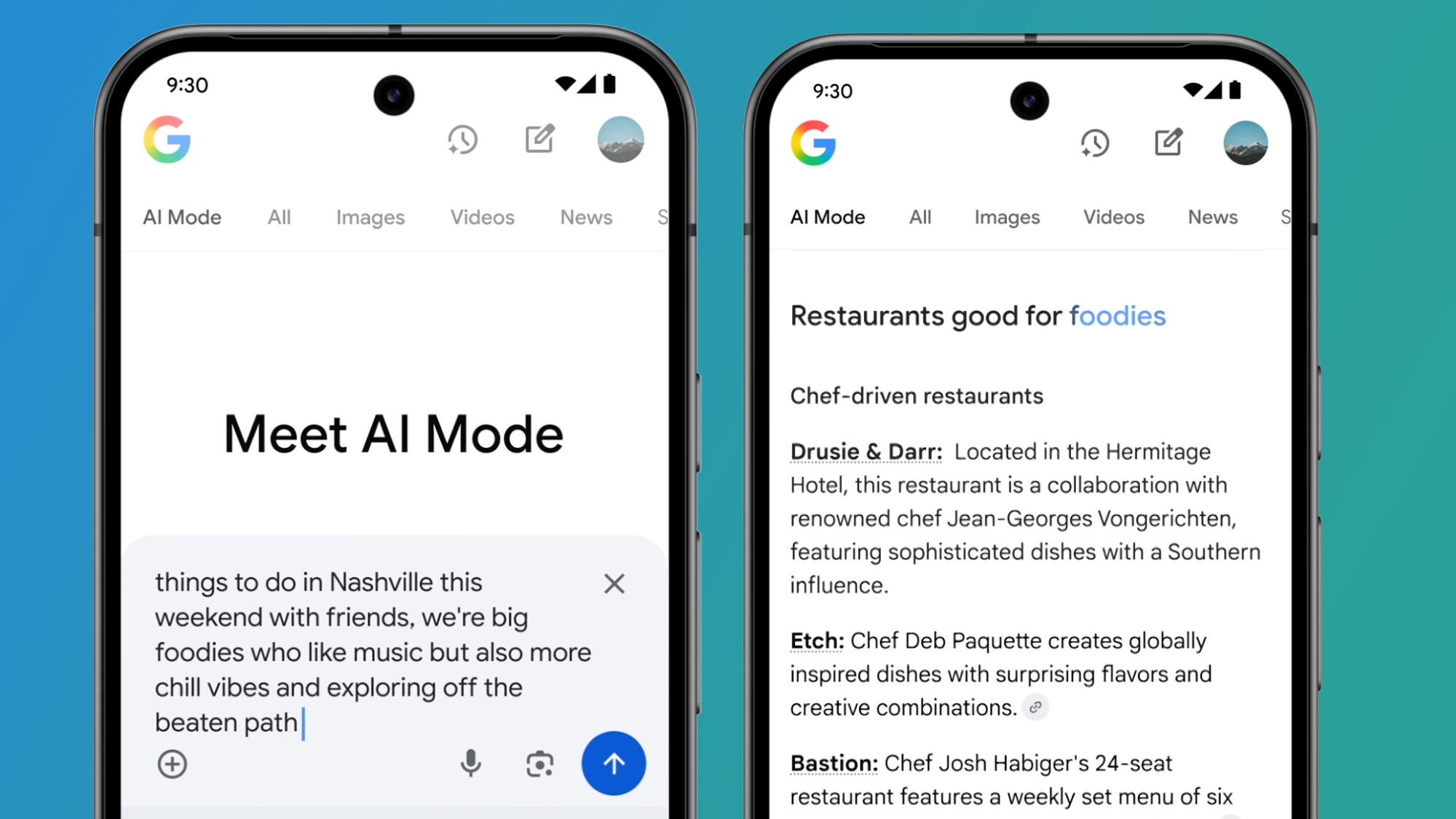
Google completely upended its golden goose, Search, at I/O 2025 this week, announcing several new features to stave off the threat of ChatGPT – and the biggest was arguably the US rollout of AI Mode.
If you're in the US and aren't seeing the new tab in Search (or in the search bar of the Google app), it's likely because Google said it'd be a gradual roll-out "over the coming weeks".
We've been using it for a while, though, and have put together a guide on how to master the new AI mode. It shouldn't be your go-to for everything, but we've concluded that "if you’re researching, planning, comparing, or learning, AI Mode can be a real comfort". Google hasn't yet commented on when it'll get a worldwide launch, but we'd imagine it'll be sometime this year.
Arguably the biggest breakthrough moment at Google I/O 2025, Veo 3 is the first AI video generator that can deliver synchronized audio (including speech) alongside its video creations. And it's available to try now for a lucky few, if you're in the US and on the new Gemini Ultra plan.
Granted, that is a pretty small group of people, but we had to include it in this list because it is actually available today for those lucky peeps, and US enterprise users on the Vertex AI platform.
The amount of processing power required for Veo 3 could mean a relatively slow rollout elsewhere, and Google has hinted as much by also releasing new features for Veo 2 like the ability to give it reference scenes.
Not sure how to weave all of your AI videos together into a cohesive whole? Google also addressed that issue with a new AI video editor called Flow – and like Veo 3, it's out now for AI Pro and Ultra subscribers in the US.
It's a bit like a Premiere Pro that you can operate entirely with natural language, to avoid learning keyboard shortcuts or complex menus. To get an idea of how it works, check out Google's short tutorial.
Impressively, it goes as far as giving you menus of camera moves like 'dolly out' and 'pan right', so you don't even have to describe them. Google has also at least promised that it's "coming soon" to more countries, so we're hopeful of a wider rollout in 2025.
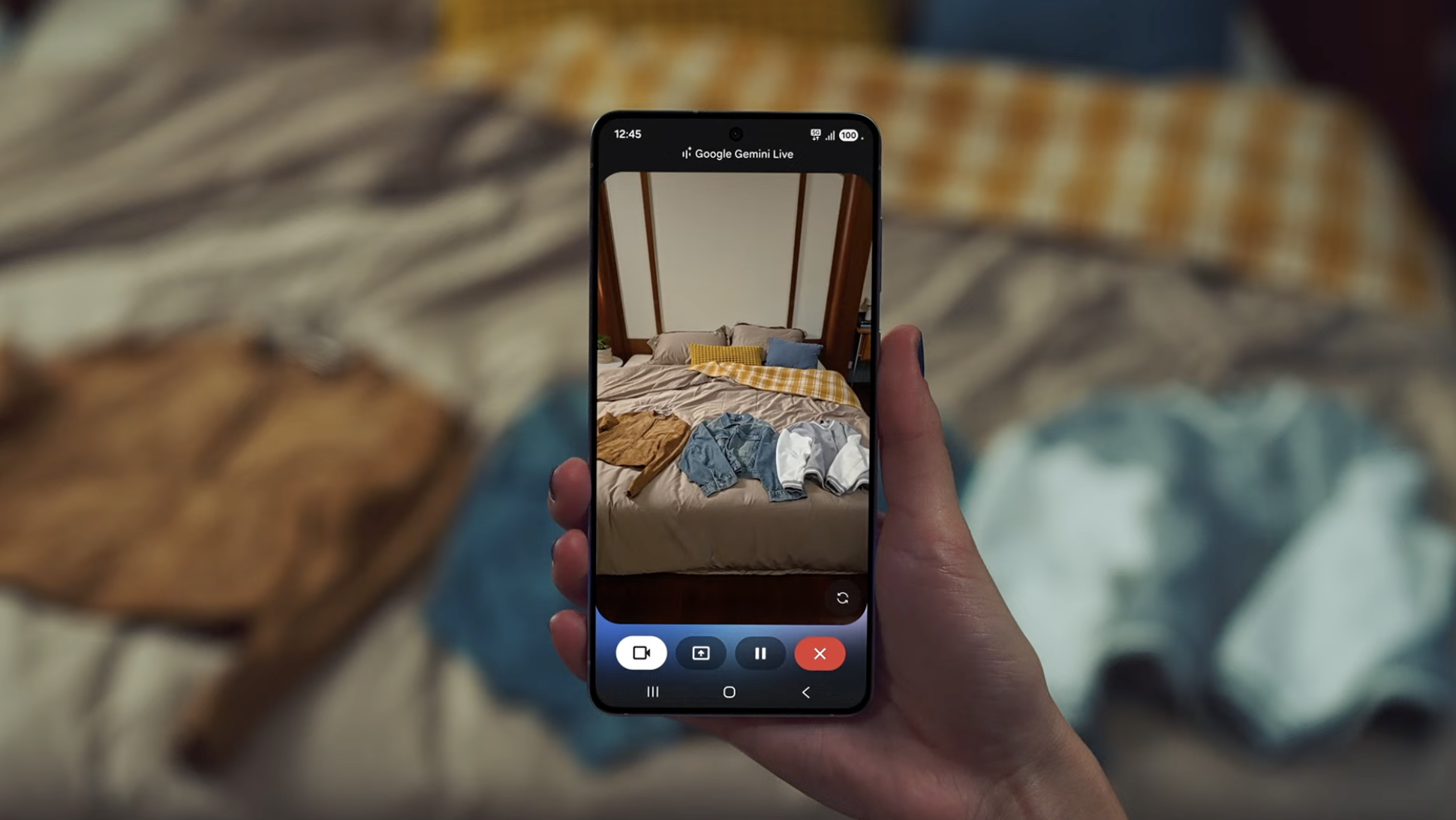
The big smartphone story of Google I/O 2025 was the full rollout of one of the best AI tools around on Android and iOS – Gemini Live.
Like ChatGPT's Advanced Voice Mode, Gemini Live is an AI assistant that you can chat to using your voice. The most useful part, though, is that you can also give it eyes using your phone's camera to get help with whatever's in front of you or on your screen.
To conjure the assistant, open the Gemini app on iOS or Android, tap the Gemini Live icon (on the far right of the text input box), and start chatting away.
available worldwide in the Gemini app, Whisk, Vertex AI
(Image credit: Google)
Google didn't just level-up its AI-generated video at I/O 2025 – we also got a new Imagen 4 model for whipping up still images in higher resolution (now up to 2K) than before.
The latest Imagen (which is available now in the Gemini app, Whisk, Vertex AI and across Google Workspace) also showed that it's been working hard on one of its main weaknesses – handling text.
This means that scenes involving typography should no longer be a jumbled mess of weird characters and look more realistic. While Imagen 4 is available to use for free, it does come with usage limits – you can expect 10-20 image generations on a free plan, while Gemini subscribers get a more generous 100-150 generations a day.
Okay, Gemini 2.5 Flash isn't brand new, but it was given a big upgrade at Google I/O 2025 – and it's now available to everyone to dabble with in the Gemini app.
In fact, Gemini 2.5 Flash is now the default model in Google's Gemini chatbot, because it's apparently the fastest and more cost-efficient one for daily use. Some of the specific improvements, over its 2.0 Flash predecessor, include a greater ability to understand images and text.
Wondering how it compares to ChatGPT 4o? We've already compared the two to help you see which might be the best for you. Spoiler: it's a close call, but Gemini 2.5 Flash is particularly appealing if you live in Google's world of apps and services.
Need a coding assistant to speed up your workflow? Google has just given Jules (first introduced as a Labs experiment last December) a wider public beta rollout, with no waiting lists.
Jules is a bit more than a coding copilot – it can autonomously beaver away on fixing bugs, writing tests and building new features without any input from you. It works 'asynchronously', which means it can work on various tasks without waiting for them to finish.
Google says Jules isn't trained on your private code and that your data stays within its private environment. With autonomous agents on the rise, it certainly looks worth dabbling with if you could do with some coding assistance.
Google Shopping has had a 'Try On' feature for clothes since 2023, but it got a big upgrade it got at Google I/O 2025. Rather than using virtual models to show you how your chosen clothes might fit, it now lets you upload a photo of yourself – and uses AI to help you avoid the hassle of changing rooms.
Once you've uploaded a full-length photo of yourself, you'll start to see little "try it on" buttons when you click on outfits that are served up in the Shopping tabs search results. We've taken it for a spin and, while it isn't flawless, it does give you a solid idea of what some clothes will look like on you. And anything that helps us avoid real-world shopping is fine by us.
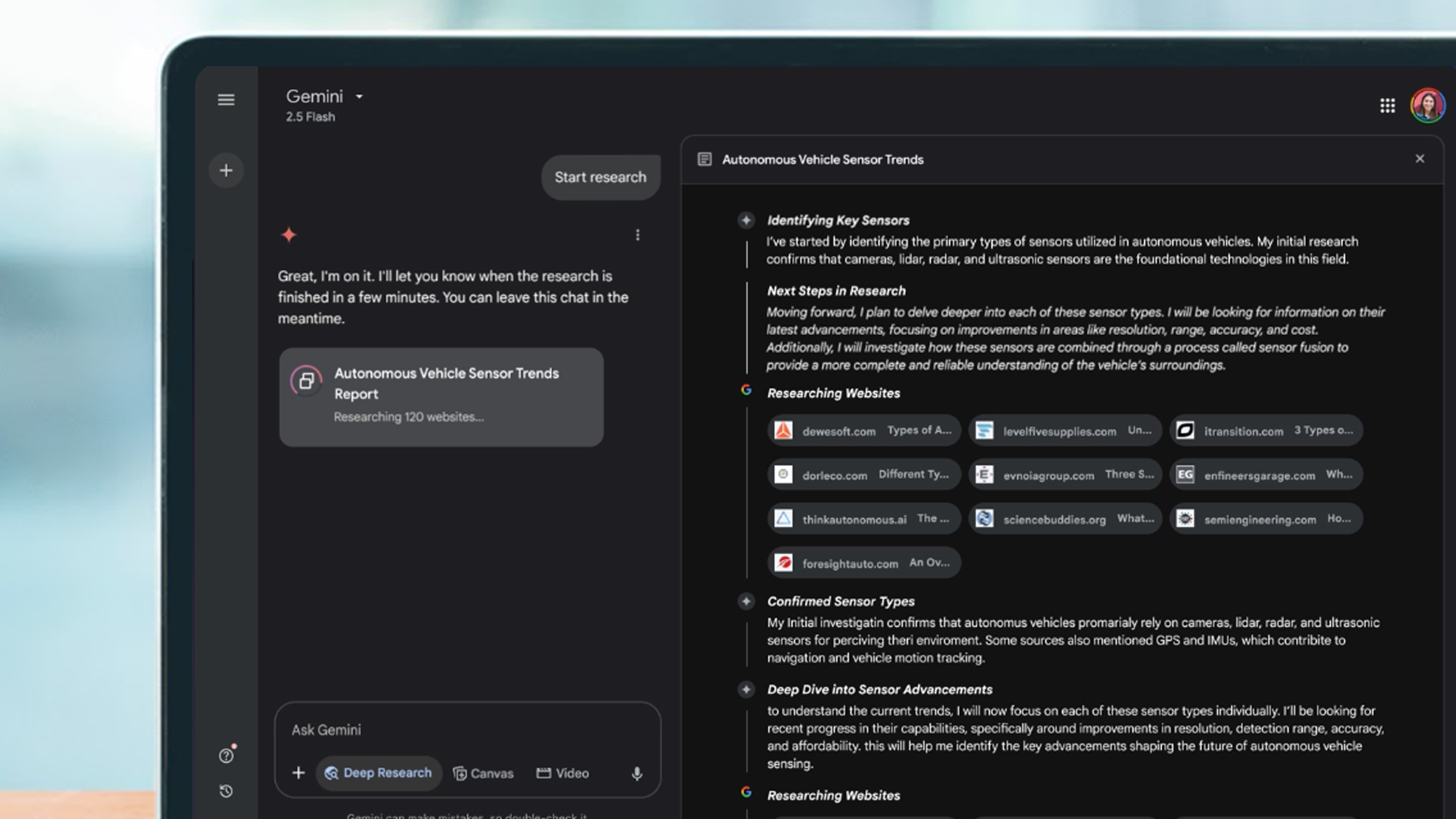
Google brought its 'Deep Research' feature to Gemini Advanced subscribers (now Gemini Pro) in late 2024. And now the handy reports tool has given a particularly useful upgrade – the ability to combine its research of public data from the web with any private PDFs or images that you uploads.
Google provided the example of a market researcher uploading their own internal sales figures so they could cross reference them with public trends. Unfortunately, you can't yet pull in docs or data from Google Drive and Gmail, but Google says this is coming "soon".
10. Gemini quizzes
available worldwide on Gemini desktop and mobile
college students in the US and UK can also get a free Gemini AI Pro upgrade for the whole school year
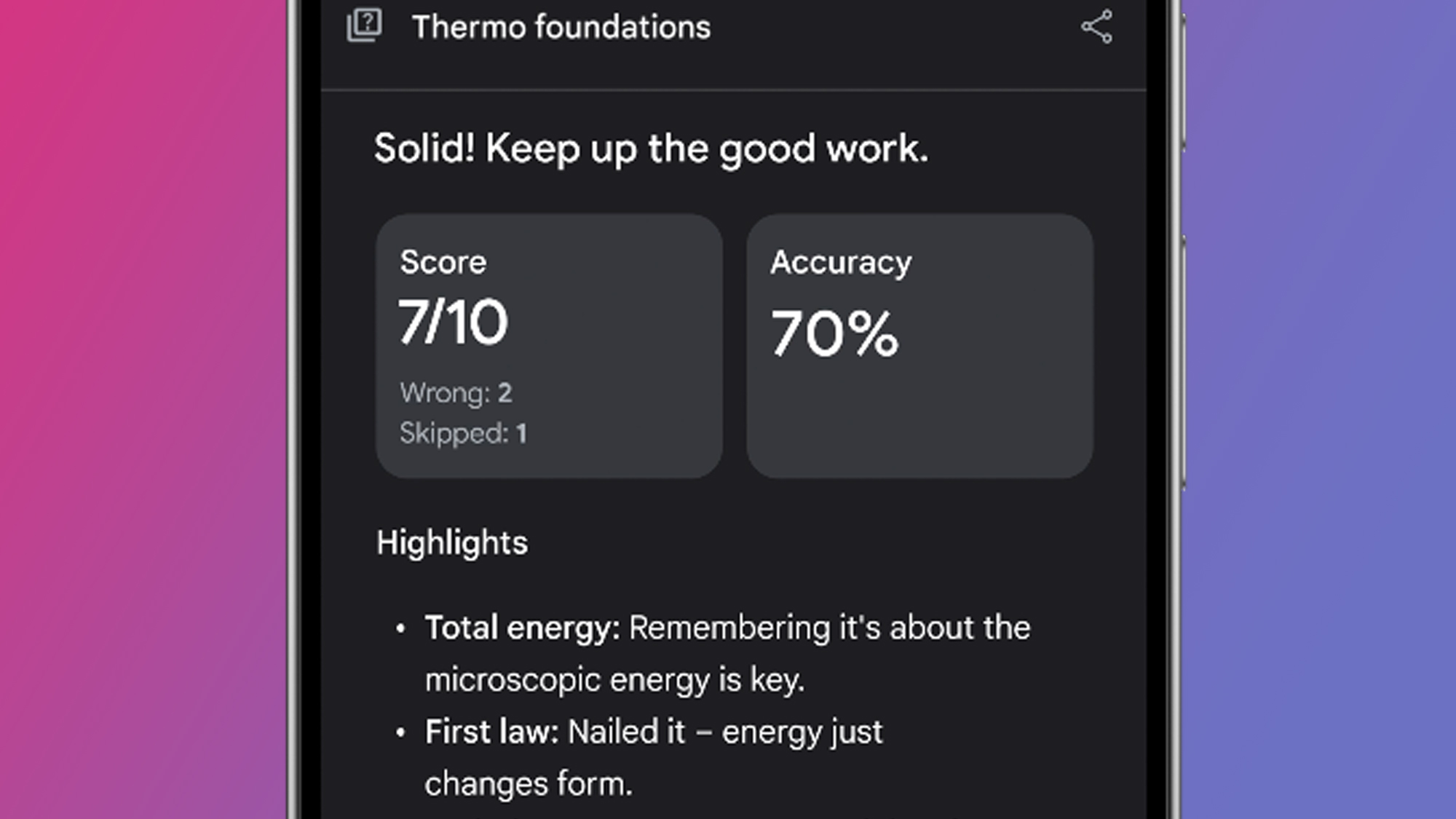
Google is particularly keen to get students using its Gemini app – not only did it extend its free access to Google AI Pro for school and university students to new countries including the UK, it also added a new quiz feature to help with revision.
To start a quiz, you can ask Gemini to "create a practice quiz" on your chosen subject. The most useful part is that it'll then make a follow-up quiz based on your weaknesses in the previous test. Not that you have to be studying to make use of this feature – it could also be a handy way to sharpen your pub quiz skills.
If you're a student in the US, Brazil, Indonesia, Japan and the UK, you can get your free year of Gemini AI Pro by signing up on Gemini's students page – the deadline is June 30, 2025 and you will need a valid student email address.
11. Google Meet speech translation
available to Google AI Pro and AI Ultra subscribers
initially only in English and Spanish, more languages coming soon
We're particularly looking forward to trying out Google Beam this year, with the glasses-free 3D video calls (formerly known as Project Starline) heading to businesses courtesy of HP's new hardware. But a new video calling feature you can try now is Google Meet's near real-time translations.
Available now for AI Pro and Ultra subscribers in beta, the feature will provide an audible translation of your speech (currently in English to Spanish, or vice versa) with a relatively short delay. It isn't seamless, but we imagine the delay will only reduce from here – and Google says more languages are coming "in the next few weeks".
Google switched up its AI subscription plans at Google I/O 2025, with 'Gemini Advanced' disappearing and being replaced by AI Pro and new 'VIP' tier called AI Ultra.
The latter is currently US-only (more countries are "coming soon") and costs a staggering $250 a month. Still, that figure does give you "the best of Google AI", according to the tech giant, with AI Ultra including access to Veo 3 with native audio generation, Project Mariner, and the highest usage limits across its other AI products. You also get YouTube Premium and 30TB of storage thrown in.
The AI Pro tier ($20 a month) still gets you access to Gemini, Flow, Whisk, NotebookLM and Gemini in Chrome, but with lower usage limits and cloud storage of a mere 2TB.
If you're an AI power user and like the sound of AI Ultra, Google is currently offering it at 50% off for your first three months. Don't tempt us, Google...